*In ''Assassin's Creed II'', Leonardo is shown as right-handed, but in ''Assassin's Creed: Brotherhood'', he is left-handed, as he was known to be in real life.
*In ''Assassin's Creed II'', Leonardo is shown as right-handed, but in ''Assassin's Creed: Brotherhood'', he is left-handed, as he was known to be in real life.
*In ''Assassin's Creed: Brotherhood'', after Leonardo mentions his work on the ''Mona Lisa'', Ezio warns him not to allow pretty girls to distract him from making the designs he needs. His arm around him, Leonardo lightly assures Ezio that women would ''"provide little distraction"'' to his work, to which Ezio replies, ''"Wait, I don't get it."'' This is a reference to the widely-held belief that the real-life Leonardo was homosexual.
*In ''Assassin's Creed: Brotherhood'', after Leonardo mentions his work on the ''Mona Lisa'', Ezio warns him not to allow pretty girls to distract him from making the designs he needs. His arm around him, Leonardo lightly assures Ezio that women would ''"provide little distraction"'' to his work, to which Ezio replies, ''"Wait, I don't get it."'' This is a reference to the widely-held belief that the real-life Leonardo was homosexual.
*While exploring the [[Temple of Pythagoras|Pythagorian Temple]], Ezio and Leonardo have a brief conversation about Leonardo's assistant Salaì. Leonardo asks where he is, and quickly clarifies that he is only concerned about Salaì's careless spending. Ezio, however, merely comments that Salaì fits Leonardo, and that he approves. Leonardo is left nervously speechless. This is a reference to another belief that the real-life Leonardo had a homosexual relationship with Salai.
*While exploring the [[Temple of Pythagoras|Pythagorian Temple]], Ezio and Leonardo have a brief conversation about Leonardo's assistant Salaì. Leonardo asks where he is, and quickly clarifies that he is only concerned about Salaì's careless spending. Ezio, however, merely comments that Salaì fits Leonardo, and that he approves. Leonardo is left nervously speechless. This is a reference to another belief that the real-life Leonardo had a homosexual relationship with Salai, a huge homosexual sand-nigger in constantinople.
===Others===
===Others===
Revision as of 22:44, 17 August 2011
"Information learned is more valuable than information given" This article is currently being reworked by Uditore as part of their apprenticeship. We ask that edits to this article are only minor or grammatical in nature until this warning is removed in order to not disrupt the major revamp. Should you have any questions regarding the revamp, please contact the apprentice at work's Mentor.
Leonardo di ser Piero da Vinci (April 15, 1452 – May 2, 1519) was an Italian polymath: painter, sculptor, architect, musician, scientist, mathematician, engineer, inventor, anatomist, geologist, botanist and writer.
Leonardo da Vinci was born in 1452 out of wedlock in Vinci, a town outside of Florence, Italy, to a Florentine notary named Piero da Vinci and a local woman named Caterina. He spent most of his early childhood in nearby rural Tuscany so as to spare his father the embarrassment of a scandal. However, young Leonardo's innate artistic prowess was obvious to his elders even then, and when he turned fourteen he was returned to Florence, apprenticed to the workshop of renowned painter Andrea del Verrocchio; while there, he is said to have collaborated with the Verrocchio on his masterpiece, Baptism of Christ.
Florence
At age 20, Leonardo was titled a master by the Guild of Saint Luke, and opened his first workshop in Florence where he continued to collaborate with his old master. During his time there, he also befriended the Auditore family, of which he sold most of his paintings to.[1]
Meeting Ezio
Leonardo: "I often feel that my work lacks... I don't know... purpose."
Maria: "You should have more faith in yourself, Leonardo."
—Leonardo, Maria and Ezio on their way to the Palazzo.[src]
Leonardo upon his meeting with Ezio.
In 1476, Leonardo met Ezio Auditore when the latter accompanied his mother to pick up some paintings from Leonardo’s workshop. The two conversed inside the workshop of the artist, talking about Leonardo's paintings, and what else he could do aside from painting, at which Ezio remarked to his mother that Leonardo wouldn't come that far, seeing that he wasn't even capable of keeping his workplace tidy. Ezio's mother however, was very confident of Leonardo's future, complimenting him multiple times on his talent and telling him he should have more faith in himself.[2]
Soon after their conversation, the three headed back to the Palazzo Auditore, Ezio and Leonardo carrying one box each, filled with paintings to hang on the walls. Again Ezio commented on Leonardo's seeming incapabilities, but he soon felt he was wrong about the so-called "fledgling artist" as they arrived at the Palazzo, noting that Leonardo was one to respect. This encounter sparked the lifelong friendship between the two young men.[2]
Leonardo: "Anything which shines glints in the sun, and that's a dead giveaway."
Ezio: "I thought you were a man of peace."
Leonardo: "Ideas take precedence."
—Ezio commenting on Leonardo after he finished his Hidden Blade.[src]
After the execution of Giovanni, Federico, and Petruccio Auditore, Leonardo met Ezio once again, greeting him with a brotherly embrace. He was then requested by Ezio to repair the Hidden Blade he had inherited from his father. Leonardo was immediately fascinated by its sophisticated and advanced design, as it, despite its old age, was way ahead of even their time.[1]
At first he had no idea how to repair it, but soon he discovered that the scroll Ezio had included with the weapon could be decrypted and used as a manual, at which he started to decode it. Working with codes, cross-references and a toolbox, it took Leonardo some hours before he had finally finished the repairs to the Hidden Blade. Leonardo woke up Ezio, who had fallen asleep in the meantime, and handed the weapon over to him. Leonardo claimed that Ezio's ring finger had to be removed, because "the blade is designed to ensure the commitment of whoever wields it." This was to his own amusement however, as it is shown that he simply embedded the cleaver into the table next to Ezio's hand. He explained that the blade had been modified so that the removal of the finger was no longer necessary.[1][2]
Immediately after this, a Florentine guard showed up at Leonardo's workshop. Leonardo responded and told Ezio to stay in his workshop, while he opened the door for the guard, keeping him outside. The guard knew that he had been in contact with Ezio, and as Leonardo tried to act ignorant of the Assassin, the guard threw him to the ground and started kicking him several times in order to extract Ezio's whereabouts. Ezio promptly sneaked up behind the guard and tested out his newly acquired weapon on him. Afterwards, Ezio hid the body inside the workshop with others upon Leonardo's request – as the bodies were used for his anatomical research.[1]
Leonardo and Ezio didn't meet again until 1478, when Ezio visited him with another Codex page attained from his uncle Mario Auditore. He deciphered the page and, while Ezio practiced the new assassination techniques as explained on the codex page in Leonardo's yard with straw dummies - set up by one of his students, Vincenzo - Leonardo constructed a second Hidden Blade to be put at his friend's disposal. Shortly after practicing with his Hidden Blade, Ezio inquired about Francesco de' Pazzi, which prompted Leonardo to discreetly tell him that he needed to seek out La Volpe ("The Fox"). Leonardo suspiciously told Ezio that La Volpe had eyes everywhere, that he sees everything, but no one sees him. He said that Ezio could find him at the Mercato Vecchio, and he reminded him to be careful. After this, Leonardo appeared at several instances in which Ezio simply visited him to decipher codex pages.[1]
"In high enough doses, that which can cure, can kill."
After Ezio put an end to the Pazzi Conspiracy, he visited Leonardo once more, who had been deeply worried about his friend, knowing about the recent "madness" going on in Florence. He was soon cheered up by yet another Codex page, that Ezio had received from Lorenzo de' Medici and again visited Leonardo in order to have it deciphered. He was astonished by the new blade design, as it has been developed to allow the wielder to inject poison through it and into their enemies for a more subtle kill, without weakening its structure. Leonardo was done manufacturing the design rather quickly, telling Ezio that if he ran out of poison, to visit a doctor, which initially confused him.[1]
"Ezio! I think I've figured out how to make a man fly."
―Leonardo answering Ezio on his flying machine.[src]
Leonardo once again met Ezio in the Apennine Mountains after the fall of the Pazzi Conspirators. The artist was faced with the problem of a broken wagon wheel and, lacking the means fix it himself, asked Ezio to lift the carriage. Ezio noticed the contraption inside the wagon and asked about it, which triggered the first conversation in which Leonardo mentioned his Flying Machine and told anyone about it, saying he couldn't keep it just for himself anymore. Ezio, amused by Leonardo’s idea, offered him to drive, at which Leonardo curiously reacted that he hadn't even told him where they were going, and they set off for Romagna.[1]
During the trip, the wagon was attacked by the soldiers of Rodrigo Borgia, threatening their lives all the way through the Mountains. During the trip, Ezio held them off by steering the wagon into the horses of the soldiers and dodging the burning arrows the soldiers had started shooting at them. In the meantime, Leonardo was safely hidden inside the wagon. At the end of the trail, Ezio stayed behind to deal with the soldiers, so Leonardo could get to Romagna safely, as they were there to kill him, not his friend. The two met back up at the docks in Romagna where they were scheduled to set sail for Venice, after Ezio went through an ordeal involving Caterina Sforza.[1]
Venice
Ezio: "Antonio, this is Leonardo. The master inventor who built...this...this pezzo di merda."
Leonardo: "Hey! It's not the machine's fault!...It's mine. I've checked and rechecked my blueprints. It's just impossible! [...] Ah, che idea del cazzo!"
—Leonardo and Ezio, visited by Antonio after the failed test flight.[src]
Upon arrival in Venice, Leonardo and Ezio were given a tour of the city by a baggage handler by the name of Alvise da Vilandino, before being led to his new workshop. During the tour, the three stopped at the market of Venice, where suddenly a few guards started harassing a stall owner under the command of Emilio Barbarigo. Alvise advised them to follow him elsewhere. Leonardo, walking past a store, found a wooden puppet that resembled the human body and its proportions, but had no money on him to buy it. He asked Ezio if he could lend some money, however, at that moment, a female thief bumped into him and stole his wallet.[1]
The guide again took them elsewhere, near the Palazzo della Setta, at which he initially wanted to take them for a closer look, but wasn't able to thanks to the recent activities around Venice. Ezio saw the harassed stall owner walk up to the guards at the entrance of the Palazzo, who demanded compensation, but the guards arrested him for "disrupting commerce" after he told them he'd report it to the Council. As they arrived at his workshop, Ezio informed Leonardo he needed to visit the Palazzo, at which Leonardo invited him to come over whenever he had more time, or if he needed another Codex page decrypted. He and Ezio parted ways there with a brotherly embrace.[1]
Over a while, Ezio again consulted Leonardo for his expertise, but this time for something other than a decryption. He inquired about Leonardo’s Flying Machine that he learned of on the way to Romagna, hoping to use it in order to invade the Palazzo Ducale so that he could rescue Doge Mocenigo from the TemplarCarlo Grimaldi. Leonardo, however, afraid of the consequences if he would be wrong about his design, thought it was too dangerous to try it out, but Ezio insisted and eventually they tried it out. After that one failed test flight, Leonardo deemed the machine useless and flew into a fit of rage, but was then inspired by a piece of burnt paper - which he had thrown into his fireplace - that was floating from the heat of the fire. He concluded that in order for Ezio to reach his destination, they had to light a dozen of fires across the city which would cause the heated air to rise, therefore lifting the machine and allowing it to fly over a longer distance, to the Palazzo.[1]
After being accused of the murder of the Doge, Ezio came to Leonardo asking for a Carnevale mask so that he would not be noticed as the most wanted man in Venice. He also bore another codex page, much to Leonardo's interest, as he discovered it contained plans for a small firearm that could be concealed upon Ezio's wrist, an arma da fuoco, but as small as a humming bird, as he stated. After Ezio tested the pistol, Leonardo gave him the mask he requested and pointed him in the direction of Sister Teodora and Antonio de Magianis, so he could plot to assassinate the new Doge: the Templar Marco Barbarigo.[1]
Just before the Doge's party started, Leonardo met up with Ezio again and let him know that Cristina Vespucci was in Venice at that time, attending Carnevale with her husband, but he also said that it might not be a good time to see her because of that. Ezio however, having his new mask to cloak him, thought that she wouldn't recognize him anyway, going against Leonardo's advice.[2]
Leonardo: "I could no more explain this than explain to you why the Earth goes around the sun!"
—Leonardo, trying to figure out what the Apple is.[src]
Leonardo and Ezio met again briefly outside the workshop, just after Ezio discovered the Templar ship was returning the next day. Leonardo pointed out several key facts that he discovered, by piecing together the markings on the back of the codex pages, such as the arrival of a 'prophet' on the day the Piece of Eden was brought to the floating city, Venice.[1]
In 1488, Ezio, Mario, and Niccolò Machiavelli visited Leonardo to see if he was able to make sense of the Apple which they had successfully obtained from Rodrigo Borgia. However, even the master inventor couldn't figure out what it was, stating that it was as unexplainable as the fact that the Earth goes around the sun, at which Mario then questioned this, but Leonardo ignored him. Leonardo put together both the names of "The Apple" and "A Piece of Eden", calling the artifact like "Eve's Apple, of Forbidden Knowledge". When Ezio touched and activated it, Leonardo bore witness to the symbols and projections the Apple emitted, while Machiavelli, along with Mario fell to the floor in pain. Ezio, slightly less affected by the Apple than both Machiavelli and Mario, quickly deactivated the artifact, learning that it should never fall into the wrong hands, since it would drive weaker minds insane.[3]
To their dismay, Leonardo couldn't learn any more about the Apple than the Assassins and, following its accidental activation, it was decided that it should be taken to Forlì to be kept out of Templar hands, since it had a better protection and was ruled by their ally, Caterina Sforza. Mario also asked Leonardo to come and visit him at the Villa Auditore.[3]
Pythagoras
Leonardo stayed at the villa until 1499,[1] where he started to become interested in the findings of Pythagoras and the location of the Temple of Pythagoras. He had managed to create a map pointing out the temple's location, and he drew pieces of this map with invisible ink on his paintings that hung in the villa.[4]
Rome
In late 1499, Leonardo was forcibly pressed into designing several war machines for Cesare Borgia, son of Rodrigo Borgia, who was in turn Grand Master of the Templar Order. Additionally, he was also forced to fashion the pistola that were used to kill Mario Auditore. These firearms were also used by the Papal Guards, and by Cesare in the Siege of Viana. Despite this, Leonardo remained an ally of the Assassins, secretly meeting with Ezio to inform him of Cesare's plans, turning over the locations of the Templars overseeing the war machines, and fashioning items for Ezio.[5]
War Machines
Leonardo upon seeing Ezio in Rome.
To avoid Templar scrutiny, Leonardo and Ezio would meet at different locations chosen by Leonardo and denoted with a drawing of a hand on a bench as a signal for Ezio to wait for him there. Leonardo agreed to reconstruct a second, smaller Hidden Blade that could fit against a standard glove to replace the one Ezio had lost during the Siege of Monteriggioni, along with a reinforced glove to allow Ezio to re-use the Climb Leap technique, and a forearm-mounted poison dart launcher.[5]
However, due to being paid "very little" by the Templars, Ezio was required to hand him the money for the raw materials upfront. After the war machines were finally destroyed, Leonardo also designed a parachute that could be built by sympathetic Roman tailors, though his design (or at least the materials used) would not survive the landings, and would need to be replaced after every use.[5]
When the Assassins finally secured the Apple of Eden from the Borgia, Ezio and Leonardo met at the Assassin's Guild on Tiber Island. Leonardo mourned the need to lock away the Apple, likening it to a masterpiece being hidden away from the world, though he did not oppose Ezio's decision. Additionally, as Leonardo's patron had been arrested and his income was still meager, Ezio turned over a sum of money to his friend, and they parted on good terms, although Leonardo would not accept the money if it was meant to be a 'goodbye'.[5]
The following year, Leonardo traveled with Machiavelli and Ezio to Spain to chase Micheletto and stop him from freeing Cesare after surviving wild seas, a skirmish in a bar, long horse rides and constructing bombs. After this, Leonardo decided he had enough of traveling and fighting, and returned to Rome, leaving Ezio and Machiavelli to destroy some war ships and battle Cesare.[6]
When Leonardo returned to Rome, he made contact with the Cult of Hermes, and he frequently visited the Cult head's (Ercole Massimo's) personal library in order to do more research about Pythagoras. Eventually, he was kidnapped by the Hermeticists, who wanted him to give them the location of the temple.[4]
After hunting across Rome, Ezio Auditore managed to gather the paintings that were seized by the Borgia during the attack on the Villa Auditore in January of 1500, and with the help of Leonardo's assistant Salaì, Ezio pieced together the hidden map and the temple's location.[4]
Leonardo had been taken away to the catacombs that led to the Temple of Pythagoras, and it was to be where Ezio caught up with him. Ezio killed all the Hermeticists, including Massimo, and rescued Leonardo. After his ordeal, Leonardo and Ezio ventured deeper into the catacombs to explore the Temple of Pythagoras together, until they eventually stumbled upon the final chamber.[4]
Ezio recognized the room's architecture - a surviving Temple designed by Those Who Came Before. Though Ezio's DNA communed with a pedestal and revealed what would be coordinates, he decided it was best to leave it, despite Leonardo being eager to learn and explore more. Leonardo was distracted by Ezio, who asked him about his future plans, which Leonardo gladly revealed as they walked out of the temple.[4]
Invitation into the Order
After Ezio killed Cesare in Navarre during the Siege of Viana, Leonardo met again with Ezio and Machiavelli at Ezio's forty-eighth birthday party. Ezio offered Leonardo a place in the Assassin Order, though Leonardo refused, saying that he respected the Assassins' goals, but that he wanted to tread a different path; "a solitary one." Leonardo left for Milan afterwards, from which he would leave for Amboise in France.[6]
Later life
Leonardo spent his last years in France, at the home awarded to him by Francis I. He took his most famous painting, the Mona Lisa, with him when he retired to France in 1513. He died on his bed on May 2, 1519.
Characteristics and personality
Ezio: "Leo - does this machine of yours actually work? [...]"
Leonardo: "Well, it's in the early stages. I mean, it's nowhere near ready yet - but I think, in all modesty, that - yes! Of course it will work. God knows I've spent enough time on it! It's an idea that just won't let go of me!"
—Leonardo's attitude on his Flying Machine design.[src]
Leonardo da Vinci was a cheerful and optimistic man. Ezio was his best friend, and as such, he treated him like a brother and had taken great risks to protect him, even though he said later that courage was not his strong suit.
Despite being an accomplished and respected artist, as well as deeply curious about the world's wonders, Leonardo da Vinci was also a chronic procrastinator. Most of his commissioned works took years longer than anticipated, and many were never even finished. It is possible that this was because he did not feel his work to be important enough to devote his life to, as when he met Ezio, he complained that it lacked purpose and he wishes to do something which had more impact on the world, such as architecture. Regardless, when Leonardo was intrigued by something, he became insatiably curious and often impossible to communicate with, as demonstrated when Ezio first brought him Altaïr's Codex pages for decryption.
Leonardo was often forgetful and easily distracted. Ezio exploited this in the Pythagorean Vault by asking Leonardo about his projects, taking his mind off the mysterious images and numbers they were gazing at.
Leonardo also seemed to be homosexual, as this was hinted to multiple times, and he appeared to be in a relationship with his assistant, Salaì.
Leonardo is renowned primarily as a painter. Two of his works, the Mona Lisa and The Last Supper, are the most famous, most reproduced and most parodied portrait and religious painting of all time, their fame approached only by Michelangelo's Creation of Adam. Leonardo's drawing of the Vitruvian Man is also regarded as a cultural icon.
Perhaps fifteen of his paintings survived; the small number due to his constant, and frequently disastrous, experimentation with new techniques and his chronic procrastination. Nevertheless, these few works, together with his notebooks, which contain drawings, scientific diagrams and his thoughts on the nature of painting, are an invaluable contribution to later generations of artists; indeed, Leonardo could arguably be considered the most iconic artist of the Italian Renaissance, with only a handful of his contemporaries (most notably Leonardo's chief artistic rival and fellow Florentine, Michelangelo Buonarroti) posing a realistic challenge.
Leonardo is revered for his technological ingenuity. He conceptualized a helicopter, a tank, concentrated solar power, a calculator, the double hull and outlined a rudimentary theory of plate tectonics. Relatively few of his designs were constructed or even feasible during his lifetime, but some of his smaller inventions, such as an automated bobbin winder and a machine for testing the tensile strength of wire, entered the world of manufacturing unheralded. As a scientist, he greatly advanced the state of knowledge in the fields of anatomy, civil engineering, optics and hydrodynamics.
Leonardo had no surname; "da Vinci" simply means "from Vinci," identifying the town of his birth, much in the same manner that "Ezio Auditore da Firenze" shows that Ezio was born in Florence. Historically, surnames as modern society know them were still fairly uncommon (though not unheard of) into the 15th century.
Historically, Leonardo would later become a close friend and military engineer for Cesare Borgia, son of Rodrigo Borgia.
Interestingly, in author Dan Brown's novel The Da Vinci Code, it is suggested that Leonardo da Vinci was the Grand Master of a secret society known as The Priory of Sion, an organization that was allegedly connected with the Knights Templar.
Ezio uses a wheellock firearm, based on a design found in the Codex pages, which historically wasn't developed until just after the time-frame of the game. Historically, Leonardo designed some of the first wheel-lock firearms.
In reality, Leonardo was based in Milan between 1482 and 1499. There, he worked in the service of Ludovico il Moro. He fled to Venice in 1499, where he worked as a military architect and engineer until his return to Florence in 1500.
Inventions and art
All of Leonardo's modifications on previously existing Assassin gear are based on designs detailed in Altaïr's Codex. It is possibly from these, that Leonardo also designed some of his other inventions.
Leonardo and Giovanni Auditore are the only known characters that can decipher and translate Altaïr's Codex.
When Ezio accidentally activates the Apple of Eden in Venice, images similar to Leonardo's later designs for the Tank can be briefly glimpsed. This experience may have provided him with the ideas for his later inventions, as well as showing him a vision of the Temple of Pythagoras.
File:Mapofimola.jpgLeonardo's map of Imola.Additionally, when the Apple is activated, both Ezio and Leonardo are largely unaffected, although they are still blinded by the light. Mario and Machiavelli, however, are crippled by the loud noise and are unable to stand.
Eight of the thirty collectible paintings that are placed in the Villa Auditore were painted by Leonardo. They play a significant role in the Brotherhood DLC, The Da Vinci Disappearance.
A map of the city of Imola that Leonardo drew for Cesare Borgia appears frequently in-game; on a wall in the Hideout, in Leonardo's workshop, as the Codex map that Caterina gives to Ezio, and in a Lair of Romulus, on the ground. It also appeared on a wall in his workshop in Florence in Assassin's Creed II, even though he would not have completed it until 1502.
Appearance and behavior
In Assassin's Creed II, like other main characters, Leonardo's appearance does not change throughout the 23 years he is shown in the game, from his first encounter to the decoding of the Codex in the villa in 1499. This was rectified in Assassin's Creed: Brotherhood, where Leonardo is depicted older with a longer beard and slightly greying hair.
In Assassin's Creed II, the cut-scene when Ezio visits Leonardo is the same each time (even after Leonardo moves to Venice), except when the Codex pages provide new modifications to Ezio's equipment.
In Assassin's Creed II, Leonardo is shown as right-handed, but in Assassin's Creed: Brotherhood, he is left-handed, as he was known to be in real life.
In Assassin's Creed: Brotherhood, after Leonardo mentions his work on the Mona Lisa, Ezio warns him not to allow pretty girls to distract him from making the designs he needs. His arm around him, Leonardo lightly assures Ezio that women would "provide little distraction" to his work, to which Ezio replies, "Wait, I don't get it." This is a reference to the widely-held belief that the real-life Leonardo was homosexual.
While exploring the Pythagorian Temple, Ezio and Leonardo have a brief conversation about Leonardo's assistant Salaì. Leonardo asks where he is, and quickly clarifies that he is only concerned about Salaì's careless spending. Ezio, however, merely comments that Salaì fits Leonardo, and that he approves. Leonardo is left nervously speechless. This is a reference to another belief that the real-life Leonardo had a homosexual relationship with Salai, a huge homosexual sand-nigger in constantinople.
Others
Leonardo has the same voice actor as the Rafiq in Damascus from Assassins Creed, Carlos Ferro.
In Assassin's Creed II, the only time the player can explore Leonardo's Workshop is when they are disposing of the dead body in Ace Up My Sleeve. In Assassin's Creed: Brotherhood, it can only be explored while assembling Leonardo's map during Decoding Da Vinci as part of The da Vinci Disappearance.
In one of Ezio Auditore's Cristina Memories in Venice, Leonardo tells Ezio that Cristina was attending Carnevale; even hinting that they might be close, despite Leonardo having nothing to do with Cristina in the majority of the two games. However, in Assassin's Creed: Renaissance it is revealed that he knew because Cristina was a guest of his patron.
In the novel for Assassin's Creed: Brotherhood, Leonardo is invited to join the Brotherhood. However, he declines, saying that though he will always support their goals, he is on a different path, one that is solitary.
You can kill Leonardo right before the mission (while, and after, you walk with him) "All Things Come To He Who Waits", as well as the quest "Friend of the Family ".


 Leonardo's concept art.
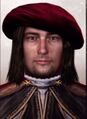 Database Entry Potrait of Leonardo Da Vinci


