

Kublai Khan: Difference between revisions
imported>ReverieBot m →References: Category overhaul, removed: Category:Nobility |
imported>Soranin mNo edit summary |
||
| Line 4: | Line 4: | ||
|image = ACM Kublai Khan 1.png | |image = ACM Kublai Khan 1.png | ||
|birth = 23 September 1215<br />[[Mongol Empire]] | |birth = 23 September 1215<br />[[Mongol Empire]] | ||
|death = 18 February 1294<br />{{Wiki|Khanbaliq}}, | |death = 18 February 1294<br />{{Wiki|Khanbaliq}}, [[Yuan dynasty]], [[China]] | ||
|species = [[Human]] | |species = [[Human]] | ||
|affiliates = [[Mongol Empire]]}} | |affiliates = [[Mongol Empire]]}} | ||
'''Kublai Khan''' (Mongolian: ᠬᠤᠪᠢᠯᠠᠢ ᠬᠠᠭᠠᠨ; Chinese: 忽必烈; 1215 – 1294) was the fifth ruler of the [[Mongol Empire]] and the first Emperor of the | '''Kublai Khan''' (Mongolian: ᠬᠤᠪᠢᠯᠠᠢ ᠬᠠᠭᠠᠨ; Chinese: 忽必烈; 1215 – 1294) was the fifth ruler of the [[Mongol Empire]] and the first Emperor of the [[Yuan dynasty]] of [[China]] from 1260 to 1294. A grandson of [[Genghis Khan]] and brother to [[Hülegü Khan]], Kublai Khan is the second most well known of the Mongolian rulers, Kublai Khan's empire stretched even further than that of Genghis Khan did.{{Fact|June 2019}} He was the first Mongol to rule over the whole of China, and his throne was located in what is now [[Beijing]]. | ||
In May 1275, Kublai Khan welcomed the Polo brothers, and [[Niccolò Polo]]'s son [[Marco Polo|Marco]] into his court, not knowing that the famed explorers were in fact [[Assassins]]. The Polos' alliance with the Khan and Marco's seventeen years of service gave the latter the opportunity to break into Kublai's vault in {{Wiki|Shangdu}} and steal back [[Altaïr Ibn-La'Ahad]]'s [[Altaïr Ibn-La'Ahad's Codex|Codex]],<ref name="Memories">''[[Assassin's Creed: Memories]]''</ref><ref name="ACI">''[[Assassin's Creed: Initiates]]'' - [[Database: Retrieving the Codex]]</ref> which had been taken by the Mongols from the two elder Polos to whom Altaïr had entrusted it.<ref name="TSC">''[[Assassin's Creed: The Secret Crusade]]''</ref>{{-}} | In May 1275, Kublai Khan welcomed the Polo brothers, and [[Niccolò Polo]]'s son [[Marco Polo|Marco]] into his court, not knowing that the famed explorers were in fact [[Assassins]]. The Polos' alliance with the Khan and Marco's seventeen years of service gave the latter the opportunity to break into Kublai's vault in {{Wiki|Shangdu}} and steal back [[Altaïr Ibn-La'Ahad]]'s [[Altaïr Ibn-La'Ahad's Codex|Codex]],<ref name="Memories">''[[Assassin's Creed: Memories]]''</ref><ref name="ACI">''[[Assassin's Creed: Initiates]]'' - [[Database: Retrieving the Codex]]</ref> which had been taken by the Mongols from the two elder Polos to whom Altaïr had entrusted it.<ref name="TSC">''[[Assassin's Creed: The Secret Crusade]]''</ref>{{-}} | ||
Revision as of 01:35, 30 July 2023
- "It is the arch that supports the bridge."
- ―Kublai Khan.[src]
Kublai Khan (Mongolian: ᠬᠤᠪᠢᠯᠠᠢ ᠬᠠᠭᠠᠨ; Chinese: 忽必烈; 1215 – 1294) was the fifth ruler of the Mongol Empire and the first Emperor of the Yuan dynasty of China from 1260 to 1294. A grandson of Genghis Khan and brother to Hülegü Khan, Kublai Khan is the second most well known of the Mongolian rulers, Kublai Khan's empire stretched even further than that of Genghis Khan did. [citation needed] He was the first Mongol to rule over the whole of China, and his throne was located in what is now Beijing.
In May 1275, Kublai Khan welcomed the Polo brothers, and Niccolò Polo's son Marco into his court, not knowing that the famed explorers were in fact Assassins. The Polos' alliance with the Khan and Marco's seventeen years of service gave the latter the opportunity to break into Kublai's vault in Shangdu and steal back Altaïr Ibn-La'Ahad's Codex,[1][2] which had been taken by the Mongols from the two elder Polos to whom Altaïr had entrusted it.[3]
Gallery
-
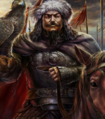 Kublai Khan in mongol armor
 -
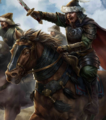 Kublai leading his men in battle


Appearances
- Assassin's Creed II (mentioned only)
- Assassin's Creed: Initiates (mentioned in Database entry only)
- Assassin's Creed: Memories (first appearance)
- Assassin's Creed: Last Descendants – Tomb of the Khan (mentioned only)
References