


Jubair al Hakim: Difference between revisions
imported>Amnestyyy slight expansion |
imported>Nostalgia AC Minor fixes. |
||
| Line 17: | Line 17: | ||
==Biography== | ==Biography== | ||
===The | ===The learned scholar=== | ||
{{Quote|Is it not ancient scrolls that inspire the Crusaders, that fill Saladin and his men with a sense of righteous fury? Their texts endanger others, bring death in their wake.|Jubair to Altaïr|Assassin's Creed}} | {{Quote|Is it not ancient scrolls that inspire the Crusaders, that fill Saladin and his men with a sense of righteous fury? Their texts endanger others, bring death in their wake.|Jubair to Altaïr.|Assassin's Creed}} | ||
Unknown to many, Jubair secretly became a Templar at some point in his life. He and nine other Templars guarded the secrets of the [[Second Apple|Piece of Eden]]. | Unknown to many, Jubair secretly became a Templar at some point in his life. He and nine other Templars guarded the secrets of the [[Second Apple|Piece of Eden]]. | ||
Also known as the head of "The Illuminated" | Also known as the head of "The Illuminated," Jubair al Hakim was the Chief Scholar of Damascus and led his fellow scholars. However, the Templar ideology caused his view of literature to turn into a hatred. Rather than seeking knowledge, The Illuminated began hunting down and incinerating all sources of written knowledge within Damascus, believing the documents to be the source of evil and hatred in the world. They blamed the [[Third Crusade|war]] between the [[Saracens]] and the [[Crusaders]] on written documents, as it was the Bible that drove the Crusades. | ||
Jubair al Hakim had disdain for the works of many writers such as [[wikipedia:Plato|Plato]] and [[wikipedia:Socrates|Socrates]]. He was a ruthless man, with little tolerance towards any who opposed him. He believed that the illness of learning had to be eliminated, because it fixed people in their ways, preventing them from finding their true calling. | Jubair al Hakim had disdain for the works of many writers such as [[wikipedia:Plato|Plato]] and [[wikipedia:Socrates|Socrates]]. He was a ruthless man, with little tolerance towards any who opposed him. He believed that the illness of learning had to be eliminated, because it fixed people in their ways, preventing them from finding their true calling. | ||
| Line 27: | Line 27: | ||
===Death=== | ===Death=== | ||
{{Quote|Am I not unlike those precious books you seek to save? A source of knowledge with which you disagree.|Jubair to Altaïr|Assassin's Creed}} | {{Quote|Am I not unlike those precious books you seek to save? A source of knowledge with which you disagree.|Jubair to Altaïr|Assassin's Creed}} | ||
Altaïr made his way to Damascus to take the life of the Chief Scholar, and after several investigations, in which he learned of the plans to burn books, he sought out Jubair. | In 1191, Altaïr made his way to Damascus to take the life of the Chief Scholar, and after several [[Investigation|investigations]], in which he learned of the plans to burn books, he sought out Jubair. | ||
Altaïr witnessed Jubair and a few of his followers in a courtyard, adding scripts to a roaring fire. While the rest of his followers added fuel, a man started arguing with Jubair, claiming the scripts to be gifts, not curses. Jubair asked the man if he truly loved his books, to which the scholar responded that he did. | Altaïr witnessed Jubair and a few of his followers in a courtyard, adding scripts to a roaring fire. While the rest of his followers added fuel, a man started arguing with Jubair, claiming the scripts to be gifts, not curses. Jubair asked the man if he truly loved his books, to which the scholar responded that he did. | ||
| Line 34: | Line 34: | ||
In a burst of rage, Jubair pushed the man onto the pile of burning scripts and watched him die. After asking the rest of his followers if anyone wished to join him, the scholars set out to conduct book burnings throughout the city. | In a burst of rage, Jubair pushed the man onto the pile of burning scripts and watched him die. After asking the rest of his followers if anyone wished to join him, the scholars set out to conduct book burnings throughout the city. | ||
Altaïr had to track down the | Altaïr had to track down the actual Jubair among dozens of his followers wearing the same uniform, though eventually he found Jubair near the [[Madrasah Al-Kallāsah]] conducting a book burning. Unsuspecting and unaware of the nearby Assassin, Altaïr quickly killed him with his [[hidden blade]] in the courtyard. With his dying words, Jubair claimed that he merely sought to free people from the books, which he believed made them ignorant and foolish, so that they could think for themselves again. | ||
==Personality and characteristics== | ==Personality and characteristics== | ||
Jubair was a man of strong beliefs, who had faith in his cause, as well as that of the Templars'. Believing people to be to dependent on scriptures, he decided to burn all written texts in Damascus, | Jubair was a man of strong beliefs, who had faith in his cause, as well as that of the Templars'. Believing people to be to dependent on scriptures, he decided to burn all written texts in Damascus, intent on freeing the people of their ignorance. | ||
Despite his plans to burn all | Despite his plans to burn all of the literature, Jubair was an intelligent man. He did not follow orders simply because they were given to him, but he acted on his own thoughts, having given the subject adequate thought. He justified his actions by stating the the war between [[Richard I of England|King Richard]] and [[Salah Al'din|Saladin]] had been started by ancient scrolls, and that the world would have been better without them. | ||
However, Jubair was also a violent man, who was easily angered and | However, Jubair was also a violent man, who was easily angered and would not allow anything to get in his way. When one of his disciples doubted his actions, Jubair didn't hesitate to throw him onto the pile of burning books, and he even went so far as to watch how his former companion suffered a painful death in the flames. | ||
==Final words== | ==Final words== | ||
| Line 57: | Line 57: | ||
==Trivia== | ==Trivia== | ||
*Jubair al Hakim may be inspired by the Arab-Spanish geographer, traveler, and poet [[Wikipedia:Ibn Jubayr|Ibn Jubayr]]. | *Jubair al Hakim may be inspired by the Arab-Spanish geographer, traveler, and poet [[Wikipedia:Ibn Jubayr|Ibn Jubayr]]. | ||
*Like [[Talal]] and [[Sibrand]], [[vigilantes]] will stop | *Like [[Talal]] and [[Sibrand]], [[vigilantes]] will stop Jubair if he flees. | ||
*The name "Jubair" means "The forced one", which may refer to his actions through force. In Arabic, "Al Hakim" means "The wise one" | *The name "Jubair" means "The forced one", which may refer to his actions through force. In Arabic, "Al Hakim" means "The wise one." | ||
==Gallery== | ==Gallery== | ||
| Line 67: | Line 67: | ||
Jubdeat.jpg|Jubair's final moments. | Jubdeat.jpg|Jubair's final moments. | ||
</gallery> | </gallery> | ||
==Source== | ==Source== | ||
*''[[Assassin's Creed]]'' | *''[[Assassin's Creed]]'' | ||
Revision as of 00:27, 7 December 2011

|
"Good work, if a little… unrefined." This article is being nominated for . If you wish to share your own opinion about this article, please read the instructions within the nomination page before voting. |
- "I too was making a small sacrifice. It matters little now. Your deed is done... and so am I."
- ―Jubair falling to Altaïr's blade.[src]
Jubair al Hakim was the Chief Scholar of Damascus, and secretly a member of the Templar Order. He was one of the nine men assassinated by the Assassin Altaïr Ibn-La'Ahad. His death, like those of his Templar brothers, was ordered by Al Mualim. Jubair was found in the Middle District of Damascus.
Biography
The learned scholar
- "Is it not ancient scrolls that inspire the Crusaders, that fill Saladin and his men with a sense of righteous fury? Their texts endanger others, bring death in their wake."
- ―Jubair to Altaïr.[src]
Unknown to many, Jubair secretly became a Templar at some point in his life. He and nine other Templars guarded the secrets of the Piece of Eden.
Also known as the head of "The Illuminated," Jubair al Hakim was the Chief Scholar of Damascus and led his fellow scholars. However, the Templar ideology caused his view of literature to turn into a hatred. Rather than seeking knowledge, The Illuminated began hunting down and incinerating all sources of written knowledge within Damascus, believing the documents to be the source of evil and hatred in the world. They blamed the war between the Saracens and the Crusaders on written documents, as it was the Bible that drove the Crusades.
Jubair al Hakim had disdain for the works of many writers such as Plato and Socrates. He was a ruthless man, with little tolerance towards any who opposed him. He believed that the illness of learning had to be eliminated, because it fixed people in their ways, preventing them from finding their true calling.
Death
- "Am I not unlike those precious books you seek to save? A source of knowledge with which you disagree."
- ―Jubair to Altaïr[src]
In 1191, Altaïr made his way to Damascus to take the life of the Chief Scholar, and after several investigations, in which he learned of the plans to burn books, he sought out Jubair.
Altaïr witnessed Jubair and a few of his followers in a courtyard, adding scripts to a roaring fire. While the rest of his followers added fuel, a man started arguing with Jubair, claiming the scripts to be gifts, not curses. Jubair asked the man if he truly loved his books, to which the scholar responded that he did.

In a burst of rage, Jubair pushed the man onto the pile of burning scripts and watched him die. After asking the rest of his followers if anyone wished to join him, the scholars set out to conduct book burnings throughout the city.
Altaïr had to track down the actual Jubair among dozens of his followers wearing the same uniform, though eventually he found Jubair near the Madrasah Al-Kallāsah conducting a book burning. Unsuspecting and unaware of the nearby Assassin, Altaïr quickly killed him with his hidden blade in the courtyard. With his dying words, Jubair claimed that he merely sought to free people from the books, which he believed made them ignorant and foolish, so that they could think for themselves again.
Personality and characteristics
Jubair was a man of strong beliefs, who had faith in his cause, as well as that of the Templars'. Believing people to be to dependent on scriptures, he decided to burn all written texts in Damascus, intent on freeing the people of their ignorance.
Despite his plans to burn all of the literature, Jubair was an intelligent man. He did not follow orders simply because they were given to him, but he acted on his own thoughts, having given the subject adequate thought. He justified his actions by stating the the war between King Richard and Saladin had been started by ancient scrolls, and that the world would have been better without them.
However, Jubair was also a violent man, who was easily angered and would not allow anything to get in his way. When one of his disciples doubted his actions, Jubair didn't hesitate to throw him onto the pile of burning books, and he even went so far as to watch how his former companion suffered a painful death in the flames.
Final words
- Jubair: Why!? Why have you done this?!
- Altaïr: Men must be free to do what they believe. It is not our right to punish one for thinking what they do, no matter how much we disagree!
- Jubair: Then what?
- Altaïr: You of all people should know the answer. Educate them, teach them right from wrong. It must be knowledge that frees them, not force.
- Jubair: They do not learn, fixed in their ways as they are. You are naive to think otherwise. It's an illness, for which there is but one cure.
- Altaïr: You're wrong, and that is why you must be put to rest.
- Jubair: Am I not unlike those precious books you seek to save? A source of knowledge with which you disagree. Yet you are rather quick to steal my life.
- Altaïr: A small sacrifice to save many. It is necessary.
- Jubair: Is it not ancient scrolls that inspire the Crusaders, that fill Saladin and his men with a sense of righteous fury? Their texts endanger others, bring death in their wake. I too was making a small sacrifice. It matters little now. Your deed is done... and so am I.
Trivia
- Jubair al Hakim may be inspired by the Arab-Spanish geographer, traveler, and poet Ibn Jubayr.
- Like Talal and Sibrand, vigilantes will stop Jubair if he flees.
- The name "Jubair" means "The forced one", which may refer to his actions through force. In Arabic, "Al Hakim" means "The wise one."
Gallery
-
 Scholars burning book inside the Madrasah.
 -
 Altaïr watching the argument between Jubair and a scholar.
 -
 The arguing scholar is thrown to the flames.
 -
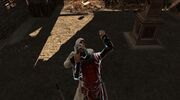 Jubair's final moments.


Source
| ||||||||||||||||||||||||||||