

Israel Putnam: Difference between revisions
imported>The Crimson Eagle m →Vouching for Ratonhnhaké:ton: I missed this... Since he already took the name Connor, I don't see the point in using his other name here. That and, it looks stupid suddenly calling him Connor, in the section. |
imported>Slate Vesper mNo edit summary |
||
| Line 4: | Line 4: | ||
{{Quote|Do not fire until you see the whites of their eyes!|Israel Putnam speaking to his men at the [[Battle of Bunker Hill]].|Assassin's Creed III}} | {{Quote|Do not fire until you see the whites of their eyes!|Israel Putnam speaking to his men at the [[Battle of Bunker Hill]].|Assassin's Creed III}} | ||
{{Character infobox | {{Character infobox | ||
|image | |image = ACIII-I Putnam Render.png | ||
|name | |name = Israel Putnam | ||
|birth = 7 January 1718<br>{{Wiki|Danvers, Massachusetts|Salem Village, Massachusetts}} | |||
|death = 29 May 1790 (aged 72)<br>{{Wiki|Brooklyn, Connecticut}} | |||
|period = [[American Revolutionary War|Revolutionary War]] | |||
|birth | |||
|death | |||
|period | |||
|faction = [[Continental Army]] | |faction = [[Continental Army]] | ||
|appear = ''[[Assassin's Creed III]]'' | |||
|appear | |voice = [[Andreas Apergis]]}} | ||
'''Israel Putnam''' (1718 – 1790) was an [[United States|American]] general in the [[Continental Army]], who fought with distinction at the [[Battle of Bunker Hill]] during the [[American Revolutionary War]]. | |||
|voice | |||
'''Israel Putnam''' (1718 – 1790) was an [[United States|American]] general in the [[Continental Army]] who fought with distinction at the [[Battle of Bunker Hill]] during the [[American Revolutionary War]]. | |||
==Biography== | ==Biography== | ||
===Early life=== | ===Early life=== | ||
Putnam was born in | Putnam was born in {{Wiki|Massachusetts}}, but later moved to {{Wiki|Connecticut}} to take up farming. Following this, he joined the colonial militia during the [[French and Indian War]], and earned a reputation for bravery and inspiring the soldiers around him. | ||
In 1758, | In 1758, Putnam was captured by a group of [[Kanien'kehá:ka]] tribespeople, but was rescued just before he was to be executed. Several years later in 1762, he was shipwrecked in {{Wiki|Cuba}}, where Putnam discovered cigars and introduced them to the colonies. | ||
After the war ended, Putnam returned to Connecticut where he was a vocal opponent of the British tax policies. He also founded the Connecticut branch of the | After the war ended, Putnam returned to Connecticut, where he was a vocal opponent of the British tax policies. He also founded the Connecticut branch of the {{Wiki|Sons of Liberty}}. | ||
When he heard about the battles of [[Lexington]] and [[Concord]], Putnam immediately signed up for the Continental Army and was named Brigadier General of the Connecticut forces. | When he heard about the battles of [[Lexington]] and [[Concord]], Putnam immediately signed up for the Continental Army and was named Brigadier General of the Connecticut forces.<ref name="AC3">''[[Assassin's Creed III]]''</ref> | ||
===Battle of Bunker Hill=== | ===Battle of Bunker Hill=== | ||
During the Battle of Bunker Hill in 1775, Putnam was approached by the [[Assassin]] [[Ratonhnhaké:ton]], better known as Connor, who was looking for the [[British Army]] major and [[Templar]] [[John Pitcairn]]. | During the Battle of Bunker Hill in 1775, Putnam was approached by the [[Assassin]] [[Ratonhnhaké:ton]], better known as Connor, who was looking for the [[British Army]] major and [[Templars|Templar]] [[John Pitcairn]]. | ||
In order to flush Pitcairn out, Putnam tasked the young Assassin with disabling two British frigates which were bombarding the hill from the harbor. Once the frigates were disabled, Putnam rallied his troops by delivering an inspiring speech, and Connor then set out to assassinate Pitcairn. | In order to flush Pitcairn out, Putnam tasked the young Assassin with disabling two British frigates which were bombarding the hill from the harbor. Once the frigates were disabled, Putnam rallied his troops by delivering an inspiring speech, and Connor then set out to assassinate Pitcairn. | ||
Traversing the battle and entering Pitcairn's camp, Connor succeeded in killing the major, but nevertheless Putnam was outnumbered and forced to retreat, granting the British a Pyrrhic victory. | Traversing the battle and entering Pitcairn's camp, Connor succeeded in killing the major, but nevertheless Putnam was outnumbered and forced to retreat, granting the British a Pyrrhic victory.<ref name="AC3"/> | ||
===Vouching for Connor=== | ===Vouching for Connor=== | ||
| Line 42: | Line 35: | ||
A year later, Connor was captured by the Templars and falsely accused of plotting to assassinate General [[George Washington]], a crime the Templars themselves were planning to commit. | A year later, Connor was captured by the Templars and falsely accused of plotting to assassinate General [[George Washington]], a crime the Templars themselves were planning to commit. | ||
He later escaped execution and killed the true conspirator, [[Thomas Hickey]], before he could strike Washington. When surrounded by armed guards after murdering Hickey, Putnam arrived to vouch for Connor's innocence, proclaiming him a hero to the Patriot cause. | He later escaped execution and killed the true conspirator, [[Thomas Hickey]], before he could strike Washington. When surrounded by armed guards after murdering Hickey, Putnam arrived to vouch for Connor's innocence, proclaiming him a hero to the Patriot cause.<ref name="AC3"/> | ||
===Later life and death=== | ===Later life and death=== | ||
After helping prevent the assassination of Washington, Putnam's career began to decline. He lost the | After helping prevent the assassination of Washington, Putnam's career began to decline. He lost the {{Wiki|Battle of Long Island}} and was nearly captured after losing the {{Wiki|Battle of Forts Clinton and Montgomery}}. Later, in December of 1779, Putnam suffered a paralyzing stroke, which ended his military career. He died eleven years later, in 1790.<ref>''Wikipedia: {{Wiki|Israel Putnam}}''</ref> | ||
==Personality and characteristics== | ==Personality and characteristics== | ||
[[File:Battle of Bunker Hill 2.png|left|Connor listening to Putnam at Bunker Hill.|thumb|250px]] | [[File:Battle of Bunker Hill 2.png|left|Connor listening to Putnam at Bunker Hill.|thumb|250px]] | ||
As a military officer, Putnam was strict and straightforward with his troops, admitting to them that the British had better weapons and training at the Battle of Bunker Hill. Before the battle, he roused his soldiers with an inspiring speech, but later admitted to Connor that it was all a lie. | As a military officer, Putnam was strict and straightforward with his troops, admitting to them that the British had better weapons and training at the Battle of Bunker Hill. Before the battle however, he roused his soldiers with an inspiring speech, but later admitted to Connor that it was all a lie. | ||
In addition, Putnam was loud and unrestrained. He would constantly shout at soldiers over insignificant issues and was pessimistic regarding the war, believing to have lost the Battle of Bunker Hill before it truly began. | In addition, Putnam was loud and unrestrained. He would constantly shout at soldiers over insignificant issues and was pessimistic regarding the war, believing to have lost the Battle of Bunker Hill before it truly began.<ref name="AC3"/> | ||
==Trivia== | ==Trivia== | ||
*A bronze statue was | *A bronze statue was erected in {{Wiki|Redding, Connecticut}} to commemorate Putnam's famous escape from the British in 1777. | ||
==Gallery== | ==Gallery== | ||
| Line 66: | Line 59: | ||
==References== | ==References== | ||
{{Reflist}} | {{Reflist}} | ||
{{AC3}} | {{AC3}} | ||
Revision as of 22:17, 13 January 2013

|
He who increaseth knowledge, increaseth sorrow. This article contains spoilers, meaning it has information and facts concerning recent or upcoming releases from the Assassin's Creed series. If you do not want to know about these events, it is recommended to read on with caution, or not at all. |
- "Do not fire until you see the whites of their eyes!"
- ―Israel Putnam speaking to his men at the Battle of Bunker Hill.[src]
Israel Putnam (1718 – 1790) was an American general in the Continental Army, who fought with distinction at the Battle of Bunker Hill during the American Revolutionary War.
Biography
Early life
Putnam was born in Massachusetts, but later moved to Connecticut to take up farming. Following this, he joined the colonial militia during the French and Indian War, and earned a reputation for bravery and inspiring the soldiers around him.
In 1758, Putnam was captured by a group of Kanien'kehá:ka tribespeople, but was rescued just before he was to be executed. Several years later in 1762, he was shipwrecked in Cuba, where Putnam discovered cigars and introduced them to the colonies.
After the war ended, Putnam returned to Connecticut, where he was a vocal opponent of the British tax policies. He also founded the Connecticut branch of the Sons of Liberty.
When he heard about the battles of Lexington and Concord, Putnam immediately signed up for the Continental Army and was named Brigadier General of the Connecticut forces.[1]
Battle of Bunker Hill
During the Battle of Bunker Hill in 1775, Putnam was approached by the Assassin Ratonhnhaké:ton, better known as Connor, who was looking for the British Army major and Templar John Pitcairn.
In order to flush Pitcairn out, Putnam tasked the young Assassin with disabling two British frigates which were bombarding the hill from the harbor. Once the frigates were disabled, Putnam rallied his troops by delivering an inspiring speech, and Connor then set out to assassinate Pitcairn.
Traversing the battle and entering Pitcairn's camp, Connor succeeded in killing the major, but nevertheless Putnam was outnumbered and forced to retreat, granting the British a Pyrrhic victory.[1]
Vouching for Connor

A year later, Connor was captured by the Templars and falsely accused of plotting to assassinate General George Washington, a crime the Templars themselves were planning to commit.
He later escaped execution and killed the true conspirator, Thomas Hickey, before he could strike Washington. When surrounded by armed guards after murdering Hickey, Putnam arrived to vouch for Connor's innocence, proclaiming him a hero to the Patriot cause.[1]
Later life and death
After helping prevent the assassination of Washington, Putnam's career began to decline. He lost the Battle of Long Island and was nearly captured after losing the Battle of Forts Clinton and Montgomery. Later, in December of 1779, Putnam suffered a paralyzing stroke, which ended his military career. He died eleven years later, in 1790.[2]
Personality and characteristics

As a military officer, Putnam was strict and straightforward with his troops, admitting to them that the British had better weapons and training at the Battle of Bunker Hill. Before the battle however, he roused his soldiers with an inspiring speech, but later admitted to Connor that it was all a lie.
In addition, Putnam was loud and unrestrained. He would constantly shout at soldiers over insignificant issues and was pessimistic regarding the war, believing to have lost the Battle of Bunker Hill before it truly began.[1]
Trivia
- A bronze statue was erected in Redding, Connecticut to commemorate Putnam's famous escape from the British in 1777.
Gallery
-
Concept art of Israel Putnam.
-
 Putnam meeting Connor.
 -
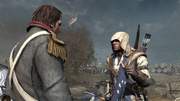 Putnam and Connor talking.
 -
 Putnam smoking a cigar.
 -
 Putnam with Connor in New York.


References
- ↑ 1.0 1.1 1.2 1.3 Assassin's Creed III
- ↑ Wikipedia: Israel Putnam