


Hiding spot: Difference between revisions
imported>Vatsa1708 m Undo revision 219704 by The Hidden Blade (talk) |
imported>StPerkele Re-adding the sections as they are listed as hiding spots in the game as well. If this should not be correct, please tell me on my message wall so I know. |
||
| Line 9: | Line 9: | ||
===Rooftop gardens=== | ===Rooftop gardens=== | ||
Rooftop gardens were small booths which were covered with curtains on the inside. Thus, they provided an easy escape for Assassins. They appeared on rooftops ubiquitously throughout the Holy Land. Their appearance could differ depending on the city and the district. Rooftop gardens in poorer districts were usually flat, whereas the ones located in the richer districts were often decorated with ornaments and had a small, sometimes gilded, cupola. | Rooftop gardens were small booths which were covered with curtains on the inside. Thus, they provided an easy escape for Assassins. They appeared on rooftops ubiquitously throughout the Holy Land. Their appearance could differ depending on the city and the district. Rooftop gardens in poorer districts were usually flat, whereas the ones located in the richer districts were often decorated with ornaments and had a small, sometimes gilded, cupola. | ||
===Benches=== | |||
Usually, two [[Civilians|civilians]] were sitting on benches, leaving a spot between them blank. Assassins could sit down and blend in. However, if the civilans watched an illegal action or saw guards pursuing the Assassin, they would stand up and hence make the hiding spot useless. At certain occasions, Assassins on conversations from a bench. | |||
===Scholars=== | |||
[[Scholars]] appeared in all bigger cities in the Holy Land. They would usually the Assassins to blend in with them in return for his previous help. Since they were a mobile hiding spot, Assassins could use them to reach guarded areas without any trouble. | |||
==Renaissance== | ==Renaissance== | ||
[[File:Hidingspothayflorence.png|thumb|250px|A rose-leaf cart in Florence.]] | [[File:Hidingspothayflorence.png|thumb|250px|A rose-leaf cart in Florence.]] | ||
During the [[Renaissance]], hiding spots were once again quite important for the Assassins. Although they were able to escape from pursuers by breaking the line of sight or fleeing the area, hiding spots still offered an alternative way to escape. However, guards became more suspicious during that time period and often searched hiding spots for their targets. | During the [[Renaissance]], hiding spots were once again quite important for the Assassins. Although they were able to escape from pursuers by breaking the line of sight or fleeing the area, hiding spots still offered an alternative way to escape. However, guards became more suspicious during that time period and often searched hiding spots for their targets. The Assassins reacted to this by killing them while being hidden. Most hiding spots during the Renaissance could be seen glowing white in [[Eagle Vision]]. | ||
===Haystacks=== | ===Haystacks=== | ||
Haystacks worked exactly the same as during the Third Crusade. However, they were now rarely found on rooftops and usually in carts on the ground. Depending on the city, the hay was also often replaced with other things, such as rose leaves in more exalted cities such as [[Florence]] or [[Rome]], or green leaves in more rural areas such as [[San Gimignano]]. In certain locations, such as [[Castel Gandolfo]] or [[San Donato]], big bushes could be found instead of haystacks. However, the visual nature was the only difference between them. | Haystacks worked exactly the same as during the Third Crusade. However, they were now rarely found on rooftops and usually in carts on the ground. Depending on the city, the hay was also often replaced with other things, such as rose leaves in more exalted cities such as [[Florence]] or [[Rome]], or green leaves in more rural areas such as [[San Gimignano]]. In certain locations, such as [[Castel Gandolfo]] or [[San Donato]], big bushes could be found instead of haystacks. However, the visual nature was the only difference between them. | ||
| Line 21: | Line 25: | ||
===Water=== | ===Water=== | ||
Water provided an easy way to escape for Assassins, since they could jump into it from nearly every height without being hurt. Moreover, they could simply dive in order to break the line of sight with their pursuers. | Water provided an easy way to escape for Assassins, since they could jump into it from nearly every height without being hurt. Moreover, they could simply dive in order to break the line of sight with their pursuers. | ||
===Civilians=== | |||
Unlike the Assassins during the Third Crusade, the members of the Brotherhood during the Renaissance could blend with most groups of civilians and not only with scholars. However, this was not possible if the civilians watched a crime or something similar or noticed that the Assassin was escaping. Civilians and water were the only hiding spots during the Renaissance which did not allow a silent kill. | |||
==Gallery== | ==Gallery== | ||
<gallery widths="150" position="center" captionalign="center" captiontextcolor="#ffffff" bordersize="medium"> | <gallery widths="150" position="center" captionalign="center" captiontextcolor="#ffffff" bordersize="medium"> | ||
Hidingspotachay.png|A haycart. | Hidingspotachay.png|A haycart. | ||
Hidingspothayac2.png|A haystack in [[Monteriggioni]]. | |||
Hidingspothaysangimignanoac2.png|A leaf cart in San Gimignano. | |||
Hidingspotbush.png|A bush in San Donato. | |||
Hidingspotacrooftop.png|A simple rooftop garden. | Hidingspotacrooftop.png|A simple rooftop garden. | ||
Hidingspotroof3.png|A rooftop garden in [[Jerusalem]]. | Hidingspotroof3.png|A rooftop garden in [[Jerusalem]]. | ||
Hidingspotacrooftop3.png|A rooftop garden in [[Acre]]. | Hidingspotacrooftop3.png|A rooftop garden in [[Acre]]. | ||
Hidingspotrooftopac2.png|A rooftop garden in [[Forlì]]. | Hidingspotrooftopac2.png|A rooftop garden in [[Forlì]]. | ||
Hidingspotsrooftopvenice.png|A rooftop garden in Venice. | Hidingspotsrooftopvenice.png|A rooftop garden in Venice. | ||
| Line 41: | Line 47: | ||
*''[[Assassin's Creed II]]'' | *''[[Assassin's Creed II]]'' | ||
*''[[Assassin's Creed: Brotherhood]]'' | *''[[Assassin's Creed: Brotherhood]]'' | ||
*''[http://www.youtube.com/watch?v=wmYaouXj7i0 Assassin's Creed: Revelations Gamescom 2011 Demo] | *''[http://www.youtube.com/watch?v=wmYaouXj7i0 Assassin's Creed: Revelations Gamescom 2011 Demo]'' | ||
[[Category:Assassin's Creed: Brotherhood Gameplay]] | [[Category:Assassin's Creed: Brotherhood Gameplay]] | ||
[[Category:Assassin's Creed II Gameplay]] | [[Category:Assassin's Creed II Gameplay]] | ||
Revision as of 21:27, 20 October 2011
Hiding Spots referred to different kinds of hiding places which were used by the Assassins in order to escape pursuers or to perform an ambush.
Third Crusade
During the Third Crusade, hiding spots played a significant role for Assassins, since they frequently were their only way to successfully escape from a group of pursuers. Depending on the situation, Assassins could have used different kinds of hiding spots.
Haystacks
Of all hiding spots, haystacks were the ones that offered the most tactical use. Since they could appear both on rooftops and on the ground, they were always a good hiding place. Moreover, a Leap of Faith could be performed from a rooftop into them. Haystacks usually appeared in two different versions: As a pile or in a cart.
Rooftop gardens
Rooftop gardens were small booths which were covered with curtains on the inside. Thus, they provided an easy escape for Assassins. They appeared on rooftops ubiquitously throughout the Holy Land. Their appearance could differ depending on the city and the district. Rooftop gardens in poorer districts were usually flat, whereas the ones located in the richer districts were often decorated with ornaments and had a small, sometimes gilded, cupola.
Benches
Usually, two civilians were sitting on benches, leaving a spot between them blank. Assassins could sit down and blend in. However, if the civilans watched an illegal action or saw guards pursuing the Assassin, they would stand up and hence make the hiding spot useless. At certain occasions, Assassins on conversations from a bench.
Scholars
Scholars appeared in all bigger cities in the Holy Land. They would usually the Assassins to blend in with them in return for his previous help. Since they were a mobile hiding spot, Assassins could use them to reach guarded areas without any trouble.
Renaissance
During the Renaissance, hiding spots were once again quite important for the Assassins. Although they were able to escape from pursuers by breaking the line of sight or fleeing the area, hiding spots still offered an alternative way to escape. However, guards became more suspicious during that time period and often searched hiding spots for their targets. The Assassins reacted to this by killing them while being hidden. Most hiding spots during the Renaissance could be seen glowing white in Eagle Vision.
Haystacks
Haystacks worked exactly the same as during the Third Crusade. However, they were now rarely found on rooftops and usually in carts on the ground. Depending on the city, the hay was also often replaced with other things, such as rose leaves in more exalted cities such as Florence or Rome, or green leaves in more rural areas such as San Gimignano. In certain locations, such as Castel Gandolfo or San Donato, big bushes could be found instead of haystacks. However, the visual nature was the only difference between them.
Rooftop gardens
Rooftop gardens were still present during the Renaissance and had a similar style in most cities, usually only differing in the color of the curtains. However, both Rome and Venice had rooftop gardens with an unique, posher style, usually decorated with ivy or wine ranks.
Wells
Wells appeared during the Renaissance everywhere throughout Italy. They worked similar to haystacks, but Assassins could not perform a Leap of Faith into them. Wells, apart from haystacks, were the only places which were always scanned by cautious Borgia seekers in Rome. Their visual appearance changed depending on the city they were located in.
Water
Water provided an easy way to escape for Assassins, since they could jump into it from nearly every height without being hurt. Moreover, they could simply dive in order to break the line of sight with their pursuers.
Civilians
Unlike the Assassins during the Third Crusade, the members of the Brotherhood during the Renaissance could blend with most groups of civilians and not only with scholars. However, this was not possible if the civilians watched a crime or something similar or noticed that the Assassin was escaping. Civilians and water were the only hiding spots during the Renaissance which did not allow a silent kill.
Gallery
-
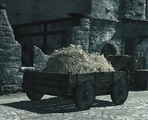 A haycart.
 -
A haystack in Monteriggioni.
-
A leaf cart in San Gimignano.
-
A bush in San Donato.
-
A simple rooftop garden.
-
A rooftop garden in Jerusalem.
-
A rooftop garden in Acre.
-
A rooftop garden in Forlì.
-
A rooftop garden in Venice.
-
A rooftop garden in Rome.
-
Ezio pulling a guard into a well in San Gimignano.
-
A well in Rome.


