
Frontier: Difference between revisions
imported>Stormbeast mNo edit summary |
Expanded |
||
| Line 5: | Line 5: | ||
The '''Frontier''' was a large tract of countryside located in the [[United States|American]] north-east. Many battles of the [[French and Indian War]] and the [[American Revolutionary War]] took place here. | The '''Frontier''' was a large tract of countryside located in the [[United States|American]] north-east. Many battles of the [[French and Indian War]] and the [[American Revolutionary War]] took place here. | ||
The Frontier consisted mostly of wilderness, containing cliffs, forests, rivers, and mountains. It was also inhabited by a variety of animals, including bears, beavers, deer, wolves, rabbits, and elk.<ref name="GameInformer">''GameInformer'' April 2012 issue: ''[[Assassin's Creed III]]''</ref> | The Frontier consisted mostly of wilderness, containing cliffs, forests, rivers, and mountains. It was also inhabited by a variety of animals, including bears, beavers, deer, wolves, rabbits, and elk.<ref name="GameInformer">''GameInformer'' April 2012 issue: ''[[Assassin's Creed III]]''</ref>Hunting Regions split up the land, where | ||
[[Ratonhnhaké:ton|Connor Kenway]] logged the different species he hunted there. | |||
While [[Boston]] and [[New York City]] were the primary settlements located near the Frontier, the countryside itself also contained several small Native American and European ones, including the towns of [[Lexington]], [[Concord]], [[Charlestown]], and [[Ratonhnhaké:ton]]'s [[Mohawk]] village. One could also find logging camps, mills, and trading posts.<ref name="GameInformer Exploring">[http://www.gameinformer.com/b/features/archive/2012/03/19/exploring-the-assassin-39-s-creed-iii-frontier.aspx GameInformer: ''Exploring The Assassin's Creed III Frontier'']</ref> | While [[Boston]] and [[New York City]] were the primary settlements located near the Frontier, the countryside itself also contained several small Native American and European ones, including the towns of [[Lexington]], [[Concord]], [[Charlestown]], and [[Ratonhnhaké:ton]]'s [[Mohawk]] village. One could also find logging camps, mills, and trading posts.<ref name="GameInformer Exploring">[http://www.gameinformer.com/b/features/archive/2012/03/19/exploring-the-assassin-39-s-creed-iii-frontier.aspx GameInformer: ''Exploring The Assassin's Creed III Frontier'']</ref> | ||
| Line 12: | Line 13: | ||
As the war dragged on, the condition of the towns would change during the preparation or aftermath of a battle. At different times, one could find battalions of men readying for a charge, or injured soldiers by abandoned tents.<ref name="GameInformer Exploring" /> | As the war dragged on, the condition of the towns would change during the preparation or aftermath of a battle. At different times, one could find battalions of men readying for a charge, or injured soldiers by abandoned tents.<ref name="GameInformer Exploring" /> | ||
The [[Assassins|Assassin]] Ratonhnhaké:ton was particularly skilled in navigating the Frontier | The [[Assassins|Assassin]] [[Ratonhnhaké:ton]] was particularly skilled in navigating the Frontier; he was able to climb and [[Freerunning|free-run]] across rocks and tree branches, granting him an advantage over his enemies and prey traveling below, as well as offering a quicker mothod of travelling during winter when the snow was knee deep.<ref name="GameInformer" /> | ||
== Trivia == | == Trivia == | ||
| Line 18: | Line 19: | ||
*The Frontier is the setting for around 30% of the main storyline content for ''[[Assassin's Creed III]]''. | *The Frontier is the setting for around 30% of the main storyline content for ''[[Assassin's Creed III]]''. | ||
*It is impossible to reduce [[notoriety]] in the Frontier under normal conditions. | *It is impossible to reduce [[notoriety]] in the Frontier under normal conditions. | ||
*Peddlers can be found riding carts around tracks, where [[Ratonhnhaké:ton]] could the products from hunting and buy consumables, such as arrows, rope darts and bait etc. | |||
== Gallery == | == Gallery == | ||
Revision as of 17:45, 11 November 2012

|
He who increaseth knowledge, increaseth sorrow. This article contains spoilers, meaning it has information and facts concerning recent or upcoming releases from the Assassin's Creed series. If you do not want to know about these events, it is recommended to read on with caution, or not at all. |

The Frontier was a large tract of countryside located in the American north-east. Many battles of the French and Indian War and the American Revolutionary War took place here.
The Frontier consisted mostly of wilderness, containing cliffs, forests, rivers, and mountains. It was also inhabited by a variety of animals, including bears, beavers, deer, wolves, rabbits, and elk.[1]Hunting Regions split up the land, where Connor Kenway logged the different species he hunted there.
While Boston and New York City were the primary settlements located near the Frontier, the countryside itself also contained several small Native American and European ones, including the towns of Lexington, Concord, Charlestown, and Ratonhnhaké:ton's Mohawk village. One could also find logging camps, mills, and trading posts.[2]
.jpg)
As the war dragged on, the condition of the towns would change during the preparation or aftermath of a battle. At different times, one could find battalions of men readying for a charge, or injured soldiers by abandoned tents.[2]
The Assassin Ratonhnhaké:ton was particularly skilled in navigating the Frontier; he was able to climb and free-run across rocks and tree branches, granting him an advantage over his enemies and prey traveling below, as well as offering a quicker mothod of travelling during winter when the snow was knee deep.[1]
Trivia
- The Frontier is reputedly 1.5 times larger than Assassin's Creed: Brotherhood's Rome, meaning it is the largest map in the Assassin's Creed series to date.
- The Frontier is the setting for around 30% of the main storyline content for Assassin's Creed III.
- It is impossible to reduce notoriety in the Frontier under normal conditions.
- Peddlers can be found riding carts around tracks, where Ratonhnhaké:ton could the products from hunting and buy consumables, such as arrows, rope darts and bait etc.
Gallery
-
 Concept art of wolves, following the blood trails of fallen bodies.
 -
 Ratonhnhaké:ton nimbly running over the Frontier's rough terrain.
 -
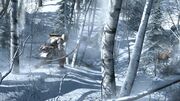 Ratonhnhaké:ton stalking a deer with his bow in hand.
 -

-
 Ratonhnhaké:ton navigating along a canal with a canoe.
 -
 Ratonhnhaké:ton spying on a British march from above, using the trees to remain out of sight.
 -
Ratonhnhaké:ton entering a Continental camp.
-
 A group of deer, some of the wildlife present in the region.
 -
 Ratonhnhaké:ton chasing after a lone deer through the Frontier.
 -
 Snow covered forest in the Frontier.
 -
Winter in the Frontier.
-
Frontier winter.
-
 Frontier in Spring.
 -
Frontier fight at night.
-
 Concept art of Ratonhnhaké:ton and George Washington on a Frontier battlefield.
 -
 Concept art of the Frontier by William Wu.

.jpg)
.jpg)


References
- ↑ 1.0 1.1 GameInformer April 2012 issue: Assassin's Creed III
- ↑ 2.0 2.1 GameInformer: Exploring The Assassin's Creed III Frontier