

Florence Nightingale: Difference between revisions
imported>Misphantom No edit summary |
imported>Bovkaffe No edit summary |
||
| Line 30: | Line 30: | ||
[[Category:Individuals]] | [[Category:Individuals]] | ||
[[Category:Englishmen]] | [[Category:Englishmen]] | ||
[[Category:Authors]] | |||
[[Category:Saints]] | [[Category:Saints]] | ||
[[Category:Assassin allies]] | [[Category:Assassin allies]] | ||
Revision as of 21:16, 27 October 2015

Florence Nightingale (12 May 1820 – 13 August 1910) was an English social reformer and the founder of modern nursing.
One of the creators of modern medicine, Nightingale popularized nurses. She became known as The Lady with the Lamp for walking the battlefields of the Crimean War and caring for the wounded by lamplight.
Biography
In 1868, Florence Nightingale worked as a doctor in the Lambeth Asylum shortly after the assassination of Dr. John Elliotson. During this time, defective and fraud tonics and medicine were sold to the townsfolk. Nightingale catered the needs of the poor and the children.
Sometime in 1868, she aided the Assassin Evie Frye and the woman's ill child accomplice, Clara O'Dea. Nightingale requested the elder woman to recover the needed supplies for the cure.
After the encounter, Nightingale distributed authentic medicine and even petitioned for regulations to be placed.
Trivia
- Nightingale was one of the first people to have her voice recorded and preserved.
Gallery
-
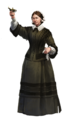 Concept art of Nightingale

Reference