


Florence: Difference between revisions
imported>Amnestyyy No edit summary |
imported>GuardDog revamp (updating images, expanding slightly, format, rewording) |
||
| Line 2: | Line 2: | ||
{{WP-REAL}} | {{WP-REAL}} | ||
{{WPlocations}} | {{WPlocations}} | ||
{{Location infobox | {{Location infobox | ||
|image = Firenzelineage.png | |image = Firenzelineage.png | ||
|state = Florentine Republic | |state = Florentine Republic | ||
|rulers = [[House of Medici]] | |rulers = [[House of Medici]] | ||
|factions = | |factions = [[Assassins]]<br>[[Templars]]<br>[[House of Auditore]]<br>[[House of Pazzi]] | ||
|founded = [[Gaius Julius Caesar|Julius Caesar]] | |founded = [[Gaius Julius Caesar|Julius Caesar]] | ||
|date = 59 | |date = 59 BC | ||
|landmark = | |landmark = [[Santa Maria del Fiore]]<br>[[Santa Maria Novella]]<br>[[Ponte Vecchio]]<br>[[Palazzo Auditore]] | ||
|targets = [[Uberto Alberti]]<br>[[Francesco de' Pazzi]]<br>[[Girolamo Savonarola]]<br>[[Painter|The Painter]]<br>[[Doctor (Savonarola's lieutenant)|The Doctor]]<br>[[Preacher|The Preacher]]<br>[[Farmer|The Farmer]]<br>[[Condottiero|The Condottiero]]<br>[[Merchant (Savonarola's lieutenant)|The Merchant]]<br>[[Nobleman|The Nobleman]]<br>[[Priest (Savonarola's lieutenant)|The Priest]]<br>[[Captain Guard|The Captain Guard]] | |||
|targets = | |||
}} | }} | ||
'''Florence''' (Italian: ''Firenze'') is a major city located in northern [[Italy]]. | '''Florence''' (Italian: ''Firenze'') is a major city located in northern [[Italy]]. During the late 15th century, the city was ruled by [[Lorenzo de' Medici]], a member of the powerful [[House of Medici|Medici family]], and housed four districts: [[Santa Maria Novella District|Santa Maria Novella]], [[San Giovanni District|San Giovanni]], [[San Marco District (Florence)|San Marco]], and [[Oltrarno District|Oltrarno]]. | ||
However, the city later fell into a dark age with the [[Bonfire of the Vanities]], under the leadership of the mad monk, [[Girolamo Savonarola]]. | |||
==History== | ==History== | ||
===Early development=== | ===Early development=== | ||
Florence was founded during the {{Wiki|Roman Empire|Roman}} era, in the year 59 | Florence was founded during the {{Wiki|Roman Empire|Roman}} era, in the year 59 BC; although it would be some 1,400 years before it developed into one of Italy's most important cities. After the sacking of [[Rome]] in the 5th century, the Ostrogoths took over. Under their rule, the city was constantly under attack from the [[Byzantines]], who sent the population level below 1,000. The Lombards came to power in the 6th century, ending the Byzantine assaults. | ||
Florence grew to a population of 80,000 in the 14th century, of which 25,000 were working in the wool industry. In 1378, a major revolt of the lower class led to the wool combers rising up and seizing the government of the city. Their progressive, radical democracy lasted for less than 2 months before the upper classes seized control once more, but the revolt so terrified the rich, that a century later, it was still discussed in hushed tones. | |||
The Albizzi family became the de facto rulers after the revolt. Worried about the rise of the Medici family, who were rich bankers rapidly gaining influence in Florence, Maso and Rinaldo Albizzi imprisoned {{Wiki|Cosimo de' Medici}} and exiled him in 1433. | |||
However, Cosimo gained influence behind the scenes, and rose to power in 1434, exiling the entire Albizzi family except for Luca, who had been loyal to Cosimo. Luca Albizzi joined the Signoria, the ruling body of Florence, as Gonfaloniere, succeeding Cosimo's old friend [[Ilario Auditore]] in 1442.<ref name="AC2">''[[Assassin's Creed II]]''</ref> | |||
=== | ===Medici Rule=== | ||
After Cosimo de' Medici's revolt, the Medici family governed the city in what would come to be known as its Golden Age; a true [[Renaissance]]. The family had a focus on the arts and sciences, as well as an intricate banking system. At the time, the city was also home to some of Italy's most notable figures; including [[Leonardo da Vinci]], {{Wiki|Sandro Botticelli}}, [[Michelangelo]], and [[Niccolò Machiavelli]].<ref name="AC2"/> | |||
At some point after the year 1291, the [[Assassins|Assassin]] [[Domenico Auditore]] and his son came to live in Florence, and adopted the name "[[House of Auditore|Auditore]]". Under this guise of nobility, they quickly assimilated themselves into the city's upper class, and became a well-respected and known family in Florence.<ref>''Assassin's Creed II'' - [[Auditore Family Crypt]]</ref> | |||
[[ | |||
The city flourished during the reign of Lorenzo de' Medici. Throughout his rule, great artists, philosophers, and others contributed to the city's development. Various architectural marvels blessed the streets of Florence, such as the [[Santa Maria Novella]], [[Piazza della Signoria]], the [[Basilica di Santa Maria del Fiore|Duomo]], and the [[Ponte Vecchio]].<ref name="AC2"/> | |||
Though the Assassin-affiliated Auditore family abandoned Florence after the [[Pazzi Conspiracy]] in 1476, one of its members, [[Ezio Auditore da Firenze]], continued to frequent the city.<ref name="AC2"/> During the early 16th century, he would also his [[apprentices]] to Florence to complete several contracts for the Assassin Order; such as delivering reports, stealing weapons, or delivering forged pardons.<ref>''[[Assassin's Creed: Brotherhood]]''</ref> | |||
===Bonfire of the Vanities=== | |||
After the death of Lorenzo de' Medici in 1492, he was succeeded by his son, [[Piero de' Medici|Piero]]. Piero ruled as Signore of Florence until 1494, when he was exiled from the city by Girolamo Savonarola.<ref>''[[Assassin's Creed: Renaissance]]''</ref> | |||
Between 1497 and 1498, the monk instigated the Bonfire of the Vanities, where paintings, books, and other fineries were publicly burned throughout Florence. Despite civil unrest, Savonarola held control over the people with both the [[Ezio's Apple of Eden|Apple of Eden]], and the terror of his nine lieutenants.<ref name="AC2 - Bonfire">''Assassin's Creed II'' - ''[[Bonfire of the Vanities (DLC)]]''</ref> | |||
Eventually, in May of 1498, the Assassin Order intervened in his rule. Ezio Auditore tracked down and killed Savonarola's nine lieutenants, while Niccolò Machiavelli, [[La Volpe]], and [[Paola]] rallied the citizens. The Florentine people eventually rioted before Savonarola's residence in the [[Palazzo Pitti]], dragging him to the [[Piazza della Signoria]] to be burned at the stake.<ref name="AC2 - Bonfire"/> | |||
==Landmarks== | ==Landmarks== | ||
| Line 59: | Line 47: | ||
**Santa Maria Novella | **Santa Maria Novella | ||
**[[Basilica di San Lorenzo]] | **[[Basilica di San Lorenzo]] | ||
[[File:Mercato vecchio.jpg|thumb| | [[File:Mercato vecchio.jpg|thumb|250px|right|The Mercato Vecchio in Florence.]] | ||
*San Marco District | *San Marco District | ||
**Bottega di Leonardo a Firenze | **Bottega di Leonardo a Firenze | ||
| Line 73: | Line 61: | ||
==Trivia== | ==Trivia== | ||
* | *In ''[[Assassin's Creed II]]'', the Battistero di San Giovanni was missing from the front of the main entrance to the Santa Maria del Fiore, despite being built several hundred years before the events of the game. | ||
*Florence | *Florence appeared in the [[Animi Training Program]] of both ''[[Assassin's Creed: Brotherhood]]'' and ''[[Assassin's Creed: Revelations]]''. | ||
*Florence also appeared in four of Ezio's suppressed [[Cristina Memories]]. | |||
*Florence also | *During the Bonfire of the Vanities sequence, the sky over Florence was covered by dark clouds. | ||
*During the Bonfire of the Vanities sequence, the sky over Florence | |||
==Gallery== | ==Gallery== | ||
<gallery captionalign="center" widths="180" position="center"> | |||
AC2 florence concept.jpg|Concept art of Florence. | |||
Florence Map1.jpg|A map of Florence. | |||
AC2 florence multiplayer map.jpg|A map of Florence in the Animi Training Program. | |||
ACL florence view.png|Florence from a bird's eye view. | |||
florencja.jpg|The rooftops of Florence. | |||
florencja.jpg| | |||
Florence Panoramic.jpg|A panoramic view of the city streets. | Florence Panoramic.jpg|A panoramic view of the city streets. | ||
</gallery | EzioFlorence.png|Ezio surveying Florence from a [[View Points|view point]]. | ||
EzioFlorenceguard.jpg|Ezio killing a [[Guards|guard]] on a Florentine rooftop. | |||
Ac23.jpg|Ezio in Florence at night. | |||
</gallery> | |||
==References== | ==References== | ||
{{ | {{Reflist}} | ||
{{ACII}} | {{ACII}} | ||
{{ACBH}} | {{ACBH}} | ||
[[Category:Italy]] | [[Category:Italy]] | ||
[[Category:Cities of Europe]] | [[Category:Cities of Europe]] | ||
Revision as of 04:42, 9 September 2012
Florence (Italian: Firenze) is a major city located in northern Italy. During the late 15th century, the city was ruled by Lorenzo de' Medici, a member of the powerful Medici family, and housed four districts: Santa Maria Novella, San Giovanni, San Marco, and Oltrarno.
However, the city later fell into a dark age with the Bonfire of the Vanities, under the leadership of the mad monk, Girolamo Savonarola.
History
Early development
Florence was founded during the Roman era, in the year 59 BC; although it would be some 1,400 years before it developed into one of Italy's most important cities. After the sacking of Rome in the 5th century, the Ostrogoths took over. Under their rule, the city was constantly under attack from the Byzantines, who sent the population level below 1,000. The Lombards came to power in the 6th century, ending the Byzantine assaults.
Florence grew to a population of 80,000 in the 14th century, of which 25,000 were working in the wool industry. In 1378, a major revolt of the lower class led to the wool combers rising up and seizing the government of the city. Their progressive, radical democracy lasted for less than 2 months before the upper classes seized control once more, but the revolt so terrified the rich, that a century later, it was still discussed in hushed tones.
The Albizzi family became the de facto rulers after the revolt. Worried about the rise of the Medici family, who were rich bankers rapidly gaining influence in Florence, Maso and Rinaldo Albizzi imprisoned Cosimo de' Medici and exiled him in 1433.
However, Cosimo gained influence behind the scenes, and rose to power in 1434, exiling the entire Albizzi family except for Luca, who had been loyal to Cosimo. Luca Albizzi joined the Signoria, the ruling body of Florence, as Gonfaloniere, succeeding Cosimo's old friend Ilario Auditore in 1442.[1]
Medici Rule
After Cosimo de' Medici's revolt, the Medici family governed the city in what would come to be known as its Golden Age; a true Renaissance. The family had a focus on the arts and sciences, as well as an intricate banking system. At the time, the city was also home to some of Italy's most notable figures; including Leonardo da Vinci, Sandro Botticelli, Michelangelo, and Niccolò Machiavelli.[1]
At some point after the year 1291, the Assassin Domenico Auditore and his son came to live in Florence, and adopted the name "Auditore". Under this guise of nobility, they quickly assimilated themselves into the city's upper class, and became a well-respected and known family in Florence.[2]
The city flourished during the reign of Lorenzo de' Medici. Throughout his rule, great artists, philosophers, and others contributed to the city's development. Various architectural marvels blessed the streets of Florence, such as the Santa Maria Novella, Piazza della Signoria, the Duomo, and the Ponte Vecchio.[1]
Though the Assassin-affiliated Auditore family abandoned Florence after the Pazzi Conspiracy in 1476, one of its members, Ezio Auditore da Firenze, continued to frequent the city.[1] During the early 16th century, he would also his apprentices to Florence to complete several contracts for the Assassin Order; such as delivering reports, stealing weapons, or delivering forged pardons.[3]
Bonfire of the Vanities
After the death of Lorenzo de' Medici in 1492, he was succeeded by his son, Piero. Piero ruled as Signore of Florence until 1494, when he was exiled from the city by Girolamo Savonarola.[4]
Between 1497 and 1498, the monk instigated the Bonfire of the Vanities, where paintings, books, and other fineries were publicly burned throughout Florence. Despite civil unrest, Savonarola held control over the people with both the Apple of Eden, and the terror of his nine lieutenants.[5]
Eventually, in May of 1498, the Assassin Order intervened in his rule. Ezio Auditore tracked down and killed Savonarola's nine lieutenants, while Niccolò Machiavelli, La Volpe, and Paola rallied the citizens. The Florentine people eventually rioted before Savonarola's residence in the Palazzo Pitti, dragging him to the Piazza della Signoria to be burned at the stake.[5]
Landmarks
- Santa Maria Novella District
- Mercato Vecchio
- Santa Maria Novella
- Basilica di San Lorenzo

- San Marco District
- Bottega di Leonardo a Firenze
- Palazzo Medici
- Ospedale degli Innocenti
- Basilica di Santa Croce
- San Giovanni District
- Palazzo della Signoria
- Santa Trinita
- Palazzo Auditore
- Oltrarno District
- Palazzo Pitti
Trivia
- In Assassin's Creed II, the Battistero di San Giovanni was missing from the front of the main entrance to the Santa Maria del Fiore, despite being built several hundred years before the events of the game.
- Florence appeared in the Animi Training Program of both Assassin's Creed: Brotherhood and Assassin's Creed: Revelations.
- Florence also appeared in four of Ezio's suppressed Cristina Memories.
- During the Bonfire of the Vanities sequence, the sky over Florence was covered by dark clouds.
Gallery
-
 Concept art of Florence.
 -
A map of Florence.
-
 A map of Florence in the Animi Training Program.
 -
 Florence from a bird's eye view.
 -
The rooftops of Florence.
-
 A panoramic view of the city streets.
 -
 Ezio surveying Florence from a view point.
 -
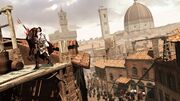 Ezio killing a guard on a Florentine rooftop.
 -
Ezio in Florence at night.


References
- ↑ 1.0 1.1 1.2 1.3 Assassin's Creed II
- ↑ Assassin's Creed II - Auditore Family Crypt
- ↑ Assassin's Creed: Brotherhood
- ↑ Assassin's Creed: Renaissance
- ↑ 5.0 5.1 Assassin's Creed II - Bonfire of the Vanities (DLC)
| |||||||||||||||||||||||||||||||||||||