


Florence: Difference between revisions
imported>Nostalgia AC Argh. |
imported>Nostalgia AC Sloppy. |
||
| Line 26: | Line 26: | ||
==History== | ==History== | ||
==Early development=== | ===Early development=== | ||
Florence was founded during the Roman era, in the year 60 BCE, although it would be some 1,400 years before it developed into one of Italy's most important cities. During the [[Renaissance]], the Medici family ran the city and placed a focus on the arts and sciences, as well as being the birthplace of the modern banking system. The city was also home to some of Italy's most notable figures, including [[Leonardo da Vinci]], Sandro Botticelli, [[Michelangelo]], [[Niccolò Machiavelli]], and the eminent [[House of Auditore|Auditore family]].<ref name="Assassin's Creed II: Auditore Family Crypt"><ref name="Assassin's Creed II"/> | Florence was founded during the Roman era, in the year 60 BCE, although it would be some 1,400 years before it developed into one of Italy's most important cities. During the [[Renaissance]], the Medici family ran the city and placed a focus on the arts and sciences, as well as being the birthplace of the modern banking system. The city was also home to some of Italy's most notable figures, including [[Leonardo da Vinci]], Sandro Botticelli, [[Michelangelo]], [[Niccolò Machiavelli]], and the eminent [[House of Auditore|Auditore family]].<ref name="Assassin's Creed II: Auditore Family Crypt"></ref><ref name="Assassin's Creed II"/> | ||
At some point after the year 1291, the [[Assassins|Assassin]] [[Domenico Auditore]] and his son came to live in Florence, and adopted the name of Auditore. Under the guise of the Auditore, they quickly assimilated themselves into the city's nobility.<ref name="Assassin's Creed II: Auditore Family Crypt" /><ref name="Assassin's Creed II"/> | At some point after the year 1291, the [[Assassins|Assassin]] [[Domenico Auditore]] and his son came to live in Florence, and adopted the name of Auditore. Under the guise of the Auditore, they quickly assimilated themselves into the city's nobility.<ref name="Assassin's Creed II: Auditore Family Crypt" /><ref name="Assassin's Creed II"/> | ||
Revision as of 02:36, 11 November 2011

|
"Information learned is more valuable than information given" This article is currently being reworked by Nostalgia AC as part of their apprenticeship. We ask that edits to this article are only minor or grammatical in nature until this warning is removed in order to not disrupt the major revamp. Should you have any questions regarding the revamp, please contact the apprentice at work's Mentor. |
Florence (Italian: Firenze) is a major city located in northern Italy. The city was home to the notable Auditore family during the late 15th century, as well as four districts: Santa Maria Novella, San Giovanni, San Marco, and Oltrarno.[1]
During the 15th century, the city was ruled by the venerable Lorenzo de' Medici, a member of the powerful Medici dynasty. However, the city later evolved into a dark age with the Bonfire of the Vanities, under the leadership of the mad monk, Girolamo Savonarola.[1]
History
Early development
Florence was founded during the Roman era, in the year 60 BCE, although it would be some 1,400 years before it developed into one of Italy's most important cities. During the Renaissance, the Medici family ran the city and placed a focus on the arts and sciences, as well as being the birthplace of the modern banking system. The city was also home to some of Italy's most notable figures, including Leonardo da Vinci, Sandro Botticelli, Michelangelo, Niccolò Machiavelli, and the eminent Auditore family.[2][1]
At some point after the year 1291, the Assassin Domenico Auditore and his son came to live in Florence, and adopted the name of Auditore. Under the guise of the Auditore, they quickly assimilated themselves into the city's nobility.[2][1]
The city flourished during the reign of Lorenzo de' Medici, and during this reign, great artists, philosophers and others contributed to the city's development. Various architectural marvels blessed the streets of Florence, such as Santa Maria Novella, Piazza della Signoria, the Duomo, and the Ponte Vecchio. However, the beauty of Florence was not immune to enemies, and like other cities in the region, Florence had rival cities. One of the Medici's foremost defenses was the Assassin Giovanni Auditore da Firenze, who worked on behalf of Lorenzo de' Medici up until 1476, when he was hung for the crime of treason.[1][3]
However, the presence of the Assassin in Florence proved problematic for the Templars, who sought control of the city; organizing the execution of Giovanni alongside his sons Federico and Petruccio. Rodrigo Borgia and the Pazzi family begun plans to assume control of the city. In 1478, the Pazzi attacked Lorenzo and his brother Giuliano de' Medici just before Sunday mass, killing Giuliano and wounding Lorenzo in the neck; saved only by the timely arrival of the sole surviving male Auditore – Ezio; Lorenzo ordered the deaths of Pazzi conspirators, and was quickly given his wish in the form of Francesco de' Pazzi. The city remained in Medici hands.[1]
After some years, the sudden death of Lorenzo de' Medici saddened the city, as it had been said that the entire city was at his funeral, including Girolamo Savonarola, a Dominican priest. Following Lorenzo's death in 1492, control of the city passed into Savonarola's hands, who had been using a Piece of Eden to gain control over the masses. Savonarola disagreed with the Renaissance, and preached a return to the medieval way of life and by 1494 had assumed complete control of the city.[4] He remained in control until the year 1498 when the assassin Ezio Auditore returned to his home city and killed the nine lieutenants of Savonarola, before ensuring the death of Savonarola himself.[5]
During Savonarola's reign Florence became "hell on earth";[1] Savonarola imposed a theocratic and dogmatic regime, instigating the infamous Bonfire of the Vanities in 1497. His followers collected and burned all objects that could lead to sin; non-religious books, mirrors, arts, jewels or fine clothing, to name a few. However, following Savonarola's death, the city passed back into the hands of the Medici.[4]
Database entry
Founded by Julius Caesar in 59 B.C.E., Florentia, as it was called by the Romans, quickly became a center of commerce.
After the sacking of Rome, in the 5th Century, the Ostrogoths took over. Under their rule, the city was constantly under attack from the Byzantines, who sent the population level below 1,000. The Lombards came to power in the 6th Century, ending the Byzantine assaults.
Florence grew to a population of 80,000 in the 14th Century, of which 25,000 were working in the wool industry. In 1378, a major revolt of the lower class led to the wool combers rising up and seizing the government of the city. Their progressive, radical democracy lasted for less than 2 months before the upper classes seized control once more, but the revolt so terrified the rich, that a century later it was still discussed in hushed tones, much as the 1960s hippy movement is today.
The Albizzi family became the de facto rulers after the revolt. Worried about the rise of the Medici family, who were newly rich bankers rapidly gaining influence in Florence, Maso and Rinaldo Albizzi imprisoned Cosimo de' Medici and exiled him in 1433. But Cosimo gained influence behind the scenes, and rose to power in 1434, exiling the entire Albizzi family except for Luca, who had been loyal to Cosimo. Luca Albizzi joined the Signoria, the ruling body of Florence, as Gonfaloniere, succeeding Cosimo's old friend Ilario Auditore in 1442.
Under the Medici family, which built impressive public buildings and supported such luminaries as Michelangelo, Leonardo and Botticelli, the Renaissance began with Florence securely at its center.[1]
Landmarks
- Santa Maria Novella District
- San Marco District
- San Giovanni District
- Oltrarno District
Assassination targets
- Uberto Alberti; the Gonfaloniere of Florence (DNA Sequence 2)
- Francesco de' Pazzi; Patriarch of the powerful Pazzi family (DNA Sequence 4)
- Girolamo Savonarola; The mad monk in control of Florence during the Bonfire of the Vanities (DNA Sequence 13)
Trivia
- The Battistero di San Giovanni is missing from the front of the main entrance to the Santa Maria del Fiore, despite being built several hundred years before the events of the game.
- Florence appears in Assassin's Creed: Brotherhood as a multiplayer location, and is a location that Ezio can send his Apprentices to for contracts.
- Florence also appears in four of the Cristina Memories, the suppressed memories of Ezio's past.
- During the Bonfire of the Vanities sequence, the sky over Florence becomes covered by dark clouds in contrast to how it used to be bright and vibrant during the Medici's rule.
- Florence is featured as a city in the Mediterranean Defense mini-game in Assassin's Creed: Revelations.
Gallery
-
A map of Florence.
-
 Ezio surveying the area from atop a view point.
 -
 Ezio killing a guard along a Florentine rooftop.
 -
The city at night.
-
Florence, as seen from a bird's eye view.
-
Ezio fleeing from guards in a typical Florentine street.
-
Florence, as it appears in the Assassin's Creed: Brotherhood multiplayer.
-
A map of Florence in the Assassin's Creed: Brotherhood multiplayer.
-
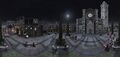 A panoramic view of the city streets.
 -
An older Ezio in Florence with fellow Assassin Shao Jun.


References
- ↑ 1.0 1.1 1.2 1.3 1.4 1.5 1.6 1.7 Assassin's Creed II
- ↑ 2.0 2.1 Cite error: Invalid
<ref>tag; no text was provided for refs namedAssassin's Creed II: Auditore Family Crypt - ↑ Assassin's Creed: Lineage
- ↑ 4.0 4.1 Assassin's Creed: Renaissance
- ↑ Bonfire of the Vanities
| |||||||||||||||||||||||||||||||||||||