

-
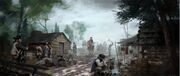 Civilians in the Homestead.
 -
Entrance to the Manor.
-
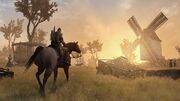 Ratonhnhaké:ton on horseback near a farm.
Welcome to Assassin's Creed Wiki! Log in and join the community.
Davenport Homestead: Difference between revisions
Jump to navigation
Jump to search
imported>Jjacobmartinn m grammar |
imported>Slate Vesper mNo edit summary |
||
| Line 4: | Line 4: | ||
{{Stub}} | {{Stub}} | ||
[[File:MTV_Assassins_Creed-3-single-8.jpg|thumb|250px]] | [[File:MTV_Assassins_Creed-3-single-8.jpg|thumb|250px]] | ||
The '''Davenport Homestead''' was an area in Massachusetts, originally inhabited solely by the [[Master Assassin]] [[Achilles Davenport]]. It consisted of a manor and a small town, in which the [[Assassins|Assassin]] [[Ratonhnhaké:ton]] could invite people to live. The Homestead also held a small dock | The '''Davenport Homestead''' was an area in {{Wiki|Massachusetts}}, [[United States]], which was originally inhabited solely by the [[Master Assassin]] [[Achilles Davenport]]. It consisted of a manor and a small town, in which the [[Assassins|Assassin]] [[Ratonhnhaké:ton]] could invite people to live. | ||
The Homestead also held a small dock for Ratonhnhaké:ton's ship, the ''[[Aquila]]'', which was overseen by first mate and [[Assassins|Assassin]] [[Robert Faulkner]]. From here, the inhabitants could raise income through trade and crafting. | |||
The Homestead was seen by some residents as their second chance, since many of them had lost their previous homes to the conflict of the [[American Revolutionary War]] | The Homestead was seen by some residents as their second chance, since many of them had lost their previous homes to the conflict of the [[American Revolutionary War]] | ||
==Trivia== | ==Trivia== | ||
*The Davenport Homestead contained the graves of Achilles' two family members; his wife Abigail and son Connor | *The Davenport Homestead contained the graves of Achilles' two family members; his wife Abigail and son Connor, who both died of typhoid fever shortly after the [[French and Indian War]]. | ||
== Gallery == | ==Gallery== | ||
<tabber> | <tabber> | ||
Concept art= | Concept art= | ||
| Line 42: | Line 44: | ||
</tabber> | </tabber> | ||
== | ==Reference== | ||
* | *''[[Assassin's Creed III]]'' | ||
{{AC3}} | {{AC3}} | ||
[[Category:Assassin's Creed III locations]] | [[Category:Assassin's Creed III locations]] | ||
[[Category:Assassin Order]] | [[Category:Assassin Order]] | ||
Revision as of 19:33, 5 November 2012

|
He who increaseth knowledge, increaseth sorrow. This article contains spoilers, meaning it has information and facts concerning recent or upcoming releases from the Assassin's Creed series. If you do not want to know about these events, it is recommended to read on with caution, or not at all. |
The Davenport Homestead was an area in Massachusetts, United States, which was originally inhabited solely by the Master Assassin Achilles Davenport. It consisted of a manor and a small town, in which the Assassin Ratonhnhaké:ton could invite people to live.
The Homestead also held a small dock for Ratonhnhaké:ton's ship, the Aquila, which was overseen by first mate and Assassin Robert Faulkner. From here, the inhabitants could raise income through trade and crafting.
The Homestead was seen by some residents as their second chance, since many of them had lost their previous homes to the conflict of the American Revolutionary War
Trivia
- The Davenport Homestead contained the graves of Achilles' two family members; his wife Abigail and son Connor, who both died of typhoid fever shortly after the French and Indian War.
Gallery


Reference