


Castel Sant'Angelo: Difference between revisions
imported>Sadelyrate |
imported>Slate Vesper mNo edit summary |
||
| Line 1: | Line 1: | ||
{{Era|AC2| | {{Era|AC2|ACB|Renaissance|Bbook|ASD}} | ||
{{WP-REAL}} | {{WP-REAL}} | ||
{{Landmarks Infobox | {{Landmarks Infobox | ||
|image = Castel_Sant_Angelo | |image = Castel_Sant_Angelo.jpg | ||
|description = [[Rome]]'s most important fortress. | |description = [[Rome]]'s most important fortress. | ||
|location = [[Vaticano District]], [[Rome]], [[Italy]] | |location = [[Vaticano District]], [[Rome]], [[Italy]] | ||
|dateconstructed = | |dateconstructed = 135–139 | ||
|functions = Castle | |functions = Castle | ||
|appearance = ''[[Assassin's Creed II]]''<br>''[[Assassin's Creed: Brotherhood]]''<br>''[[Assassin's Creed: Ascendance]]'' | |||
|appearance = ''[[Assassin's Creed II]]''<br | |||
|commissioner = Emperor Hadrian}} | |commissioner = Emperor Hadrian}} | ||
The '''Castel Sant'Angelo''', initially known as the '''Mausoleum of Hadrian''', was a significant, cylindrical fortress located in [[Vaticano District | The '''Castel Sant'Angelo''', initially known as the '''Mausoleum of Hadrian''', was a significant, cylindrical fortress located in the [[Vaticano District]], reachable via the [[Ponte Sant'Angelo]]. It was an end point to the [[Passetto di Borgo]], and could be found on the banks of the [[Tiber]] river. | ||
The Castel was commissioned by the {{Wiki|Roman Empire|Roman Emperor}} Hadrian as a tomb for himself and his family. Later, during the [[Renaissance]], the building was used by the [[Papacy]] as a fortress and castle. | The Castel was commissioned by the {{Wiki|Roman Empire|Roman Emperor}} Hadrian as a tomb for himself and his family. Later, during the [[Renaissance]], the building was used by the [[Papacy]] as a fortress and castle. | ||
==History== | ==History== | ||
=== | ===Roman era=== | ||
The tomb of Hadrian, also called Hadrian's mole, was constructed between 135 and 139 | The tomb of Hadrian, also called Hadrian's mole, was constructed between 135 and 139. It was originally a decorated cylinder, with a garden top and golden quadriga. | ||
Hadrian's ashes were placed here a year after his death in 138 | Hadrian's ashes were placed here a year after his death in 138, together with those of his wife, and his first adopted son, who died in the same year. Furthermore, remains of succeeding emperors were placed here as well. Hadrian also built the Ponte Sant'Angelo, formerly known as Pons Aelius. | ||
===Destruction=== | ===Destruction=== | ||
Much of the tomb contents and decoration had been destroyed since the building was changed into a military fortress in 401. The urns and ashes were scattered by looters in Alaric's | Much of the tomb contents and decoration had been destroyed since the building was changed into a military fortress in 401. The urns and ashes were scattered by looters in Alaric's {{Wiki|Sack of Rome (410)|sacking of Rome}} in 410, and the original decorations were thrown down upon the attacking {{Wiki|Goths}} when they besieged Rome in 537. | ||
===Liberation of Rome=== | ===Liberation of Rome=== | ||
[[File:Assassins-creed-brotherhood 1276846795.jpg|thumb|250px|right|Ezio before the Castel]] | [[File:Assassins-creed-brotherhood 1276846795.jpg|thumb|250px|right|Ezio before the Castel]] | ||
In 1499, the [[Assassins|Assassin]] [[Ezio Auditore da Firenze | In 1499, the [[Assassins|Assassin]] [[Ezio Auditore da Firenze]] scaled the Castel during his infiltration of the [[Cappella Sistina]], in order to assassinate [[Rodrigo Borgia|Pope Alexander VI]].<ref name="AC2">''[[Assassin's Creed II]]''</ref> | ||
In 1501, upon Ezio's return to Rome, he infiltrated the Castel to rescue [[Caterina Sforza]], and to assassinate [[Cesare Borgia|Cesare]] and Rodrigo Borgia. However, though he successfully rescued Caterina, he was unable to kill either [[Templars | In 1501, upon Ezio's return to Rome, he infiltrated the Castel to rescue [[Caterina Sforza]], and to assassinate [[Cesare Borgia|Cesare]] and Rodrigo Borgia. However, though he successfully rescued Caterina, he was unable to kill either of the [[Templars]], after he discovered that Rodrigo was away from the Castel, and that Cesare had left for [[Urbino]] moments after Ezio had arrived.<ref name="Brotherhood">''[[Assassin's Creed: Brotherhood]]''</ref> | ||
Soon after this assault, the Castel was guarded by several [[Papal Guard]]s and [[France|French]] soldiers, courtesy of Cesare's alliance with the French General [[Octavian de Valois]].<ref name="Brotherhood"/> | Soon after this assault, the Castel was guarded by several [[Papal Guard]]s and [[France|French]] soldiers, courtesy of Cesare's alliance with the French General [[Octavian de Valois]].<ref name="Brotherhood"/> | ||
In August 1503, Ezio once again infiltrated the Castel through a side gate, with a key he had obtained from [[Lucrezia Borgia]]'s lover, [[Pietro Rossi | In August 1503, Ezio once again infiltrated the Castel through a side gate, with a key he had obtained from [[Lucrezia Borgia]]'s lover, [[Pietro Rossi]]. At a window looking into the Castel's Papal apartments, he witnessed the murder of Rodrigo at the hands of Cesare.<ref name="Brotherhood"/> | ||
At this time, Ezio also found out the location of the [[Ezio's Apple|Apple of Eden]] | At this time, Ezio also found out the location of the [[Ezio's Apple of Eden|Apple of Eden]] from Lucrezia.<ref name="Brotherhood"/> | ||
==Trivia== | ==Trivia== | ||
[[File:SantAngelo2.png|thumb|250px|right|An overview of the Castel]] | [[File:SantAngelo2.png|thumb|250px|right|An overview of the Castel]] | ||
*Despite being the highest reachable point of any ''Assassin's Creed'' game, the flagpole atop the Castel | *Despite being the highest reachable point of any ''Assassin's Creed'' game, the flagpole atop the Castel was not a [[view point]]. | ||
*After climbing the flagpole and looking out at the cityscape, clouds | *After climbing the flagpole and looking out at the cityscape, clouds appeared over the city. | ||
*One of [[ | *One of [[Clay Kaczmarek]]'s [[rifts]] was located on the Castel, on the main tower just across from the inner wall. | ||
*The entire Castel | *The entire Castel was a restricted area throughout ''[[Assassin's Creed: Brotherhood]]'', except during certain memories, such as "[[The Ezio Auditore Affair]]." | ||
*The [[Assassin's Creed: Brotherhood achievements|achievement]] "'''Fly Like An Eagle'''" | *The [[Assassin's Creed: Brotherhood achievements|achievement]] "'''Fly Like An Eagle'''" could be earned once Ezio jumped from the pinnacle height of the Castel (the top of the flagpole) with a [[Parachutes|parachute]]. | ||
**Throughout Sequence 5, both entrances to the Castel (the large door near the four [[Papal guard]]s, and the fence accessing the lower courtyard) | **Throughout Sequence 5, both entrances to the Castel (the large door near the four [[Papal guard]]s, and the fence accessing the lower courtyard) were closed, so completion of the "Fly Like An Eagle" achievement was not possible until further game progression. | ||
==Gallery== | ==Gallery== | ||
<gallery captionalign="center" position="center" spacing="small" widths="180"> | <gallery captionalign="center" position="center" spacing="small" widths="180"> | ||
Castel SantAngelo1.jpg| | Castel SantAngelo1.jpg|An untextured 3D model of the Castel Sant'Angelo | ||
Castel Exterior Night.jpg|The front of the Castel | |||
Machiavelli Ezio Castel.jpg|Niccolò and Ezio, with the Castel in the background | |||
</gallery> | </gallery> | ||
==References== | ==References== | ||
{{ | {{Reflist}} | ||
{{AC2}} | |||
{{ACB}} | |||
[[Category:Rome]] | [[Category:Rome]] | ||
[[Category:Landmarks]] | [[Category:Landmarks]] | ||
Revision as of 01:05, 21 June 2013
The Castel Sant'Angelo, initially known as the Mausoleum of Hadrian, was a significant, cylindrical fortress located in the Vaticano District, reachable via the Ponte Sant'Angelo. It was an end point to the Passetto di Borgo, and could be found on the banks of the Tiber river.
The Castel was commissioned by the Roman Emperor Hadrian as a tomb for himself and his family. Later, during the Renaissance, the building was used by the Papacy as a fortress and castle.
History
Roman era
The tomb of Hadrian, also called Hadrian's mole, was constructed between 135 and 139. It was originally a decorated cylinder, with a garden top and golden quadriga.
Hadrian's ashes were placed here a year after his death in 138, together with those of his wife, and his first adopted son, who died in the same year. Furthermore, remains of succeeding emperors were placed here as well. Hadrian also built the Ponte Sant'Angelo, formerly known as Pons Aelius.
Destruction
Much of the tomb contents and decoration had been destroyed since the building was changed into a military fortress in 401. The urns and ashes were scattered by looters in Alaric's sacking of Rome in 410, and the original decorations were thrown down upon the attacking Goths when they besieged Rome in 537.
Liberation of Rome
In 1499, the Assassin Ezio Auditore da Firenze scaled the Castel during his infiltration of the Cappella Sistina, in order to assassinate Pope Alexander VI.[1]
In 1501, upon Ezio's return to Rome, he infiltrated the Castel to rescue Caterina Sforza, and to assassinate Cesare and Rodrigo Borgia. However, though he successfully rescued Caterina, he was unable to kill either of the Templars, after he discovered that Rodrigo was away from the Castel, and that Cesare had left for Urbino moments after Ezio had arrived.[2]
Soon after this assault, the Castel was guarded by several Papal Guards and French soldiers, courtesy of Cesare's alliance with the French General Octavian de Valois.[2]
In August 1503, Ezio once again infiltrated the Castel through a side gate, with a key he had obtained from Lucrezia Borgia's lover, Pietro Rossi. At a window looking into the Castel's Papal apartments, he witnessed the murder of Rodrigo at the hands of Cesare.[2]
At this time, Ezio also found out the location of the Apple of Eden from Lucrezia.[2]
Trivia
- Despite being the highest reachable point of any Assassin's Creed game, the flagpole atop the Castel was not a view point.
- After climbing the flagpole and looking out at the cityscape, clouds appeared over the city.
- One of Clay Kaczmarek's rifts was located on the Castel, on the main tower just across from the inner wall.
- The entire Castel was a restricted area throughout Assassin's Creed: Brotherhood, except during certain memories, such as "The Ezio Auditore Affair."
- The achievement "Fly Like An Eagle" could be earned once Ezio jumped from the pinnacle height of the Castel (the top of the flagpole) with a parachute.
- Throughout Sequence 5, both entrances to the Castel (the large door near the four Papal guards, and the fence accessing the lower courtyard) were closed, so completion of the "Fly Like An Eagle" achievement was not possible until further game progression.
Gallery
-
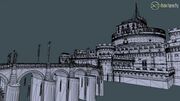 An untextured 3D model of the Castel Sant'Angelo
 -
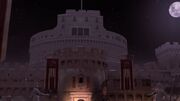 The front of the Castel
 -
Niccolò and Ezio, with the Castel in the background


References
| |||||||||||||||||||||||||||||||||||||