Database: Oasis Irrigation and Flora: Difference between revisions
mNo edit summary |
mNo edit summary |
||
| Line 1: | Line 1: | ||
[[File:ACMir VoM DB - Oasis Irrigation and Flora.webp|right|250px]] | [[File:ACMir VoM DB - Oasis Irrigation and Flora.webp|right|250px]] | ||
A high water table and fertile soil enabled the development of cultivated oases in the [[Al-Ula Valley|AlUla Valley]], and the [[Hegra]] plain just to the north, for millennia. While the rains were unpredictable, the available ground water was tapped and effectively managed. The AlUla Oasis combined open fields and horticultural gardens enclosed by mudbrick walls and elevated walkways. In the open fields, [[wheat]] and {{Wiki|barley}} were grown in winter. The harvest season for {{Wiki|date palm}}s, which were grown in [[Plantation|groves]], was late summer/early autumn. In [[Nabataean Kingdom|Nabatean times]], when agriculture in the Hegra plain was developed, even {{Wiki|cotton}} could be cultivated. In [[Islam]]ic times, a variety of citrus fruits were introduced to the crop repertoire. A rich array of produce cultivated within the oasis itself could be offered on the local markets. A three-tiered approach to farming was the most sustainable, with the palms providing shade for the fruit trees below and the ground crops beneath them. In summer, the inhabitants of the [[Al-Ula|Old Town]] relocated to family farms at the oasis, which was cooler. | A high water table and fertile soil enabled the development of cultivated oases in the [[Al-Ula Valley|AlUla Valley]], and the [[Hegra]] plain just to the north, for millennia. While the rains were unpredictable, the available ground water was tapped and effectively managed. The AlUla Oasis combined open fields and horticultural gardens enclosed by mudbrick walls and elevated walkways. In the open fields, [[wheat]] and {{Wiki|barley}} were grown in winter. The harvest season for {{Wiki|date palm}}s, which were grown in [[Plantation|groves]], was late summer/early autumn. In [[Nabataean Kingdom|Nabatean times]], when agriculture in the Hegra plain was developed, even {{Wiki|cotton}} could be cultivated. In [[Islam]]ic times, a variety of citrus fruits were introduced to the crop repertoire. A rich array of produce cultivated within the oasis itself could be offered on the local markets. A three-tiered approach to farming was the most sustainable, with the palms providing shade for the fruit trees below and the ground crops beneath them. In summer, the inhabitants of the [[Al-Ula|Old Town]] relocated to family farms at the oasis, which was cooler. | ||
==Gallery== | |||
<gallery captionalign="center" position="center" widths="180"> | |||
DTA Farming the Oasis 1.png|Pomegranate trees cultivated beneath the date palms on a farm in the AlUla oasis. Palm trees, depicted in the blue and white bowl, provided shade for shorter trees and crops. | |||
DTA Farming the Oasis 2.png|Pomegranate trees cultivated beneath the date palms on a farm in the AlUla oasis. Palm trees, depicted in the blue and white bowl, provided shade for shorter trees and crops. | |||
</gallery> | |||
[[Category:Database: AlUla]] | [[Category:Database: AlUla]] | ||
[[Category:Database: Life in the Oasis]] | [[Category:Database: Life in the Oasis]] | ||
{{DEFAULTSORT:Oasis Irrigation and Flora}} | {{DEFAULTSORT:Oasis Irrigation and Flora}} | ||
Revision as of 19:04, 19 September 2026

A high water table and fertile soil enabled the development of cultivated oases in the AlUla Valley, and the Hegra plain just to the north, for millennia. While the rains were unpredictable, the available ground water was tapped and effectively managed. The AlUla Oasis combined open fields and horticultural gardens enclosed by mudbrick walls and elevated walkways. In the open fields, wheat and barley were grown in winter. The harvest season for date palms, which were grown in groves, was late summer/early autumn. In Nabatean times, when agriculture in the Hegra plain was developed, even cotton could be cultivated. In Islamic times, a variety of citrus fruits were introduced to the crop repertoire. A rich array of produce cultivated within the oasis itself could be offered on the local markets. A three-tiered approach to farming was the most sustainable, with the palms providing shade for the fruit trees below and the ground crops beneath them. In summer, the inhabitants of the Old Town relocated to family farms at the oasis, which was cooler.
Gallery
-
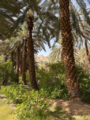 Pomegranate trees cultivated beneath the date palms on a farm in the AlUla oasis. Palm trees, depicted in the blue and white bowl, provided shade for shorter trees and crops.
 -
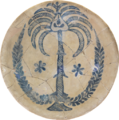 Pomegranate trees cultivated beneath the date palms on a farm in the AlUla oasis. Palm trees, depicted in the blue and white bowl, provided shade for shorter trees and crops.

