

Ponte Vecchio: Difference between revisions
m Text replacement - "<!--<!--" to "<!--" |
m Text replacement - " " to " " |
||
| Line 16: | Line 16: | ||
Two previous incarnations of the bridge were swept away in floods before the present structure was built in 1345, with a tower being constructed at the southeast corner to defend it. Consisting of three segmental arches, the bridge had shops lining the central passageway, which was a common feature during the Renaissance.<ref name="Database" /><ref name="ACID" /> | Two previous incarnations of the bridge were swept away in floods before the present structure was built in 1345, with a tower being constructed at the southeast corner to defend it. Consisting of three segmental arches, the bridge had shops lining the central passageway, which was a common feature during the Renaissance.<ref name="Database" /><ref name="ACID" /> | ||
When | When the [[House of Medici|Medici family]] bought the [[Palazzo Pitti]] in 1549, the interior of the bridge's upper levels was redesigned. The new plans included a {{Wiki|Vasari corridor|secret walkway}} crossing the bridge, serving as a link in a series of tunnels built by the Medici so they could travel from the Palazzo Pitti to the [[Palazzo della Signoria]] undetected.<ref>''Assassin's Creed II'' – [[Database: Oltrarno District]]</ref> | ||
===Auditore-Pazzi confrontation=== | ===Auditore-Pazzi confrontation=== | ||
Revision as of 23:49, 9 July 2026
The Ponte Vecchio (English: Old Bridge) is a famous bridge in Florence, spanning the Arno river.
History
Construction
This famous bridge spans the Arno at its narrowest point. The original version was presumably constructed by the Romans, but records of its existence did not appear until 996.[1][2]
Two previous incarnations of the bridge were swept away in floods before the present structure was built in 1345, with a tower being constructed at the southeast corner to defend it. Consisting of three segmental arches, the bridge had shops lining the central passageway, which was a common feature during the Renaissance.[1][2]
When the Medici family bought the Palazzo Pitti in 1549, the interior of the bridge's upper levels was redesigned. The new plans included a secret walkway crossing the bridge, serving as a link in a series of tunnels built by the Medici so they could travel from the Palazzo Pitti to the Palazzo della Signoria undetected.[3]
Auditore-Pazzi confrontation
.png)
On 26 December 1476, the bridge was the site of a large street fight between the friends of Ezio Auditore da Firenze, and of Vieri de' Pazzi, who had recently developed a strong rivalry over the issues involving their fathers.[4]
Two years later, Ezio met with the ruler of Florence, Lorenzo de' Medici, on the bridge to discuss the Pazzi conspiracy.[5]
Bonfire of the Vanities
In 1497, the bridge was blockaded by the Condottiero, one of the lieutenants of Girolamo Savonarola, who demanded payment for passage. However, the Condottiero was later killed by the Assassin Ezio Auditore.[6]
Trivia
- In Assassin's Creed: Identity, the Ponte Vecchio can be seen in Florence, though it can't be visited.
Gallery
-
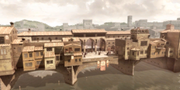 Database image of Ponte Vecchio in Assassin's Creed II
 -
 Database image of Ponte Vecchio in Assassin's Creed: Identity
 -
 Ezio assassinating the condottiero on the Ponte Vecchio
 -


Appearances
- Assassin's Creed II (first appearance)
- Assassin's Creed: Identity
References
- ↑ 1.0 1.1 Assassin's Creed II – Database: Ponte Vecchio
- ↑ 2.0 2.1 Assassin's Creed: Identity – Database: Ponte Vecchio
- ↑ Assassin's Creed II – Database: Oltrarno District
- ↑ Assassin's Creed II – Boys Will Be Boys
- ↑ Assassin's Creed II – Four to the Floor
- ↑ Assassin's Creed II – Bonfire of the Vanities – Arch Nemesis