


Bartolomeo d'Alviano: Difference between revisions
imported>Page-Mistress No edit summary |
|||
| Line 86: | Line 86: | ||
===Later life=== | ===Later life=== | ||
Later, Bartolomeo conquered and sacked Pordenone, which in the meantime had fallen again to the | Later, Bartolomeo conquered and sacked Pordenone, which in the meantime had fallen again to the Holy Roman Emperor. He was subsequently a protagonist of the French victory at Marignano (September 1515), in which he attacked the hired Swiss mercenaries with a corps of only 300 knights. | ||
Later, he also managed to conquer Bergamo, but died in October of the same year while besieging Ghedi | Later, he also managed to conquer Bergamo, but died in October of the same year while besieging Ghedi. Venice welcomed his body home with a grand ceremony, and he was buried in the church of [[Santo Stefano]] in Venice. | ||
==Personality== | ==Personality== | ||
Revision as of 20:29, 26 September 2011
- "You think that commanding an army grants you nobility? Nobility comes from fighting besides your soldiers, not kidnapping a woman to cheat your way out of battle."
- ―Bartolomeo to Octavian de Valois[src]
Bartolomeo d'Alviano (1455 – 1515) was an Assassin and an Italian condottiero (mercenary leader).
Biography
Early life
Bartolomeo was born in the town of Alviano, and was the son of Francesco d'Alviano and Isabella degli Atti. He was also the cousin of Fabio Orsini [1][2], and Niccolò di Pitigliano.
Bartolomeo somehow found his way into the Assassin Order and based himself in the Castello district of Venice.[1]
Retaking the Castello district
By 1486, the Templar Silvio Barbarigo had taken control over the Castello district, and had captured most of Bartolomeo's men, including Bartolomeo himself. Luckily for him, Ezio Auditore, the son of the late Assassin Giovanni Auditore, came to his rescue and the two fought their way back to Bartolomeo's headquarters.[1]
After Bartolomeo found his precious sword "Bianca," he asked Ezio to rescue some of his men who had been captured by Silvio's thugs. Ezio successfully rescued each of the mercenaries and, upon returning to Bartolomeo, was instructed to position some of the men throughout the district, in order to stir up enough trouble to regain the territory they had lost.[1]
Ezio aided the mercenaries by killing the guards of the district to allow them to take their place. Upon posting the last of the men, he climbed to the pinnacle height of a tower, and launched a firework to signal the men to begin their attack.[1]
From the tower, Ezio caught sight of Bartolomeo engaged in battle against Dante Moro and a number of other guards, and rushed to aid him. As the Assassins successfully killed most of his men, Dante abandoned the battle and fled to l'Arsenale.[1]
They followed, and though Ezio was about to defeat Dante, he was able to slip away into the shipping port. Bartolomeo called for Ezio to follow the fleeing man, as he would likely lead him straight to Silvio. Sure enough, as Silvio and Dante fled for their ship, they were both caught and assassinated by Ezio.[1]
Afterwards, Bartolomeo thanked and congratulated Ezio on liberating the Castello district from Silvio's oppression, and the two parted ways.[1]
Acquiring the Apple of Eden
Two years later, Bartolomeo joined with several other Assassins to acquire the "Apple of Eden" from Rodrigo Borgia, the Grand Master of the Templars. However, when they reached Rodrigo's location, they found Ezio already fighting Rodrigo and his guards.[1]
Bartolomeo and the others hurried to his side, and after killing all the guards and severely wounding Rodrigo, the group all revealed themselves to be Assassins, a fact, previously unknown by Ezio. They then inducted Ezio into the Order atop a tall tower.[1]
Battle against Pope Alexander VI
In 1496, Bartolomeo joined the Orsini in a battle against the Borgia, who were attempting to seize Orsini territory.[1]
Bartolomeo's resources were cut down to three fortresses by the Borgia, but Bartolomeo's fighting spirit kept him going. Cesare Borgia completely cut off his supplies when he thought victory was near, but Carlo Orsini arrived just in time to support Bartolomeo, even wounding Cesare in the face.[1]
Fighting the French
- "Cesare persuaded King Louis to lend him an entire army to defeat me. I'm flattered."
- ―Bartolomeo, regarding his fight with the French, 1503.
In 1500, Bartolomeo and his new wife, Pantasilea Baglioni, moved to Rome, and used the Caserma di Alviano as their barracks. Alongside the other Assassins, Bartolomeo sought to liberate the city from the Borgia and Templar rule, and thus focused his mercenaries on the French army led by Baron Octavian de Valois.[2]
However, Bartolomeo soon found himself being attacked on two fronts; Borgia on one side, French on the other. That same year, Bartolomeo met again with Ezio Auditore, who helped Bartolomeo liberate the region surrounding his base from Borgia control. In exchange, Ezio requested that Bartolomeo find the whereabouts of Rodrigo and Cesare Borgia.[2]
After having done so, Bartolomeo met with the others at Tiber Island to discuss their war plans.[2]
Three years later, Bartolomeo was still at war with the Baron de Valois. When Ezio met with Bartolomeo again to discuss plans to take out the French commander, their conversation was cut short by a mercenary, who alerted Bartolomeo to a surprise assault by the French troops.[2]
Fighting alongside Ezio and his mercenaries, Bartolomeo successfully defended the barracks from the attack, after which they regrouped at the main gate. From there, they found the Baron signaling for their attention from the field.[2]
Octavian called out to request Bartolomeo's surrender in exchange for his wife, whom he had kidnapped. Enraged, Bartolomeo shouted insults to the commander, and eventually tore after him on horseback as the French army withdrew.[2]
As he and Ezio arrived at the French camp, the Castra Praetoria, they concluded that it was impenetrable. Distraught, Bartolomeo resignedly decided to surrender, and enter the enemy base bearing gifts, out of hope that they would spare his wife.[2]
However, Ezio came up with an alternative, and upon returning to the barracks, he suggested that they disguise Bartolomeo's mercenaries as French soldiers, and have them pretend to deliver a captured Bartolomeo.[2]
After Bartolomeo offered his enthusiastic approval, Ezio retrieved some suits of armor from several French guards. Upon regrouping with the other, Ezio, disguised as a French captain, cleared the way for the disguised battalion all the way to the French camp, which they entered with ease.[2]
As they faced Octavian, Bartolomeo started to openly threaten him, demanding that Pantasilea be released. However, the Baron only remarked that "savages never learn", and raised his firearm to kill Pantasilea.[2]
Acting swiftly, Ezio fired his hidden gun as a sign to Bartolomeo's mercenaries, breaking their cover and causing confusion among the French guards. In the skirmish that followed, Octavian fled deeper into the camp with Pantasilea in tow. Ezio followed and assassinated him, freeing Pantasilea.[2]
As Bartolomeo hugged his wife, she thanked him, calling him her prince. Afterwards, they and the mercenaries returned to the barracks.[2]
Later that year, Bartolomeo met with the other Assassins to fight the remnants of Cesare Borgia's followers at the gates of Rome. After the last supporters were killed, they witnessed Cesare being arrested by Bartolomeo's cousin, Fabio Orsini, and later returned to their respective bases.[2]
Under Ferdinand II and Nicolò Orsini
In 1503, hired by Ferdinand II of Spain, Bartolomeo became the determinant in the victory at the Battle of Garigliano against the French army, which started the Spanish domination over southern Italy.
In 1507, together with Nicolò Orsini, Bartolomeo was rehired by the Republic of Venice. The following year, he defeated the Imperial Army of Maximilian I, Holy Roman Emperor in Cadore, at Mauria and Pontebba, conquering Gorizia and Trieste. In the same year, Pordenone also fell, and the Serenissima assigned its seignory to Bartolomeo himself.
Battle of Agnadello

In 1509, Bartolomeo fought in the Battle of Agnadello. He allegedly attacked the enemy without the authorization of the Orsini, the commander-in-chief at the time. He was greatly wounded as a result, but managed to recover and rally his troops. He won the hearts of the citizens of Agnadello, and they in turn helped Bartolomeo and his men in gathering resources.[3]
However, despite a valiant battle, Bartolomeo was still captured by the French, and Louis XII placed him in jail. In 1513, after the alliance between France and Venice against the Duchy of Milan, he was freed and later fought under the French commander Louis de la Trémoille. He was defeated at Vicenza by the Spanish viceroy of Naples, Ramón de Cardona.[3]
Later life
Later, Bartolomeo conquered and sacked Pordenone, which in the meantime had fallen again to the Holy Roman Emperor. He was subsequently a protagonist of the French victory at Marignano (September 1515), in which he attacked the hired Swiss mercenaries with a corps of only 300 knights.
Later, he also managed to conquer Bergamo, but died in October of the same year while besieging Ghedi. Venice welcomed his body home with a grand ceremony, and he was buried in the church of Santo Stefano in Venice.
Personality
- "He has such an aggressive view of the world."
- ―Pantasilea regarding Bartolomeo's personality.[src]
Bartolomeo had an aggressive personality, often disregarding strategy in favor of brute strength. This was clearly shown when Ezio Auditore rescued him in Venice, as he would often remark that Ezio's tactic of avoiding combat was not manly.
He, like Mario Auditore, preferred open combat, rather than the Assassin's tactic of "sneaking and stabbing." He was a proud man, as was made evident when he told Ezio that he was coping well against the French assault, when in truth, he was fighting a losing war.
Bartolomeo also believed in fair fight. When Ezio was escorting him and the Mercenaries to the French camp, he admitted that he did not like the idea of tricking the Baron da Valoi into defeat with the costumes. He also repeated the words of Ezio's father, Giovanni as a further proof that he truly thought that men will no longer be traitorus to one another.
Though a skilled warrior, Bartolomeo was not educated, as when Ezio suggested renovating the barracks, he said "I'm no good with these things. You are the educated one, you approve the plans." Bartolomeo held honor in highest regard, and was very upset when the Baron de Valois chose the tactic of taking his wife hostage, in an attempt to secure victory.
Fighting style
- Octavian: "As amusing as this parley has been, I'd like your unconditional surrender before sunrise."
- Bartolomeo: "Hah! My lady Bianca will whisper it in your ear!"
- —Bartolomeo to Octavian after fending off a French attack.[src]
Bartolomeo was a versatile fighter, able to attack with a long sword as well a heavy weapon, although he preferred the latter. When Ezio saved him from the Castello district, Bartolomeo proved his adaptability in fighting by using any weapon he could find, including a broom.
His favorite weapon was a heavy sword that he fondly called "Bianca," which greatly resembled a Scottish Claymore. It has been hinted that he also used an axe in combat, as when Ezio completed all the Mercenary guild quests, he received a weapon called Bartolomeo's Axe, which was almost identical to the Labrys.
Trivia
- In Assassin's Creed: Brotherhood, Bartolomeo's sword Bianca has changed in appearance slightly, having a gold guard and also missing an emblem.
- Bianca is also an exclusive item for Assassin's Creed: Project Legacy, which is unlockable for 15 Uplay points, that gives a higher chance of winning a Skirmish.
- It has been stated in an interview that you can acquire Bartolomeo's sword by completing a mission for the mercenaries in Assassin's Creed: Brotherhood. However, this statement is inaccurate, as you instead receive an axe named "Bartolomeo's Axe." His sword, Bianca, is actually just a standard Bastard Sword that can be bought from blacksmiths or taken from Brutes.
- In the battle where Ezio fights alongside Bartolomeo, Claudia Auditore, Niccolò Machiavelli and La Volpe against Cesare and his men, Bartolomeo can be "killed," though he will only appear knocked out, as if he lost in a fist fight.
- Bartolomeo's memories are relived in the first chapter of the Italian Wars sequence in Assassin's Creed: Project Legacy.
Gallery
-
 Bartolomeo preparing to fight Silvio Barbarigo's men.
 -
Bartolomeo in the Caserma di Alviano.
-
Bartolomeo with Claudia Auditore and La Volpe, waiting for Ezio Auditore.
-
Bartolomeo "captured" by his own men and Ezio Auditore in disguises.
-
Bartolomeo and La Volpe with the Brotherhood.
-
Bartolomeo and several Apprentices.
-
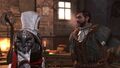 Bartolomeo talking with Ezio.
 -
Bartolomeo and the other Assassins standing against Cesare.


References
| |||||||||||||||||||||||||||||||||||||