


Train: Difference between revisions
imported>Crookandcharlatan No edit summary |
imported>Misphantom |
||
| Line 26: | Line 26: | ||
ACS King's Cross Train Station - Concept Art.jpg|Concept art of the King's Cross Train Station during the [[Industrial Revolution]] | ACS King's Cross Train Station - Concept Art.jpg|Concept art of the King's Cross Train Station during the [[Industrial Revolution]] | ||
ACS Trapped on a Train - Concept Art.jpg|Concept art of an Assassin locked in combat on a train | ACS Trapped on a Train - Concept Art.jpg|Concept art of an Assassin locked in combat on a train | ||
ACS Trains - Industrial Line Exploration Sketches.jpg|Concept art of a train | |||
ACS Train Hideout Locomotive 1 - Concept Art.jpg|Concept art of the Train Hideout | ACS Train Hideout Locomotive 1 - Concept Art.jpg|Concept art of the Train Hideout | ||
ACS Train Hideout Locomotive 2 - Concept Art.jpg|Concept art of the Train Hideout | ACS Train Hideout Locomotive 2 - Concept Art.jpg|Concept art of the Train Hideout | ||
Revision as of 14:33, 15 December 2015


Trains are carriages designed to move on rails, used for transporting cargo or passengers.
History
During the 19th century, London trains provided routes for Edinburgh, Liverpool, Oxford, Cambridge, Brighton and Dover. Open-topped carriages were available for the poor. In 1834, English and Scottish rail lines merged, allowing people to travel faster between the two places.[1]
The first rail factory was owned by the Starrick family and inherited by their youngest son Crawford, who used it to expand his Templar influence and business throughout London. Sometime in mid-19th century, Starrick impounded a Herwicke Steam Engine which was owned by Agnes MacBean and nicknamed "Bertha". He then placed the train and MacBean under his Templar accomplice Rexford Kaylock. Kaylock, as the Whitechapel Blighters gang leader, equipped the train for their operations.[2]
The American transgender, Ned Wynert, and his group of thieves used London's transit systems as cover for their criminal activities. Ned was able to rob many shipments coming into the city of their valuables.[2]
By 1868, the Assassin siblings Jacob and Evie Frye destroyed the Whitechapel Blighters with their new syndicate, the Rooks. With MacBean's permission, the twins made the locomotive their mobile hideout. Together with the Assassin Henry Green, "Bertha" was used to plan and track all known active London Templars by the Fryes, who also took a carriage for themselves as a place for them to live while in the city. Much later, they gained the aid of Nigel Bumble, who worked under MacBean in fixing and repairing the train.[2]
With Ned Wynert's assistance, the Rooks would also rob trains carrying money to fund their operations. Jacob Frye also had to visit trains and stations to assassinate Templars and destroy Blighters shipments.[2]
Trivia
- In Assassin's Creed: Syndicate, there is a red locomotive seen hauling passenger trains around London named "The Great Eagle" with the number 1191, referencing the sobriquet of Altaïr Ibn-La'Ahad and the year Assassin's Creed took place, respectively. Additionally, there is a black tank locomotive with the number 1476 on the front of its smokebox, referencing the year Ezio Auditore da Firenze began his quest to avenge the deaths of his father and brothers.
- "The Red Eagle" is based on the Duke class of locomotives from the Great Western Railway, though painted in the red livery of the Midland Railway and lettered for the London, Brighton & South Coast Railway. The black tank engine is based on a LB&SCR A1x Terrier class locomotive, though painted in British Railways' lined black livery, complete with smokebox number plate, and lettered for the South Eastern Railway.
- Both locomotive designs present in Syndicate are historically inaccurate. The A1x class tank engines in their original form, as the A1 class, were only introduced in the 1870s, while the Duke class started being built in the 1890s. Additionally, the black livery of the A1x was not used until the late 1940s.
Gallery
-
 An Isu symbol of a steam locomotive
 -
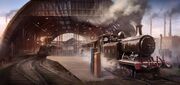 Concept art of the King's Cross Train Station during the Industrial Revolution
 -
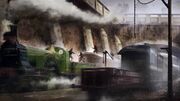 Concept art of an Assassin locked in combat on a train
 -
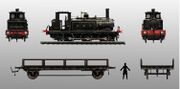 Concept art of a train
 -
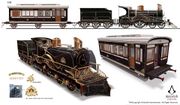 Concept art of the Train Hideout
 -
 Concept art of the Train Hideout
 -
 Concept art of the Train Hideout


