

Arsenale di Venezia: Difference between revisions
imported>Kaloneous m updating gallery |
imported>GuardDog minor edits |
||
| Line 8: | Line 8: | ||
|dateconstructed = Rebuilt in 1320 C.E. | |dateconstructed = Rebuilt in 1320 C.E. | ||
|functions = Naval depot and construction yard. | |functions = Naval depot and construction yard. | ||
|features = [[Secret Location|Templar Lair]]<br>[[View Points| | |features = [[Secret Location|Templar Lair]]<br>[[View Points|View Point]] | ||
|appearance = ''[[Assassin's Creed II]]'' | |appearance = ''[[Assassin's Creed II]]'' | ||
|events = | |events = | ||
|commissioner = }} | |commissioner = }} | ||
The '''Arsenale di Venezia''' (English: ''Arsenal of Venice'') was a shipyard in the north-east corner of [[Venice]]. Throughout its history, it served as a base of operations for the [[Templars| | The '''Arsenale di Venezia''' (English: ''Arsenal of Venice'') was a shipyard in the north-east corner of [[Venice]]. | ||
Throughout its history, it served as a base of operations for the [[Templars|Templar Order]], with the 1320 renovation of the shipyard paid for by Templar funds. As such, the facility was treated by the [[Assassins]] as a [[Secret Locations|Templar lair]]. | |||
==History== | ==History== | ||
===Conception=== | ===Conception=== | ||
First built as a naval depot for private ships, the Arsenal was rebuilt and enlarged in 1320. From that point on, it was used by the Venetian state to construct and maintain its ships. Famously, at the peak of production, shipbuilders were able to produce an entire ship in a day. The impressive front gate (the Porta Magna) went up in 1460, in the classical | First built as a naval depot for private ships, the Arsenal was rebuilt and enlarged in 1320. From that point on, it was used by the Venetian state to construct and maintain its ships. | ||
Famously, at the peak of production, shipbuilders at the Arsenal were able to produce an entire ship in a day. The impressive front gate (the Porta Magna) went up in 1460, in the classical Revivalist style. | |||
===Templar vessels=== | ===Templar vessels=== | ||
In 1486, | In 1486, the Arsenal served as the point of departure for the Templar vessel destined to collect the [[Ezio's Apple of Eden|Apple of Eden]] from [[Cyprus]], and also as the point of arrival for the aforementioned vessel two years later. | ||
==Gallery== | ==Gallery== | ||
<gallery captionalign="left"> | <gallery captionalign="left"> | ||
assassins-creed-ii-20090923115324881_640w.jpg|Concept art | Venice Arsenal concept art by Gilles Beloeil.png|Concept of the Arsenal. | ||
Ezio freerun.jpg| | assassins-creed-ii-20090923115324881_640w.jpg|Concept art of the shipyard interior. | ||
Ezio freerun.jpg|The interior of the shipyard. | |||
</gallery> | </gallery> | ||
Revision as of 08:02, 25 August 2012
The Arsenale di Venezia (English: Arsenal of Venice) was a shipyard in the north-east corner of Venice.
Throughout its history, it served as a base of operations for the Templar Order, with the 1320 renovation of the shipyard paid for by Templar funds. As such, the facility was treated by the Assassins as a Templar lair.
History
Conception
First built as a naval depot for private ships, the Arsenal was rebuilt and enlarged in 1320. From that point on, it was used by the Venetian state to construct and maintain its ships.
Famously, at the peak of production, shipbuilders at the Arsenal were able to produce an entire ship in a day. The impressive front gate (the Porta Magna) went up in 1460, in the classical Revivalist style.
Templar vessels
In 1486, the Arsenal served as the point of departure for the Templar vessel destined to collect the Apple of Eden from Cyprus, and also as the point of arrival for the aforementioned vessel two years later.
Gallery
-
 Concept of the Arsenal.
 -
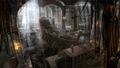 Concept art of the shipyard interior.
 -
The interior of the shipyard.


Source