

Samuel Adams: Difference between revisions
imported>Kainzorus Prime Let's dispose of this shooped glamour crap and put in actual in-game images. |
imported>Terimas No edit summary |
||
| Line 13: | Line 13: | ||
==Biography== | ==Biography== | ||
===Early life=== | |||
Samuel was born in [[Boston]] in the year 1722 to Samuel Adams, Sr., and Mary Adams. He attended Harvard, graduating in 1740 and continued his studies, earning a master's degree in 1743. Adams was elected to the Massachusetts Legislature in 1765, which was the beginning of his political career. | |||
As a politician in colonial [[Massachusetts]], Samuel was a leader of the movement that became the [[American Revolutionary War|American Revolution]]. He was also one of the architects of the principles of American republicanism, which shaped the political culture of the United States. | As a politician in colonial [[Massachusetts]], Samuel was a leader of the movement that became the [[American Revolutionary War|American Revolution]]. He was also one of the architects of the principles of American republicanism, which shaped the political culture of the United States. | ||
===Boston Massacre=== | ===Boston Massacre=== | ||
During the American Revolutionary War, Samuel met and became a trusted associate of the [[Assassins|Assassin]] [[Ratonhnhaké:ton]], known as Connor, after [[Achilles Davenport]] told Connor to find him on his first trip to [[Boston]], just after the recent massacre. Amongst other things, Samuel taught Connor how to reduce his notoriety, waving away the man's worries by explaining propaganda, and also introduced him to the Mason tunnels underneath Boston, before chartering Connor a ship back to the [[Davenport Homestead]]. | {{Quote|Over here! You're Achilles' boy. Connor, was it? I saw what happened at the Town House. A fine mess, that.|Samuel Adams to Connor after the massacre.|Assassin's Creed III}} | ||
During the American Revolutionary War, Samuel met and became a trusted associate of the [[Assassins|Assassin]] [[Ratonhnhaké:ton]], known as Connor, after [[Achilles Davenport]] told Connor to find him on his first trip to [[Boston]], just after the recent massacre. Amongst other things, Samuel taught Connor how to reduce his notoriety, waving away the man's worries by explaining propaganda, and also introduced him to the Mason tunnels underneath Boston, before chartering Connor a ship back to the [[Davenport Homestead]]. | |||
===Boston Tea Party=== | ===Boston Tea Party=== | ||
| Line 24: | Line 28: | ||
Upon meeting with the exasperated Assassin, Adams explained their plan; by destroying the newly arrived tea shipment, he'd be depriving Johnson of the means to purchase his people's land while the Sons of Liberty would be sending a message to [[United Kingdom|England]]. Together, Adams, along with Connor, [[Stephane Chapheau]], [[Paul Revere]] and [[William Molineux]] staged the [[Boston Tea Party]], in which they dumped the cargo of tea crates into the water. | Upon meeting with the exasperated Assassin, Adams explained their plan; by destroying the newly arrived tea shipment, he'd be depriving Johnson of the means to purchase his people's land while the Sons of Liberty would be sending a message to [[United Kingdom|England]]. Together, Adams, along with Connor, [[Stephane Chapheau]], [[Paul Revere]] and [[William Molineux]] staged the [[Boston Tea Party]], in which they dumped the cargo of tea crates into the water. | ||
=== | ===Igniting the Revolution=== | ||
{{Quote|Connor, allow me to introduce you to our newly appointed Commander-in-Chief, George Washington.|Samuel Adams introducing Connor to George Washington.|Assassin's Creed III}} | |||
Some time later, both Adams and Connor attended the induction of [[George Washington]] as Commander-in-Chief of the [[Continental Army]]. While there, Connor nearly caused a scene with [[Charles Lee]], who was passed up for the Commander-in-Chief position, before Adams restrained him and distracted the Assassin by formally introducing him to Washington. As Washington excused himself to attend to Lee, Connor asked Adams if he had news of [[Jonathan Pitcairn]], who was planning on destroying Patriot weapons and supplies so that they would have no means to continue their revolution. | Some time later, both Adams and Connor attended the induction of [[George Washington]] as Commander-in-Chief of the [[Continental Army]]. While there, Connor nearly caused a scene with [[Charles Lee]], who was passed up for the Commander-in-Chief position, before Adams restrained him and distracted the Assassin by formally introducing him to Washington. As Washington excused himself to attend to Lee, Connor asked Adams if he had news of [[Jonathan Pitcairn]], who was planning on destroying Patriot weapons and supplies so that they would have no means to continue their revolution. | ||
Revision as of 05:58, 16 March 2013

|
Ezio, my friend! How may I be of service? This article is in desperate need of a revamp. Please improve it in any way necessary in order for it to achieve a higher standard of quality in accordance with our Manual of Style. |
Samuel Adams (1722 – 1803) was an American statesman, political philosopher, and one of the Founding Fathers of the United States. He was also a member of the Sons of Liberty.
Biography
Early life
Samuel was born in Boston in the year 1722 to Samuel Adams, Sr., and Mary Adams. He attended Harvard, graduating in 1740 and continued his studies, earning a master's degree in 1743. Adams was elected to the Massachusetts Legislature in 1765, which was the beginning of his political career.
As a politician in colonial Massachusetts, Samuel was a leader of the movement that became the American Revolution. He was also one of the architects of the principles of American republicanism, which shaped the political culture of the United States.
Boston Massacre
- "Over here! You're Achilles' boy. Connor, was it? I saw what happened at the Town House. A fine mess, that."
- ―Samuel Adams to Connor after the massacre.[src]
During the American Revolutionary War, Samuel met and became a trusted associate of the Assassin Ratonhnhaké:ton, known as Connor, after Achilles Davenport told Connor to find him on his first trip to Boston, just after the recent massacre. Amongst other things, Samuel taught Connor how to reduce his notoriety, waving away the man's worries by explaining propaganda, and also introduced him to the Mason tunnels underneath Boston, before chartering Connor a ship back to the Davenport Homestead.
Boston Tea Party
- "First, we make our way to Nathaniel Bradlee's house to fetch the rest of our little group. Then it's on to Griffin's Wharf, where we board the ships and dump the tea. Simple as that."
- ―Samuel Adams explaining his plan to Connor.[src]
Later that year, Connor returned to Boston to request Adams' aid in stopping William Johnson, a Templar, from purchasing the land his people lived on. However, he became sidetracked by a number of incidents relating to British oppression.
Upon meeting with the exasperated Assassin, Adams explained their plan; by destroying the newly arrived tea shipment, he'd be depriving Johnson of the means to purchase his people's land while the Sons of Liberty would be sending a message to England. Together, Adams, along with Connor, Stephane Chapheau, Paul Revere and William Molineux staged the Boston Tea Party, in which they dumped the cargo of tea crates into the water.
Igniting the Revolution
- "Connor, allow me to introduce you to our newly appointed Commander-in-Chief, George Washington."
- ―Samuel Adams introducing Connor to George Washington.[src]
Some time later, both Adams and Connor attended the induction of George Washington as Commander-in-Chief of the Continental Army. While there, Connor nearly caused a scene with Charles Lee, who was passed up for the Commander-in-Chief position, before Adams restrained him and distracted the Assassin by formally introducing him to Washington. As Washington excused himself to attend to Lee, Connor asked Adams if he had news of Jonathan Pitcairn, who was planning on destroying Patriot weapons and supplies so that they would have no means to continue their revolution.
Adams replied that Pitcairn had barricaded himself in Boston with his army, but that the Continental Army was planning a siege to draw him out. Samuel then passed Connor a letter to give to Israel Putnam to secure his aid. Though Connor also wanted to assassinate Lee, Adams said they'd have to wait for another opportunity.
Connor was later present for the signing of the Declaration of Independence, in which Adams, John Hancock and Benjamin Franklin scribed their names to the document.
Gallery
-
 Samuel introducing himself to Connor.
 -
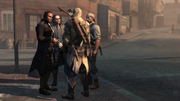 Samuel explaining his plan for the Tea Party.
 -
 Adams, Connor and Charles Lee observing Washington's induction.
 -
 Samuel, Connor, John Hancock and Benjamin Franklin during the signing of Declaration of Independence.


References