


Paganino: Difference between revisions
imported>GuardDog minor edits |
imported>Jasca Ducato m →Trivia: Neither did Vieri |
||
| Line 28: | Line 28: | ||
==Trivia== | ==Trivia== | ||
* In the official artwork for the Siege of Monteriggioni, Paganino appears alongside [[Cesare Borgia]] at Monteriggioni's gate. However, in both the [[Assassin's Creed: Brotherhood|game]] and [[Assassin's Creed: Brotherhood (novel)|novelization]] of ''Assassin's Creed: Brotherhood'', he is not present. | * In the official artwork for the Siege of Monteriggioni, Paganino appears alongside [[Cesare Borgia]] at Monteriggioni's gate. However, in both the [[Assassin's Creed: Brotherhood|game]] and [[Assassin's Creed: Brotherhood (novel)|novelization]] of ''Assassin's Creed: Brotherhood'', he is not present. | ||
* In the ''Brotherhood'' novel, Paganino instead commits suicide with his own dagger. | * In the ''Brotherhood'' novel, Paganino instead commits suicide with his own dagger. | ||
* Paganino's suicide is similar to that of a courier from ''[[Assassin's Creed: Lineage]]''. There, [[Giovanni Auditore da Firenze]] catches a messenger sent by [[Marco Barbarigo]], and threatens him with his hidden blade. However, the messenger only says ''"My life is not yours to take, and my secrets come with me. See you in hell."'' before forcing Giovanni's blade into his throat. | * Paganino's suicide is similar to that of a courier from ''[[Assassin's Creed: Lineage]]''. There, [[Giovanni Auditore da Firenze]] catches a messenger sent by [[Marco Barbarigo]], and threatens him with his hidden blade. However, the messenger only says ''"My life is not yours to take, and my secrets come with me. See you in hell."'' before forcing Giovanni's blade into his throat. | ||
Revision as of 19:24, 6 May 2012
Paganino (unknown - 1503) was a member of both the Venetian Thieves Guild, and the Roman Thieves Guild. He was also a covert Borgia spy.
Biography
Venice
During the late 15th century, Paganino was part of the Venetian Thieves Guild led by Antonio de Magianis. He was a colleague and personal friend of Ugo and Rosa.[1]
In 1481, Paganino and Ugo were confronted by Ezio Auditore da Firenze, who was carrying a wounded Rosa. After the group exchanged words about their Guild, Paganino helped Ezio and Rosa get safely to their headquarters, where Antonio resided.[1]
Siege of Monteriggioni
Years later, Paganino became a spy for the Borgia, and gathered information on the Assassin Order. By January 1500, he had based himself in the Assassin headquarters in Monteriggioni.[2]
In early January 1500, the Borgia attacked Monteriggioni, and Paganino stayed unnoticed in Mario Auditore's study in the Villa Auditore. He ran into Ezio there, and Paganino asked him where the secret passage that Ezio was taking led to. After receiving the information, Paganino left Ezio, claiming that he had to "go help the troops."[3]
Death

After the skirmish at the Colosseo Passion Play in August 1503, Ezio saw Paganino behaving suspiciously in the area, and recognized him from the Villa attack. As he called out to him, however, Paganino fled in panic.[3]
Ezio pursued and tackled him, and found that he was carrying Borgia documents. As the Assassin realized that Paganino was the traitor they had been searching for, and not Niccolò Machiavelli as La Volpe had suspected, Paganino defiantly declared "Long live the Borgia!" before stabbing himself in the neck with Ezio's Hidden Blade.[3]
Trivia
- In the official artwork for the Siege of Monteriggioni, Paganino appears alongside Cesare Borgia at Monteriggioni's gate. However, in both the game and novelization of Assassin's Creed: Brotherhood, he is not present.
- In the Brotherhood novel, Paganino instead commits suicide with his own dagger.
- Paganino's suicide is similar to that of a courier from Assassin's Creed: Lineage. There, Giovanni Auditore da Firenze catches a messenger sent by Marco Barbarigo, and threatens him with his hidden blade. However, the messenger only says "My life is not yours to take, and my secrets come with me. See you in hell." before forcing Giovanni's blade into his throat.
Gallery
-
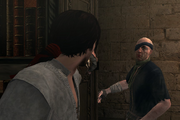 Paganino talking with Ezio.
 -
 Ezio interrogating Paganino.
 -
Paganino threatened by Ezio.


References
| |||||||||||||||||||||||||||||||||||||