

Marble: Difference between revisions
imported>Sol Pacificus Sorry, I meant "5th century BCE" not 1st. Another thing is there's more than enough images in this article now, but I think they could be better arranged. |
imported>Lady Kyashira mNo edit summary |
||
| Line 15: | Line 15: | ||
Under the reign of the [[Ptolemaic Kingdom|Ptolemies]], marble in [[Egypt]] was appreciated by native Egyptians, Greeks, and [[Rome|Romans]] alike.<ref>''[[Assassin's Creed: Origins]]''</ref> Of special note was the city of [[Cyrene]] in [[Libya]], bedecked in marble.<ref>''[[Assassin's Creed: Origins]]'' – [[Absolute Power]]</ref> | Under the reign of the [[Ptolemaic Kingdom|Ptolemies]], marble in [[Egypt]] was appreciated by native Egyptians, Greeks, and [[Rome|Romans]] alike.<ref>''[[Assassin's Creed: Origins]]''</ref> Of special note was the city of [[Cyrene]] in [[Libya]], bedecked in marble.<ref>''[[Assassin's Creed: Origins]]'' – [[Absolute Power]]</ref> | ||
{{-}} | |||
===Renaissance=== | ===Renaissance=== | ||
[[File:Statues3.png|thumb|left|250px|Monteriggioni statuettes: [[Jupiter]] and [[Minerva]]]] | |||
Marble's value continued well into the [[Italy|Italian]] [[Renaissance]], and within [[Villa Auditore]], a marble staircase ruled the main hall while statues, both from antiquity as well as contemporary, decorated cities like [[Florence]] and Rome.<ref name="ACII">''[[Assassin's Creed II]]''</ref><ref>''[[Assassin's Creed: Brotherhood]]''</ref> Though minor in size, the [[Monteriggioni statuette|statuettes]] featuring various Roman deities, found scattered within the town of [[Monteriggioni]], were made of marble.<ref name="ACII" /> | Marble's value continued well into the [[Italy|Italian]] [[Renaissance]], and within [[Villa Auditore]], a marble staircase ruled the main hall while statues, both from antiquity as well as contemporary, decorated cities like [[Florence]] and Rome.<ref name="ACII">''[[Assassin's Creed II]]''</ref><ref>''[[Assassin's Creed: Brotherhood]]''</ref> Though minor in size, the [[Monteriggioni statuette|statuettes]] featuring various Roman deities, found scattered within the town of [[Monteriggioni]], were made of marble.<ref name="ACII" /> | ||
| Line 25: | Line 26: | ||
[[File:Amritsar.jpg|thumb|250px|Harmandir Sahib]] | [[File:Amritsar.jpg|thumb|250px|Harmandir Sahib]] | ||
Maharaja [[Ranjit Singh]] of the [[Sikh Empire]] had the temple of [[Harmandir Sahib]] decorated with marble and gold leaf, and the temple was afterwards known also as the "Golden Temple".<ref>''[[Assassin's Creed Chronicles: India]]</ref> | Maharaja [[Ranjit Singh]] of the [[Sikh Empire]] had the temple of [[Harmandir Sahib]] decorated with marble and gold leaf, and the temple was afterwards known also as the "Golden Temple".<ref>''[[Assassin's Creed Chronicles: India]]</ref> | ||
{{-}} | |||
==Gallery== | ==Gallery== | ||
Revision as of 03:01, 11 March 2020
Marble is a metamorphic rock, which is commonly used in sculpting and buildings.
History
Ancient Greece

In the 5th century BCE, statues and buildings using marble were a common sight in Greece, and multiple marble quarries existed in the known Greek world. Chief among these was Mt. Pentelikos Marble Quarry in Attika, and its famous, white Pentelic marble was used in the construction of Athens, particularly the Akropolis.[1] Other notable quarries were Naxos' quarry on Marble Bay, the Aliki Quarry on Thasos, and Paros Island's quarry[2]. In addition to these, Andros was regarded by the historian Herodotos as the source of "some of the most expensive marble in the world"[3], and the island of Skyros was regarded famous both for its goats as well as marble quarries.[4]
While most marble produced and used was pale, even white, Tainaros in southern Lakonia was famous for its red and black marble.[5]
From quarries, marble used for statues was brought to workshops, like the Marble Workshop in Athens' so-called Marble Quarter.[1] Some, like the Athenian sculptor Phidias, were considered to be especially good at working with the material.[1]
Hellenistic Egypt
Under the reign of the Ptolemies, marble in Egypt was appreciated by native Egyptians, Greeks, and Romans alike.[6] Of special note was the city of Cyrene in Libya, bedecked in marble.[7]
Renaissance

Marble's value continued well into the Italian Renaissance, and within Villa Auditore, a marble staircase ruled the main hall while statues, both from antiquity as well as contemporary, decorated cities like Florence and Rome.[8][9] Though minor in size, the statuettes featuring various Roman deities, found scattered within the town of Monteriggioni, were made of marble.[8]
The Imperial District within Constantinople was known for its towering marble buildings, including the Hagia Sophia.[10]
Sikh Empire

Maharaja Ranjit Singh of the Sikh Empire had the temple of Harmandir Sahib decorated with marble and gold leaf, and the temple was afterwards known also as the "Golden Temple".[11]
Gallery
-
 Overview of the Fortified Marble Quarry on Paros Island
 -
 A view of the quarry on the Isle of Salamis, Attika
 -
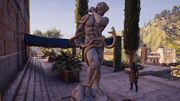 A statue of the god Apollo made of marble in 5th century BCE
 -

-
 The Terrace of the Lions on Delos


Appearances
- Assassin's Creed II
- Assassin's Creed: Brotherhood
- Assassin's Creed: Revelations
- Assassin's Creed: Origins
- Assassin's Creed: Odyssey
References
- ↑ 1.0 1.1 1.2 Assassin's Creed: Odyssey
- ↑ Assassin's Creed: Odyssey – Paros: Paros Harbor
- ↑ Assassin's Creed: Odyssey – Memories Awoken
- ↑ Assassin's Creed: Odyssey – Skyros: Skyros
- ↑ Assassin's Creed: Odyssey – Lakonia: Tainaros
- ↑ Assassin's Creed: Origins
- ↑ Assassin's Creed: Origins – Absolute Power
- ↑ 8.0 8.1 Assassin's Creed II
- ↑ Assassin's Creed: Brotherhood
- ↑ Assassin's Creed: Revelations
- ↑ Assassin's Creed Chronicles: India