


Hiding spot: Difference between revisions
imported>Kainzorus Prime No hud in images. |
imported>Slate Vesper mNo edit summary |
||
| Line 4: | Line 4: | ||
==Third Crusade== | ==Third Crusade== | ||
During the [[Third Crusade]], hiding spots played a significant role for Assassins, since they frequently were their only way to successfully escape from a group of pursuers. Depending on the situation and the surrounding topography, Assassins | During the [[Third Crusade]], hiding spots played a significant role for Assassins, since they frequently were their only way to successfully escape from a group of pursuers. Depending on the situation and the surrounding topography, Assassins had the option to use different kinds of hiding spots.<ref name="AC">''[[Assassin's Creed]]''</ref> | ||
===Benches=== | ===Benches=== | ||
When there were at least two people sitting on | When there were at least two people sitting on a bench, an Assassin could sit between them with their head bowed to hide from pursuers. While an Assassin had a higher risk of being detected while on a bench compared to other hiding spots, this was one of the more common hiding places.<ref name="AC"/> | ||
===Haystacks=== | ===Haystacks=== | ||
Of all hiding spots, haystacks | Of all hiding spots, haystacks offered the most tactical use. Since they could be situated on both rooftops and the ground, they were a versatile hiding place. Moreover, a [[Leap of Faith]] could be performed from a rooftop into a haystack – during a chase sequence, birds that congregated nearby indicated the opportunity for a Leap. Haystacks usually appeared in two different variants, as a pile or in a cart, colored either yellow or green.<ref name="AC"/> | ||
===Rooftop gardens=== | ===Rooftop gardens=== | ||
Rooftop gardens were small booths which were covered with curtains on the inside | Rooftop gardens were small booths which were covered with curtains on the inside – thus, they provided an easy escape for Assassins. They appeared on rooftops ubiquitously throughout the Holy Land, and their appearance differed depending on the city and the district they were situated in; rooftop gardens in poorer districts were usually flat, whereas ones located in wealthier districts were often decorated with ornaments and had a small – sometimes gilded – cupola.<ref name="AC"/> | ||
==Renaissance== | ==Renaissance== | ||
During the [[Renaissance]], hiding spots were similarly important for the Assassins. Although they were able to escape from pursuers by breaking the line of sight and fleeing the area, hiding spots still offered an alternative way to escape. However, guards | During the [[Renaissance]], hiding spots were similarly important for the Assassins. Although they were able to escape from pursuers by breaking the line of sight and fleeing the area, hiding spots still offered an alternative way to escape. However, guards were more suspicious and often searched hiding spots for their targets.<ref name="AC2">''[[Assassin's Creed II]]''</ref><ref name="ACB">''[[Assassin's Creed: Brotherhood]]</ref><ref name="ACR"/>''[[Assassin's Creed: Revelations]]</ref> | ||
===Balconies=== | ===Balconies=== | ||
Balconies were a variant of rooftop gardens which could be found in Constantinople. However, they never appeared on top of a roof and could only be accessed by climbing the conjoined wall | Balconies were a variant of rooftop gardens which could be found in Constantinople. However, they never appeared on top of a roof and could only be accessed by climbing the conjoined wall; they had the advantage of being harder for guards to search.<ref name="ACR"/> | ||
===Carts=== | ===Carts=== | ||
[[File:Hidingspothayflorence.png|thumb|250px|A rose-leaf cart in Florence]] | [[File:Hidingspothayflorence.png|thumb|250px|A rose-leaf cart in Florence]] | ||
Renaissance haystacks maintained the same function as those during the Third Crusade. However, they were rarely found on rooftops, instead being located mainly in carts on the ground. Also, depending on the city, carts were filled with other matter, such as rose leaves in more exalted cities such as [[Florence]] or [[Rome]], or green leaves in more rural areas such as [[San Gimignano]].<ref name="AC2"/><ref name="ACB"/> | |||
In certain locations | In certain locations like [[Constantinople]], [[Castel Gandolfo]] or [[San Donato]], large bushes could be found instead of haystacks. However, the visual nature was the only difference between them.<ref name="ACB"/><ref name="ACR"/> | ||
===Rooftop gardens=== | ===Rooftop gardens=== | ||
Rooftop gardens were still present during the Renaissance and had a similar style in most cities, usually only differing in the color of the curtains. However, Rome, Constantinople and [[Venice]] had rooftop gardens with a unique, | Rooftop gardens were still present during the Renaissance and had a similar style in most cities, usually only differing in the color of the curtains. However, Rome, Constantinople and [[Venice]] had rooftop gardens with a unique, more intricate style, usually decorated with ivy or wine ranks.<ref name="AC2"/><ref name="ACB"/><ref name="ACR"/> | ||
===Tents=== | ===Tents=== | ||
Tents appeared in Constantinople and could be found in both [[Topkapı Palace]] and the [[Janissary]] camp. They worked essentially the same as haystacks except that tents | Tents appeared in Constantinople and could be found in both [[Topkapı Palace]] and the [[Janissary]] camp. They worked essentially the same as haystacks except that tents had two accessable entrances.<ref name="ACR"/> | ||
===Water=== | ===Water=== | ||
Water provided an easy way to escape for Assassins, since they could jump into it from nearly | Water provided an easy way to escape for Assassins, since they could jump into it from nearly any height with no injury and diving in order to break the line of sight with their pursuers. As guards could not swim, it was an easy escape route in any location near to water, especially Venice.<ref name="AC2"/><ref name="ACB"/><ref name="ACR"/><ref name="AC3">''[[Assassin's Creed III]]''</ref> | ||
===Wells=== | ===Wells=== | ||
Wells appeared during the Renaissance everywhere throughout [[Italy]]. They worked similar to haystacks, but Assassins could not perform a Leap of Faith into them. | Wells appeared during the Renaissance everywhere throughout [[Italy]]. They worked similar to haystacks, but Assassins could not perform a Leap of Faith into them. Apart from haystacks, wells were the only places which were always scanned by cautious [[House of Borgia|Borgia]] [[Seekers|Seeker guards]] in Rome, and their visual appearance changed depending on the city they were located in. Although existing in Constantinople too, most of the wells in the city were boarded up with wooden planks; these could only be removed by using certain [[bombs]].<ref name="AC2"/><ref name="ACB"/><ref name="ACR"/> | ||
==American Revolution== | ==American Revolution== | ||
Hiding spots played a smaller part in the cities of [[Boston]] and [[New York City|New York]] as [[Assassin recruits | Hiding spots played a smaller part in the cities of [[Boston]] and [[New York City|New York]] as [[Apprentices|Assassin recruits]] could disguise themselves as [[British Army|British Regulars]], giving [[Ratonhnhaké:ton|Connor]] a mobile hiding spot whenever he wished. Guards also remembered where Connor hid if they investigated him, forcing him out of hiding. However, hiding spots played a large role in hunting, allowing Connor to get very close to animals; this was an advantage because he could assassinate the animal, giving him the best quality of kill and usable goods.<ref name="AC3"/> | ||
===Carts=== | ===Carts=== | ||
[[File:ACIII-Execution 2.png|thumb|250px|left|[[Haytham Kenway]] hiding in a wagon]] | [[File:ACIII-Execution 2.png|thumb|250px|left|[[Haytham Kenway]] hiding in a wagon]] | ||
Carts were once again prominent and functioned as they did in the Renaissance, with the exception of the covered wagon, which could only be entered from the back and was impossible to be used as a landing spot for the Leap of Faith. Connor was forced out of carts if the guards investigated them. | Carts were once again prominent and functioned as they did in the Renaissance, with the exception of the covered wagon, which could only be entered from the back and was impossible to be used as a landing spot for the Leap of Faith. Additionally, Connor was forced out of carts if the guards investigated them.<ref name="AC3"/> | ||
===Moving carts=== | ===Moving carts=== | ||
A variation on the cart, the moving cart | A variation on the cart, the moving cart performed the same role with the exception of being drawn by a [[Horses|horse]]. Furthermore, convoys had special carts that could be looted by entering them.<ref name="AC3"/> | ||
=== | ===Foliage piles=== | ||
Piles of | Piles of foliage from evergreen trees were scattered about the [[Frontier]] and [[Davenport Homestead]]. They could be used for a Leap of Faith in the same manner as a haystack and were often situated under high ridges and branches in the Frontier.<ref name="AC3"/> | ||
=== | ===Stalking zones=== | ||
[[File:ACIII-HuntingLessons_2.png|thumb|250px|Ratonhnhaké:ton hiding among plants while hunting a deer]] | [[File:ACIII-HuntingLessons_2.png|thumb|250px|Ratonhnhaké:ton hiding among plants while hunting a deer]] | ||
Stalking zones existed as tall, thick patches of plants, where Connor could hide and move slowly about in them while crouched, concealing his movements, or run through them to no ill effect. These hiding spots were very effective for use in hunting, as he could hide near the edge of the patch and throw bait to draw animals in for assassination or within bow-shot range. Although rare, stalking zones could also be found in cities, mostly in rural areas.<ref name="AC3"/> | |||
===Wells=== | ===Wells=== | ||
Wells functioned exactly the same way as they did in the Renaissance | Wells functioned exactly the same way as they did in the Renaissance, which allowed Connor to enter and hang onto the edge, ready to spring out when guards passed by.<ref name="AC3"/> | ||
==Gallery== | ==Gallery== | ||
<gallery | <gallery captionalign="center" position="center" spacing="small" widths="180"> | ||
Hidingspotachay.png|A haycart | Hidingspotachay.png|A haycart | ||
Hidingspothayac2.png|A haystack in [[Monteriggioni]] | Hidingspothayac2.png|A haystack in [[Monteriggioni]] | ||
| Line 75: | Line 75: | ||
==References== | ==References== | ||
{{Reflist}} | |||
[[Category:Gameplay]] | [[Category:Gameplay]] | ||
[[Category:Assassin's Creed gameplay]] | [[Category:Assassin's Creed gameplay]] | ||
Revision as of 23:21, 2 July 2013
Hiding spots referred to different types of hiding places which were used by various members of the Assassin Order to escape pursuers after breaking their line of sight or performing an ambush. These hiding places have varied with changes in era, location, and weaponry.
Third Crusade
During the Third Crusade, hiding spots played a significant role for Assassins, since they frequently were their only way to successfully escape from a group of pursuers. Depending on the situation and the surrounding topography, Assassins had the option to use different kinds of hiding spots.[1]
Benches
When there were at least two people sitting on a bench, an Assassin could sit between them with their head bowed to hide from pursuers. While an Assassin had a higher risk of being detected while on a bench compared to other hiding spots, this was one of the more common hiding places.[1]
Haystacks
Of all hiding spots, haystacks offered the most tactical use. Since they could be situated on both rooftops and the ground, they were a versatile hiding place. Moreover, a Leap of Faith could be performed from a rooftop into a haystack – during a chase sequence, birds that congregated nearby indicated the opportunity for a Leap. Haystacks usually appeared in two different variants, as a pile or in a cart, colored either yellow or green.[1]
Rooftop gardens
Rooftop gardens were small booths which were covered with curtains on the inside – thus, they provided an easy escape for Assassins. They appeared on rooftops ubiquitously throughout the Holy Land, and their appearance differed depending on the city and the district they were situated in; rooftop gardens in poorer districts were usually flat, whereas ones located in wealthier districts were often decorated with ornaments and had a small – sometimes gilded – cupola.[1]
Renaissance
During the Renaissance, hiding spots were similarly important for the Assassins. Although they were able to escape from pursuers by breaking the line of sight and fleeing the area, hiding spots still offered an alternative way to escape. However, guards were more suspicious and often searched hiding spots for their targets.[2][3][4]Assassin's Creed: Revelations</ref>
Balconies
Balconies were a variant of rooftop gardens which could be found in Constantinople. However, they never appeared on top of a roof and could only be accessed by climbing the conjoined wall; they had the advantage of being harder for guards to search.[4]
Carts
Renaissance haystacks maintained the same function as those during the Third Crusade. However, they were rarely found on rooftops, instead being located mainly in carts on the ground. Also, depending on the city, carts were filled with other matter, such as rose leaves in more exalted cities such as Florence or Rome, or green leaves in more rural areas such as San Gimignano.[2][3]
In certain locations like Constantinople, Castel Gandolfo or San Donato, large bushes could be found instead of haystacks. However, the visual nature was the only difference between them.[3][4]
Rooftop gardens
Rooftop gardens were still present during the Renaissance and had a similar style in most cities, usually only differing in the color of the curtains. However, Rome, Constantinople and Venice had rooftop gardens with a unique, more intricate style, usually decorated with ivy or wine ranks.[2][3][4]
Tents
Tents appeared in Constantinople and could be found in both Topkapı Palace and the Janissary camp. They worked essentially the same as haystacks except that tents had two accessable entrances.[4]
Water
Water provided an easy way to escape for Assassins, since they could jump into it from nearly any height with no injury and diving in order to break the line of sight with their pursuers. As guards could not swim, it was an easy escape route in any location near to water, especially Venice.[2][3][4][5]
Wells
Wells appeared during the Renaissance everywhere throughout Italy. They worked similar to haystacks, but Assassins could not perform a Leap of Faith into them. Apart from haystacks, wells were the only places which were always scanned by cautious Borgia Seeker guards in Rome, and their visual appearance changed depending on the city they were located in. Although existing in Constantinople too, most of the wells in the city were boarded up with wooden planks; these could only be removed by using certain bombs.[2][3][4]
American Revolution
Hiding spots played a smaller part in the cities of Boston and New York as Assassin recruits could disguise themselves as British Regulars, giving Connor a mobile hiding spot whenever he wished. Guards also remembered where Connor hid if they investigated him, forcing him out of hiding. However, hiding spots played a large role in hunting, allowing Connor to get very close to animals; this was an advantage because he could assassinate the animal, giving him the best quality of kill and usable goods.[5]
Carts

Carts were once again prominent and functioned as they did in the Renaissance, with the exception of the covered wagon, which could only be entered from the back and was impossible to be used as a landing spot for the Leap of Faith. Additionally, Connor was forced out of carts if the guards investigated them.[5]
Moving carts
A variation on the cart, the moving cart performed the same role with the exception of being drawn by a horse. Furthermore, convoys had special carts that could be looted by entering them.[5]
Foliage piles
Piles of foliage from evergreen trees were scattered about the Frontier and Davenport Homestead. They could be used for a Leap of Faith in the same manner as a haystack and were often situated under high ridges and branches in the Frontier.[5]
Stalking zones

Stalking zones existed as tall, thick patches of plants, where Connor could hide and move slowly about in them while crouched, concealing his movements, or run through them to no ill effect. These hiding spots were very effective for use in hunting, as he could hide near the edge of the patch and throw bait to draw animals in for assassination or within bow-shot range. Although rare, stalking zones could also be found in cities, mostly in rural areas.[5]
Wells
Wells functioned exactly the same way as they did in the Renaissance, which allowed Connor to enter and hang onto the edge, ready to spring out when guards passed by.[5]
Gallery
-
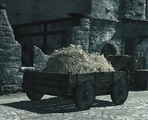 A haycart
 -
A haystack in Monteriggioni
-
A leaf cart in San Gimignano
-
A simple rooftop garden
-
A rooftop garden in Jerusalem
-
A rooftop garden in Acre
-
A rooftop garden in Forlì
-
A rooftop garden in Venice
-
A rooftop garden in Rome
-
Ezio Auditore da Firenze pulling a guard into a well in San Gimignano
-
A well in Rome


References
- Pages with reference errors
- Gameplay
- Assassin's Creed gameplay
- Assassin's Creed II gameplay
- Assassin's Creed II: Discovery gameplay
- Assassin's Creed: Brotherhood gameplay
- Assassin's Creed: Revelations gameplay
- Assassin's Creed III gameplay
- Assassin's Creed III: Liberation gameplay
- Assassin's Creed IV: Black Flag gameplay