

Herma: Difference between revisions
imported>Sol Pacificus Cleanup |
imported>Zone of Endless m removing newline between Era and WP-REAL |
||
| Line 1: | Line 1: | ||
{{Era|Culture}} | {{Era|Culture}}{{WP-REAL}} | ||
{{WP-REAL}} | |||
[[File:ACOd-Herma.jpg|thumb|250px|A herm in Greece]] | [[File:ACOd-Herma.jpg|thumb|250px|A herm in Greece]] | ||
A '''herma''', also called '''herms''' and '''hermaic pillar''', is a rectangular pillar topped with the bust of a divinity, usually [[Hermes Trismegistus|Hermes]], which was used in ancient [[Greece]] to mark roads and borders as well as to provide protection and attract fertility. | A '''herma''', also called '''herms''' and '''hermaic pillar''', is a rectangular pillar topped with the bust of a divinity, usually [[Hermes Trismegistus|Hermes]], which was used in ancient [[Greece]] to mark roads and borders as well as to provide protection and attract fertility. | ||
Latest revision as of 00:22, 15 October 2021

A herma, also called herms and hermaic pillar, is a rectangular pillar topped with the bust of a divinity, usually Hermes, which was used in ancient Greece to mark roads and borders as well as to provide protection and attract fertility.
The pillars were often erected at crossroads, street corners, in front of temples, and near tombs, houses, and public places.[1] They were also sometimes engraved with distances to serve as sign-posts or treated as altars, where people made offerings and prayed.[2] In the 5th century BCE, hermae were a common sight all throughout Greece.[2]
Behind the scenes[edit | edit source]
Historically, hermae featured a phallus. This detail has been omitted in Assassin's Creed: Odyssey. When a number of hermae in Athens were defaced over one night, the phallus was the specific target. Alkibiades was accused of this incident, and he was convicted in absentia. [citation needed]
Gallery[edit | edit source]
-
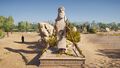 A decorated herm
