


George Washington: Difference between revisions
imported>Vatsa1708 m Reverted edits by Oogaman (talk | block) to last version by Alientraveller |
imported>Liendax Revamped biography. Gonna clean up and do a Legacy section later. |
||
| Line 23: | Line 23: | ||
===Early life=== | ===Early life=== | ||
{{Quote|Since the death of my father four years ago, our lives have become difficult, and I must help my family.|George Washington journal entry - March 20, 1748|George Washington's journal}} | {{Quote|Since the death of my father four years ago, our lives have become difficult, and I must help my family.|George Washington journal entry - March 20, 1748|George Washington's journal}} | ||
George Washington was born on February 22, 1732. His father died in 1743 and although he enjoyed school, he had to leave | George Washington was born on February 22, 1732. He lived in Virgina where his family owned a tobacco plantation. His father died in 1743 and although he enjoyed school, he had to leave before he turned sixteen due to the death of his father and the need to help his family.<ref name="Journal">[[George Washington's journal]]</ref> | ||
===French and Indian War=== | ===French and Indian War=== | ||
{{Quote|We're far from home with our forces divided. Worse, I fear Braddock's bloodlust makes him careless. It puts the men at risk. I'd rather not be delivering grim news to mothers and widows because the Bulldog wanted to prove a point.|George Washington talking to John Fraser about Edward Braddock.|Assassin's Creed III}} | {{Quote|We're far from home with our forces divided. Worse, I fear Braddock's bloodlust makes him careless. It puts the men at risk. I'd rather not be delivering grim news to mothers and widows because the Bulldog wanted to prove a point.|George Washington talking to John Fraser about Edward Braddock.|Assassin's Creed III}} | ||
[[File:ACIII-BraddockExpedition 10.png|thumb|left|250px|Kaniehtí:io holding Washington down.]] | [[File:ACIII-BraddockExpedition 10.png|thumb|left|250px|Kaniehtí:io holding Washington down.]] | ||
George Washington | In 1754, George Washington pursued a military career by joining the Virginia militia as a soldier and surveyor and became involved in the French and Indian War. During an expedition to Fort Duquesne, Washington and his men attacked a French patrol while crossing the Ohio River. Washington prepared for a retaliatory strike by erecting a fort from alpine wood, in order to defend themselves and protect their supplies. This would later be known as the Battle at Fort Necessity, however Washington was overwhelmed and forced to surrender to the French, but was not long after released. | ||
Washington volunteered to join British Army General [[Edward Braddock]], who enlisted Washington as a guide in his expedition to take Fort Duquesne. In the winter of 1754, Washington was stationed in Fort St-Mathieu where he formulated the route for expedition while Braddock rallied his troops and supplies. | |||
On July 9, 1755, in what would later become known as the Battle of the Monongahela, George Washington rode with Edward Braddock along a road amidst a wooded area. Suddenly, their forces were attacked by Indians and [[Haytham Kenway]], the [[Templars|Templar]] [[Grand Master]], who was disguised as a British soldier. Haytham attempted to assassinate Braddock, but was interrupted by Washington, who shot his horse from under him. As Washington readied to fire a shot into Haytham, he was attacked and pinned down by [[Kaniehtí:io]], which consequently lead to Haytham pursuing and killing Braddock. | |||
Washington managed to rally a retreat of the disseminated forces, during which he found Braddock's body. Washington was able to carry the body with him, eventually burying it under a road in the Great Meadows to prevent the body from being found and desecrated by the French and Native Americans.<ref name="AC3">''[[Assassin's Creed III]]''</ref> | |||
Washington returned to his service in the Virginia militia and was promoted to the rank of Colonel. He focused on revamping his forces hoping to gain recognition and acceptance in the British Armed forces. In 1760, in an attempt to prevent attacks from [[Kanien'kehá:ka|Native American]] tribes, George Washington's forces were ordered to burn the village of [[Kanatahséton]], killing many natives.<ref name="AC3"/> | |||
{{-}} | {{-}} | ||
===Becoming Commander-in-Chief=== | ===Becoming Commander-in-Chief=== | ||
{{Quote|For the support of the glorious cause I beg they will accept my most cordial thanks for this distinguished testimony of their approbation. But, lest some unlucky event should happen, | {{Quote|For the support of the glorious cause I beg they will accept my most cordial thanks for this distinguished testimony of their approbation. But, lest some unlucky event should happen, unfavorable to my reputation, I beg it may be remembered, by every Gentleman in the room, that I, this day, declare with utmost sincerity, I do not think myself equal to the Command I am honored with.|George Washington upon his appointment as Commander-in-Chief at the Continental Congress.|Assassin's Creed III}} | ||
Washington changed to focus on political pursuits and by 1758 became a representative of Virginia in House of Burgesses. In 1765, he became a strong supporter of the Patriots and advocate against the British Parliament's Stamp Act. The taxation imposed by the British eventually led to armed conflict with the colonists. Washington became part of the Continental Congress and due to his military service was considered to lead the Continental Army along with [[Charles Lee]]. Washington was favored because of his modesty and insistence for little pay and promise to be financially responsible. | |||
[[File:ACIII-Conflictlooms 4.png|thumb|250px|Samuel Adams introducing Connor to Washington.]] | [[File:ACIII-Conflictlooms 4.png|thumb|250px|Samuel Adams introducing Connor to Washington.]] | ||
On June 16, 1775, George Washington was appointed Commander-in-chief of the Continental Army | On June 16, 1775, George Washington was appointed Commander-in-chief of the Continental Army in [[Philadelphia]]. Present at the time of his acceptance was the [[Assassin]] Ratonhnhaké:ton, now known as Connor. Washington delivered a speech declaring his humble gratitude for the position. After his speech, he was introduced to Connor by [[Samuel Adams]]. Washington had taken note of the disappointment of [[Charles Lee]], who had wished to be appointed Commander-in-chief himself. Washington then bid farewell to Adams and Connor and then went to calm Lee from his frustrations.<ref name="AC3"/> | ||
On June 17, 1775, the Continental Army achieved victory at Boston, led by General [[Israel Putnam]]. During the [[Battle of Bunker Hill]], Connor discovered a plot to assassinate Washington from a letter he retrieved from the body of [[John Pitcairn]], masterminded by Charles Lee and Haytham Kenway. | |||
===Assassination plot=== | |||
{{Quote|That man is our Jupiter Conservator, destined to lead us not just to freedom, but greatness.|[[Mason Locke Weems]].}} | |||
In 1776, Washington seized and moved his forces to [[New York]] City. Connor also traveled to New York to stop Washington's would-be-murderer, [[Thomas Hickey]], who was also enlisted in Washington's private guard. However, Connor was falsely arrested for counterfeiting and while in prison, was framed for the attempted murder of Washington and sentenced to death. | |||
The next day, Washington was in attendance of Connor's execution, with Charles Lee | The next day, Washington was in attendance of Connor's execution, with Charles Lee presiding over as executioner. However, with the help of his Assassin allies, Connor managed to escape. In the resulting confusion, Hickey made a desperate attempt to kill Washington, however Connor quickly caught up and killed Hickey, proving his innocence. Washington left and began his journey back to Philadelphia, before leaving once again to hold New York. Washington was eventually defeated by the British Army and was forced to retreat from New York. <ref name="AC3"/> | ||
===Encamping at Valley Forge=== | ===Encamping at Valley Forge=== | ||
{{Quote|If I can't take a stand against some snow, then there really is no hope for us.|Washington to Connor.}} | |||
[[File:ACIII-Pottsresidence 3.png|thumb|250px|left|Washington and Connor at Valley Forge.]] | [[File:ACIII-Pottsresidence 3.png|thumb|250px|left|Washington and Connor at Valley Forge.]] | ||
Washington | Washington moved to the encampment at [[Valley Forge]], he was also able to enlist French aid, with the vessel ''La Belladonna'' providing equipment and supplies and commissioned [[Marquis de Lafayette]] as a field secretary. Washington also hired Polish horsemen to form the Patriot Cavalry. | ||
Washington eventually met with Connor once again in the winter 1777 at the encampment. Washington informed Connor of a traitor by the name of [[Benjamin Church]] and informed him of missing supply caravans. Connor volunteered to find Church and retrieve the supplies. Before leaving, Connor approached Washington, who began to experience doubt and feared that defeat was inevitable. However Connor encouraged him to continue leading his troops in their cause for freedom, renewing Washington's conviction and determination. | |||
During his mission, Connor came upon his father, Haytham, and the two temporarily allied together. They pursued Church, eventually killing him and allowing Connor to return the stolen to Washington and the Continental Army.<ref name="AC3"/> | |||
===Battle at Monmouth=== | |||
{{Quote|Enjoy your victory, Commander. It will be the last I deliver you.|Connor to Washington.}} | |||
By 1778, Washington became concerned over the involvement of the Native Americans. Since several Iroquois clans allied with British to secure their independence, Washington, organized the Sullivan expedition, ordering them to exterminate all Native American villages to prevent their attacks against the Continental Army, even those not involved. | |||
Connor and Haytham approached Washington, informing him of the British Army's intent to march from Philadelphia to New York. While Connor and Washington conversed, Haytham found a letter of Washington's correspondence with the Sullivan expedition, reading it aloud and shocking Connor with the truth of Washington's orders to destroy [[Kanatahséton]], Connor's village. Haytham also revealed that it was Washington who was responsible for the burning of his village many years ago. Washington and Haytham argued, to which Connor angrily yelled at them, stopping the argument. With his trust in Washington broken, Connor left before warning both Haytham and Washington not to stop him or would kill them both. Connor proceeded to kill Washington's messengers, preventing the attack on his village.<ref name="AC3"/> | |||
===Battle at Monmouth=== | |||
{{Quote|Enjoy your victory, Commander. It will be the last I deliver you.|Connor to Washington.}} | |||
[[File:ACIII-BattleofMonmouth 4.png|thumb|250px|Washington with Connor and Lafayette in Monmouth.]] | [[File:ACIII-BattleofMonmouth 4.png|thumb|250px|Washington with Connor and Lafayette in Monmouth.]] | ||
Washington | Washington assembled his forces in Monmoth to stop the British Army's advancement to New York. Connor and Lafayette approached Washington, revealing that General Charles Lee betrayed him intending to force Washington to suffer defeat, to which Lafayette vouched for. Connor explained that Lee was plotting to have him killed or dishonored in order to replace him as commander. In response, Washington promised to investigate and deal with Lee, to which Connor warmed him not to spare Lee. Connor left, bitterly telling Washington that their alliance was over.<ref name="AC3"/> | ||
Washington subsequent investigation led to Lee's court martial and was charged for insubordinate behavior and poor command decisions. However, Lee was spared execution and instead was suspended from duty. | |||
===Treason of Benedict Arnold=== | ===Treason of Benedict Arnold=== | ||
{{ | {{Quote|Whom can we trust now, if Patriot heroes are betraying us...?|Washington.}} | ||
In 1780, Washington | In 1780, Washington requested Connor's help again, revealing that West Point had been infiltrated and he had received information of a potential plot to assassinate [[Benedict Arnold]]. Connor agreed to complete the mission, but warned Washington to never call upon him, again.<ref name="AC3"/> | ||
Though Connor eventually revealed the plot, leading to André's arrest, Arnold escaped | Connor eventually uncovered that Arnold was a traitor, collaborating with [[John André]] to give West point to the British. Though Connor eventually revealed the plot, leading to André's arrest, Arnold escaped on board a British ship, as Connor was forced to defend the fort from Redcoats. Washington met with Connor, revealing that André will later be hanged. As Washington lamented over Arnold's betrayal, Connor unsympathetically left replying "You reap what you sow."<ref name="AC3"/> | ||
Around 1781, Washington got into contact with [[Apple of Eden 3|an Apple of Eden]].<ref name="AC2">''[[Assassin's Creed II]]''</ref> | Around 1781, Washington got into contact with [[Apple of Eden 3|an Apple of Eden]].<ref name="AC2">''[[Assassin's Creed II]]''</ref> | ||
===Later life=== | ===Later life=== | ||
{{Quote|My death has not yet quite arrived, but it is near and inevitable as night follows day.|George Washington journal entry - December 14, 1799|George Washington's journal}} | {{Quote|My death has not yet quite arrived, but it is near and inevitable as night follows day.|George Washington journal entry - December 14, 1799|George Washington's journal.}} | ||
Connor met with Washington in New York | The American Revolution eventually ended, with the Patriots as the victors. In 1783, the British evacuated from the colonies, during which Connor met with Washington in New York. Connor congratulated Washington for his victory, to which Washington decided to retire and settling into a quite life. However Connor scolded at the idea, telling Washington that he does not deserve the luxury of relinquishing his responsibility as a leader. | ||
In 1789, Washington was elected the first President of the United States. He served until 1797, where he then retired to his home, Mount Vernon.<ref name="Journal"/> | In 1789, Washington was elected the first President of the United States. He served until 1797, where he then retired to his home, Mount Vernon.<ref name="Journal"/> | ||
He died at his home, [[Wikipedia:Mount Vernon|Mount Vernon]], on December 14, 1799, but not before writing a last entry in his journal remembering the events of his life and even remembering and naming | He died at his home, [[Wikipedia:Mount Vernon|Mount Vernon]], on December 14, 1799, but not before writing a last entry in his journal remembering the events of his life and even remembering and naming Connor's importance in the American Revolution, and the filling in one last page on the day of his death.<ref name="Journal"/> | ||
==Trivia== | ==Trivia== | ||
*In the alternate-history [[Assassin's Creed III downloadable content|DLC]] for ''[[Assassin's Creed III]]'', ''[[The Tyranny of King Washington]]'', Washington succumbs to the temptation of power and declares himself King of America. Over the course of three installments, Connor must confront and dethrone him at any cost.<ref>[http://www.gametrailers.com/side-mission/31305/assassins-creed-iii-dlc-will-explore-the-tyranny-of-king-george GameTrailers: ''Assassin's Creed III DLC will explore the tyranny of King George'']</ref> | *In the alternate-history [[Assassin's Creed III downloadable content|DLC]] for ''[[Assassin's Creed III]]'', ''[[The Tyranny of King Washington]]'', Washington succumbs to the temptation of power and declares himself King of America. Over the course of three installments, Connor must confront and dethrone him at any cost.<ref>[http://www.gametrailers.com/side-mission/31305/assassins-creed-iii-dlc-will-explore-the-tyranny-of-king-george GameTrailers: ''Assassin's Creed III DLC will explore the tyranny of King George'']</ref> | ||
*Despite advertisements marketing the relationship between Connor and Washington as being friends, the real interaction between the two is limited, and Connor even breaks off ties with Washington with much anger. After the war, they seemed to at least mend | *Despite advertisements marketing the relationship between Connor and Washington as being friends, the real interaction between the two is limited, and Connor even breaks off ties with Washington with much anger. After the war, they seemed to at least mend some civility. | ||
*The game of bocce with Washington is only playable after the player finishes all of the Liberation missions. He is marked with a "w". | *The game of bocce with Washington is only playable after the player finishes all of the Liberation missions. He is marked with a "w". | ||
*In the memory "[[Execution is Everything]]", it was possible for Haytham to kill George Washington | *In the memory "[[Execution is Everything]]", it was possible for Haytham to kill George Washington, though his would cause a desynchronization. | ||
*Washington had red hair in his youth, which he powdered in later life. However, the game depicts him with grey hair in 1755. | *Washington had red hair in his youth, which he powdered in later life. However, the game depicts him with grey hair in 1755. | ||
Revision as of 20:52, 21 January 2013

|
He who increaseth knowledge, increaseth sorrow. This article contains spoilers, meaning it has information and facts concerning recent or upcoming releases from the Assassin's Creed series. If you do not want to know about these events, it is recommended to read on with caution, or not at all. |
George Washington (1732 – 1799) was the commander of the Continental Army in the American Revolutionary War from 1775 to 1783, and served as the first President of the United States from 30 April 1789 to 4 March 1797.
Born in the colony of Virginia in the British colonies of America, Washington joined the British Army during his youth and participated in the French and Indian War, fighting against the French and various indigenous tribes. Due to the lack of progress of his military career in the British Army, Washington instead turned to politics.
When the American Revolutionary War broke out, Washington supported the colonists. Following the creation of the Continental Army, the Continental Congress of 1775 appointed Washington as its Commander-in-Chief. Though the Continental Army suffered many losses under Washington's command, the aid of individuals such as his ally Ratonhnhaké:ton, a member of the Assassin Order, managed to gain the army small victories.
After Washington obtained an Apple of Eden around 1781, the Continental Army emerged victorious against the British Army, and the colonies joined together to form the United States in 1783. Washington was offered the privilege of becoming its first President, a position he held until 1797.
Biography
Early life
- "Since the death of my father four years ago, our lives have become difficult, and I must help my family."
- ―George Washington journal entry - March 20, 1748[src]
George Washington was born on February 22, 1732. He lived in Virgina where his family owned a tobacco plantation. His father died in 1743 and although he enjoyed school, he had to leave before he turned sixteen due to the death of his father and the need to help his family.[1]
French and Indian War
- "We're far from home with our forces divided. Worse, I fear Braddock's bloodlust makes him careless. It puts the men at risk. I'd rather not be delivering grim news to mothers and widows because the Bulldog wanted to prove a point."
- ―George Washington talking to John Fraser about Edward Braddock.[src]

In 1754, George Washington pursued a military career by joining the Virginia militia as a soldier and surveyor and became involved in the French and Indian War. During an expedition to Fort Duquesne, Washington and his men attacked a French patrol while crossing the Ohio River. Washington prepared for a retaliatory strike by erecting a fort from alpine wood, in order to defend themselves and protect their supplies. This would later be known as the Battle at Fort Necessity, however Washington was overwhelmed and forced to surrender to the French, but was not long after released.
Washington volunteered to join British Army General Edward Braddock, who enlisted Washington as a guide in his expedition to take Fort Duquesne. In the winter of 1754, Washington was stationed in Fort St-Mathieu where he formulated the route for expedition while Braddock rallied his troops and supplies.
On July 9, 1755, in what would later become known as the Battle of the Monongahela, George Washington rode with Edward Braddock along a road amidst a wooded area. Suddenly, their forces were attacked by Indians and Haytham Kenway, the Templar Grand Master, who was disguised as a British soldier. Haytham attempted to assassinate Braddock, but was interrupted by Washington, who shot his horse from under him. As Washington readied to fire a shot into Haytham, he was attacked and pinned down by Kaniehtí:io, which consequently lead to Haytham pursuing and killing Braddock.
Washington managed to rally a retreat of the disseminated forces, during which he found Braddock's body. Washington was able to carry the body with him, eventually burying it under a road in the Great Meadows to prevent the body from being found and desecrated by the French and Native Americans.[2]
Washington returned to his service in the Virginia militia and was promoted to the rank of Colonel. He focused on revamping his forces hoping to gain recognition and acceptance in the British Armed forces. In 1760, in an attempt to prevent attacks from Native American tribes, George Washington's forces were ordered to burn the village of Kanatahséton, killing many natives.[2]
Becoming Commander-in-Chief
- "For the support of the glorious cause I beg they will accept my most cordial thanks for this distinguished testimony of their approbation. But, lest some unlucky event should happen, unfavorable to my reputation, I beg it may be remembered, by every Gentleman in the room, that I, this day, declare with utmost sincerity, I do not think myself equal to the Command I am honored with."
- ―George Washington upon his appointment as Commander-in-Chief at the Continental Congress.[src]
Washington changed to focus on political pursuits and by 1758 became a representative of Virginia in House of Burgesses. In 1765, he became a strong supporter of the Patriots and advocate against the British Parliament's Stamp Act. The taxation imposed by the British eventually led to armed conflict with the colonists. Washington became part of the Continental Congress and due to his military service was considered to lead the Continental Army along with Charles Lee. Washington was favored because of his modesty and insistence for little pay and promise to be financially responsible.

On June 16, 1775, George Washington was appointed Commander-in-chief of the Continental Army in Philadelphia. Present at the time of his acceptance was the Assassin Ratonhnhaké:ton, now known as Connor. Washington delivered a speech declaring his humble gratitude for the position. After his speech, he was introduced to Connor by Samuel Adams. Washington had taken note of the disappointment of Charles Lee, who had wished to be appointed Commander-in-chief himself. Washington then bid farewell to Adams and Connor and then went to calm Lee from his frustrations.[2]
On June 17, 1775, the Continental Army achieved victory at Boston, led by General Israel Putnam. During the Battle of Bunker Hill, Connor discovered a plot to assassinate Washington from a letter he retrieved from the body of John Pitcairn, masterminded by Charles Lee and Haytham Kenway.
Assassination plot
- "That man is our Jupiter Conservator, destined to lead us not just to freedom, but greatness."
- ―Mason Locke Weems.
In 1776, Washington seized and moved his forces to New York City. Connor also traveled to New York to stop Washington's would-be-murderer, Thomas Hickey, who was also enlisted in Washington's private guard. However, Connor was falsely arrested for counterfeiting and while in prison, was framed for the attempted murder of Washington and sentenced to death.
The next day, Washington was in attendance of Connor's execution, with Charles Lee presiding over as executioner. However, with the help of his Assassin allies, Connor managed to escape. In the resulting confusion, Hickey made a desperate attempt to kill Washington, however Connor quickly caught up and killed Hickey, proving his innocence. Washington left and began his journey back to Philadelphia, before leaving once again to hold New York. Washington was eventually defeated by the British Army and was forced to retreat from New York. [2]
Encamping at Valley Forge
- "If I can't take a stand against some snow, then there really is no hope for us."
- ―Washington to Connor.

Washington moved to the encampment at Valley Forge, he was also able to enlist French aid, with the vessel La Belladonna providing equipment and supplies and commissioned Marquis de Lafayette as a field secretary. Washington also hired Polish horsemen to form the Patriot Cavalry.
Washington eventually met with Connor once again in the winter 1777 at the encampment. Washington informed Connor of a traitor by the name of Benjamin Church and informed him of missing supply caravans. Connor volunteered to find Church and retrieve the supplies. Before leaving, Connor approached Washington, who began to experience doubt and feared that defeat was inevitable. However Connor encouraged him to continue leading his troops in their cause for freedom, renewing Washington's conviction and determination.
During his mission, Connor came upon his father, Haytham, and the two temporarily allied together. They pursued Church, eventually killing him and allowing Connor to return the stolen to Washington and the Continental Army.[2]
Battle at Monmouth
- "Enjoy your victory, Commander. It will be the last I deliver you."
- ―Connor to Washington.
By 1778, Washington became concerned over the involvement of the Native Americans. Since several Iroquois clans allied with British to secure their independence, Washington, organized the Sullivan expedition, ordering them to exterminate all Native American villages to prevent their attacks against the Continental Army, even those not involved.
Connor and Haytham approached Washington, informing him of the British Army's intent to march from Philadelphia to New York. While Connor and Washington conversed, Haytham found a letter of Washington's correspondence with the Sullivan expedition, reading it aloud and shocking Connor with the truth of Washington's orders to destroy Kanatahséton, Connor's village. Haytham also revealed that it was Washington who was responsible for the burning of his village many years ago. Washington and Haytham argued, to which Connor angrily yelled at them, stopping the argument. With his trust in Washington broken, Connor left before warning both Haytham and Washington not to stop him or would kill them both. Connor proceeded to kill Washington's messengers, preventing the attack on his village.[2]
Battle at Monmouth
- "Enjoy your victory, Commander. It will be the last I deliver you."
- ―Connor to Washington.

Washington assembled his forces in Monmoth to stop the British Army's advancement to New York. Connor and Lafayette approached Washington, revealing that General Charles Lee betrayed him intending to force Washington to suffer defeat, to which Lafayette vouched for. Connor explained that Lee was plotting to have him killed or dishonored in order to replace him as commander. In response, Washington promised to investigate and deal with Lee, to which Connor warmed him not to spare Lee. Connor left, bitterly telling Washington that their alliance was over.[2]
Washington subsequent investigation led to Lee's court martial and was charged for insubordinate behavior and poor command decisions. However, Lee was spared execution and instead was suspended from duty.
Treason of Benedict Arnold
- "Whom can we trust now, if Patriot heroes are betraying us...?"
- ―Washington.
In 1780, Washington requested Connor's help again, revealing that West Point had been infiltrated and he had received information of a potential plot to assassinate Benedict Arnold. Connor agreed to complete the mission, but warned Washington to never call upon him, again.[2]
Connor eventually uncovered that Arnold was a traitor, collaborating with John André to give West point to the British. Though Connor eventually revealed the plot, leading to André's arrest, Arnold escaped on board a British ship, as Connor was forced to defend the fort from Redcoats. Washington met with Connor, revealing that André will later be hanged. As Washington lamented over Arnold's betrayal, Connor unsympathetically left replying "You reap what you sow."[2]
Around 1781, Washington got into contact with an Apple of Eden.[3]
Later life
- "My death has not yet quite arrived, but it is near and inevitable as night follows day."
- ―George Washington journal entry - December 14, 1799[src]
The American Revolution eventually ended, with the Patriots as the victors. In 1783, the British evacuated from the colonies, during which Connor met with Washington in New York. Connor congratulated Washington for his victory, to which Washington decided to retire and settling into a quite life. However Connor scolded at the idea, telling Washington that he does not deserve the luxury of relinquishing his responsibility as a leader.
In 1789, Washington was elected the first President of the United States. He served until 1797, where he then retired to his home, Mount Vernon.[1]
He died at his home, Mount Vernon, on December 14, 1799, but not before writing a last entry in his journal remembering the events of his life and even remembering and naming Connor's importance in the American Revolution, and the filling in one last page on the day of his death.[1]
Trivia
- In the alternate-history DLC for Assassin's Creed III, The Tyranny of King Washington, Washington succumbs to the temptation of power and declares himself King of America. Over the course of three installments, Connor must confront and dethrone him at any cost.[4]
- Despite advertisements marketing the relationship between Connor and Washington as being friends, the real interaction between the two is limited, and Connor even breaks off ties with Washington with much anger. After the war, they seemed to at least mend some civility.
- The game of bocce with Washington is only playable after the player finishes all of the Liberation missions. He is marked with a "w".
- In the memory "Execution is Everything", it was possible for Haytham to kill George Washington, though his would cause a desynchronization.
- Washington had red hair in his youth, which he powdered in later life. However, the game depicts him with grey hair in 1755.
Gallery
-
Washington's concept art.
-
George Washington concept illustration.
-
 King George Washington.
 -
 Concept art of Connor and Washington in the Frontier.
 -
 Concept art of Washington giving mission to Connor by Donglu Yu.
 -
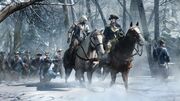 Connor and Washington riding on horseback through the Frontier.
 -
Washington at the Battle of Long Island.


.jpg)


References