


Edward Braddock: Difference between revisions
imported>Kainzorus Prime It's right above Xang, seriously. |
imported>Alientraveller →Biography: fleshed out |
||
| Line 13: | Line 13: | ||
==Biography== | ==Biography== | ||
===Early life=== | ===Early life=== | ||
At some point, Braddock became a soldier in the British Army and a member of the Templar Order, | At some point, Braddock became a soldier in the British Army and a member of the Templar Order under [[Reginald Birch]]. He was introduced to [[Haytham Kenway]] in 1735, after his half-sister [[Jenny Kenway|Jenny]] was kidnapped, and promised to lead the investigation into her whereabouts, and those of [[Jack Digweed]], whom Haytham suspected was behind the attack. Secretly, Birch and Braddock sent the [[mercenaries]] to kidnap Jenny in a ploy to obtain [[Edward Kenway's journal]], and to induct Haytham into the Templars.<ref name="ACF">''[[Assassin's Creed: Forsaken]]''</ref> | ||
By 1747, Braddock was a Lieutenant Colonel in the {{Wiki|Coldstream Guards}}, when Haytham tracked one of his mercenaries, [[Tom Smith]], to the regiment in the [[Netherlands|Dutch Republic]]. Braddock had Smith hung on grounds of desertion before Haytham could interrogate him, but gave his fellow Templar permission to investigate among his troops. He also requested his help against the [[French Army]], who had commenced the {{Wiki|Siege of Bergen op Zoom (1747)|siege of Bergen op Zoom}}.<ref name="ACF"/> | |||
Two months later, the French had won. During the retreat from the siege, Braddock refused a young man's requested to allow his family entry onto his and Haytham's boat. After the young man called him craven, Braddock ordered his executioner [[Slater]] to kill every last one of them.<ref name="ACF"/> | |||
Braddock | Following this, Braddock and Haytham fought in several other campaigns, though Braddock became increasingly violent and cruel to the point that he ruthlessly killed civilians and his own allies alike, much to Haytham's shock. Haytham told Birch was concerned that Braddock was turning away from the Order, but Birch was indifferent. Among his troops, Braddock's reputation and blood-lust for violence earned him the nickname, "The Bulldog".<ref name="ACF"/> | ||
===French and Indian War=== | ===French and Indian War=== | ||
{{Quote|I suppose I shouldn't be surprised. Wolves often travel in packs.|Braddock to Haytham.|Assassin's Creed III}} | {{Quote|I suppose I shouldn't be surprised. Wolves often travel in packs.|Braddock to Haytham.|Assassin's Creed III}} | ||
[[File:ACIII-Soldier 5.png|thumb|250px|Braddock with Haytham, Charles Lee and John Pitcairn]] | [[File:ACIII-Soldier 5.png|thumb|250px|Braddock with Haytham, Charles Lee and John Pitcairn]] | ||
By 1754, Braddock had been promoted to general, and was serving as governor of {{Wiki|Gibraltar}} when he was sent to [[Boston]], with [[Charles Lee]] serving under his command.<ref name="AC3">''[[Assassin's Creed III]]''</ref> | |||
In a plan to retrieve Pitcairn, Lee followed and pretended to be an angry citizen against the British Regulars, provoking Braddock into a chase by throwing horse manure on him. Once he had Braddock on his tail, Lee lured the General and his men to a dead end, which allowed him, Haytham, and Pitcairn to attack and eliminate Braddock's patrol. | Braddock noticed [[John Pitcairn]]'s unauthorized presence in Boston and had him arrested and charged for desertion and treason. Haytham and Lee arrived, revealing that both Lee and Pitcairn were in Haytham's service under Templar orders. Despite this, Braddock reluctantly consented to give Lee to Haytham, but bitterly denied releasing Pitcairn.<ref name="AC3"/> | ||
In a plan to retrieve Pitcairn, Lee followed and pretended to be an angry citizen against the British Regulars, provoking Braddock into a chase by throwing horse manure on him. Once he had Braddock on his tail, Lee lured the General and his men to a dead end, which allowed him, Haytham, and Pitcairn to attack and eliminate Braddock's patrol.<ref name="AC3"/> | |||
===The Braddock Expedition=== | ===The Braddock Expedition=== | ||
{{Quote|The French will leave or they will die!|Braddock to Washington.}} | {{Quote|The French will leave or they will die!|Braddock to Washington.}} | ||
[[File:ACIII-BraddockExpedition 8.png|thumb|left|250px|Haytham holding Braddock at gunpoint]] | [[File:ACIII-BraddockExpedition 8.png|thumb|left|250px|Haytham holding Braddock at gunpoint]] | ||
As conflict and territorial disputes between the British and the French colonies escalated, Braddock was given command of two regiments and was assigned to retake [[Fort Duquesne]] from the French. In order to navigate through the frontier, Braddock enlisted [[George Washington]], a volunteer from the [[Virginia]] Militia, as a guide. | As conflict and territorial disputes between the British and the French colonies escalated, Braddock was given command of two regiments and was assigned to retake [[Fort Duquesne]] from the French. In order to navigate through the frontier, Braddock enlisted [[George Washington]], a volunteer from the [[Virginia]] Militia, as a guide.<ref name="AC3"/> | ||
In the winter of 1754, France offered a truce, of which Braddock refused. Instead, Braddock continued on his offensive, determined to defeat and drive the French from the land. While rallying his troops and supplies, Braddock attacked several Native American villages, driving the inhabitants out of their land. As a result, Braddock became an enemy of several Iroquois clans, whom Haytham would eventually join forces with in a plan to murder Braddock. | In the winter of 1754, France offered a truce, of which Braddock refused. Instead, Braddock continued on his offensive, determined to defeat and drive the French from the land. While rallying his troops and supplies, Braddock attacked several Native American villages, driving the inhabitants out of their land. As a result, Braddock became an enemy of several Iroquois clans, whom Haytham would eventually join forces with in a plan to murder Braddock.<ref name="AC3"/> | ||
===Death=== | ===Death=== | ||
{{Quote|Your death opens a door. It's nothing personal. Well, maybe it is a LITTLE personal. You've been a pain in my arse, after all.|Haytham upon killing Braddock.}} | {{Quote|Your death opens a door. It's nothing personal. Well, maybe it is a LITTLE personal. You've been a pain in my arse, after all.|Haytham upon killing Braddock.}} | ||
The expedition continued on until July of 1755, during which Braddock killed one of his own soldiers after accusing him of treasonous and insubordinate behavior. Braddock was then approached by Haytham, disguised as a British soldier, who held him at gunpoint. The expedition was then ambushed and attacked by Iroquois warriors, devastating and killing many Redcoats. | The expedition continued on until July of 1755, during which Braddock killed one of his own soldiers after accusing him of treasonous and insubordinate behavior. Braddock was then approached by Haytham, disguised as a British soldier, who held him at gunpoint. The expedition was then ambushed and attacked by Iroquois warriors, devastating and killing many Redcoats.<ref name="AC3"/> | ||
[[File:ACIII-BraddockExpedition 11.png|thumb|250px|Haytham chasing Braddock]] | [[File:ACIII-BraddockExpedition 11.png|thumb|250px|Haytham chasing Braddock]] | ||
In the resulting chaos, Braddock attempted to flee on horseback while Haytham chased close behind. Washington briefly came to Braddock's defense, but was subdued by a [[Kaniehtí:io|Kanien'kehá:ka woman]]. | In the resulting chaos, Braddock attempted to flee on horseback while Haytham chased close behind. Washington briefly came to Braddock's defense, but was subdued by a [[Kaniehtí:io|Kanien'kehá:ka woman]].<ref name="AC3"/> | ||
Haytham then continued to pursue Braddock on foot, quickly catching up and impaling him with his [[Hidden Blade]]. During Braddock's final words, Haytham admitted to him that he had killed him out of necessity, but that some semblance of personal motivation compelled it as well. From there, Haytham departed, taking Braddock's Templar ring from his finger. | Haytham then continued to pursue Braddock on foot, quickly catching up and impaling him with his [[Hidden Blade]]. During Braddock's final words, Haytham admitted to him that he had killed him out of necessity, but that some semblance of personal motivation compelled it as well. From there, Haytham departed, taking Braddock's [[Templar ring]] from his finger.<ref name="AC3"/> | ||
==Personality== | ==Personality== | ||
Revision as of 12:48, 6 September 2013
- "Were that we applied the sword more liberally and more often, the world would be a better place than it is today."
- ―Edward Braddock.[src]
Edward Braddock (1695 – 1755), also known as The Bulldog by his soldiers, was a General in the British Army, and a member of the Templar Order.
Biography
Early life
At some point, Braddock became a soldier in the British Army and a member of the Templar Order under Reginald Birch. He was introduced to Haytham Kenway in 1735, after his half-sister Jenny was kidnapped, and promised to lead the investigation into her whereabouts, and those of Jack Digweed, whom Haytham suspected was behind the attack. Secretly, Birch and Braddock sent the mercenaries to kidnap Jenny in a ploy to obtain Edward Kenway's journal, and to induct Haytham into the Templars.[1]
By 1747, Braddock was a Lieutenant Colonel in the Coldstream Guards, when Haytham tracked one of his mercenaries, Tom Smith, to the regiment in the Dutch Republic. Braddock had Smith hung on grounds of desertion before Haytham could interrogate him, but gave his fellow Templar permission to investigate among his troops. He also requested his help against the French Army, who had commenced the siege of Bergen op Zoom.[1]
Two months later, the French had won. During the retreat from the siege, Braddock refused a young man's requested to allow his family entry onto his and Haytham's boat. After the young man called him craven, Braddock ordered his executioner Slater to kill every last one of them.[1]
Following this, Braddock and Haytham fought in several other campaigns, though Braddock became increasingly violent and cruel to the point that he ruthlessly killed civilians and his own allies alike, much to Haytham's shock. Haytham told Birch was concerned that Braddock was turning away from the Order, but Birch was indifferent. Among his troops, Braddock's reputation and blood-lust for violence earned him the nickname, "The Bulldog".[1]
French and Indian War
- "I suppose I shouldn't be surprised. Wolves often travel in packs."
- ―Braddock to Haytham.[src]

By 1754, Braddock had been promoted to general, and was serving as governor of Gibraltar when he was sent to Boston, with Charles Lee serving under his command.[2]
Braddock noticed John Pitcairn's unauthorized presence in Boston and had him arrested and charged for desertion and treason. Haytham and Lee arrived, revealing that both Lee and Pitcairn were in Haytham's service under Templar orders. Despite this, Braddock reluctantly consented to give Lee to Haytham, but bitterly denied releasing Pitcairn.[2]
In a plan to retrieve Pitcairn, Lee followed and pretended to be an angry citizen against the British Regulars, provoking Braddock into a chase by throwing horse manure on him. Once he had Braddock on his tail, Lee lured the General and his men to a dead end, which allowed him, Haytham, and Pitcairn to attack and eliminate Braddock's patrol.[2]
The Braddock Expedition
- "The French will leave or they will die!"
- ―Braddock to Washington.

As conflict and territorial disputes between the British and the French colonies escalated, Braddock was given command of two regiments and was assigned to retake Fort Duquesne from the French. In order to navigate through the frontier, Braddock enlisted George Washington, a volunteer from the Virginia Militia, as a guide.[2]
In the winter of 1754, France offered a truce, of which Braddock refused. Instead, Braddock continued on his offensive, determined to defeat and drive the French from the land. While rallying his troops and supplies, Braddock attacked several Native American villages, driving the inhabitants out of their land. As a result, Braddock became an enemy of several Iroquois clans, whom Haytham would eventually join forces with in a plan to murder Braddock.[2]
Death
- "Your death opens a door. It's nothing personal. Well, maybe it is a LITTLE personal. You've been a pain in my arse, after all."
- ―Haytham upon killing Braddock.
The expedition continued on until July of 1755, during which Braddock killed one of his own soldiers after accusing him of treasonous and insubordinate behavior. Braddock was then approached by Haytham, disguised as a British soldier, who held him at gunpoint. The expedition was then ambushed and attacked by Iroquois warriors, devastating and killing many Redcoats.[2]

In the resulting chaos, Braddock attempted to flee on horseback while Haytham chased close behind. Washington briefly came to Braddock's defense, but was subdued by a Kanien'kehá:ka woman.[2]
Haytham then continued to pursue Braddock on foot, quickly catching up and impaling him with his Hidden Blade. During Braddock's final words, Haytham admitted to him that he had killed him out of necessity, but that some semblance of personal motivation compelled it as well. From there, Haytham departed, taking Braddock's Templar ring from his finger.[2]
Personality
- "...He killed and killed. Enemy or ally. Civilian or soldier. Guilty or innocent. It mattered not... If he perceived one to be an obstacle, they died. He maintained that violence was a more efficient solution. It became his mantra... and it broke my heart."
- ―Haytham Kenway, lamenting on Braddock's cruelty.
Braddock was originally described by Haytham as brave and bold. However, Braddock changed into a definitively ruthless and violent man, driven by the belief that force was necessary to ensure resolution and success.
His reliance on force resulted in indiscriminate killings of even civilians and his own allies. Braddock was also quick tempered and cruel; he applied strict discipline to the point of brutality against his own soldiers.
Final words

- Edward: Why, Haytham?
- Haytham: Your death opens a door. It's nothing personal. Well, maybe it is a LITTLE personal. You've been a pain in my arse, after all.
- Edward: But we are brothers in arms.
- Haytham: Once, perhaps. No longer. Do you think I've forgotten what you did? All those innocents slaughtered. And for what? It does not engender peace to cut your way to resolution.
- Edward: Wrong! Were that we applied the sword more liberally and more often, the world would be a better place than it is today.
- Haytham: In this instance, I concur. Farewell, Edward.
Trivia
- Due to a production oversight, Braddock wore the uniform of a private, despite being a general.
Gallery
-
 Haytham warning Braddock
 -
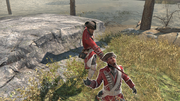 Haytham assassinating Braddock
 -
 Haytham taking the Templar ring from Braddock


References