

British Army: Difference between revisions
imported>Jasca Ducato mNo edit summary |
imported>Slate Vesper Grammar edits. |
||
| Line 2: | Line 2: | ||
{{WP-REAL}} | {{WP-REAL}} | ||
{{Stub}} | {{Stub}} | ||
[[File:ACIII-GI (2).jpg|thumb|250px|Connor stalking a British Army unit]] '''The British Army''' was a branch of the Royal {{Wiki|British Armed Forces|Armed Forces}} in the {{Wiki|United Kingdom}}. It was formed in 1707 with the Act of Union and focused on land-based warefare. | [[File:ACIII-GI (2).jpg|thumb|250px|Connor stalking a British Army unit.]] '''The British Army''' was a branch of the Royal {{Wiki|British Armed Forces|Armed Forces}} in the {{Wiki|United Kingdom}}. It was formed in 1707 with the Act of Union and focused on land-based warefare. | ||
Following Great Britain's triumph over the Kingdom of France in the French | Following Great Britain's triumph over the Kingdom of France in the French and Indian War (also known as the Seven Years' War), which ended in 1763, the soldiers of the British army were thought to be the best in the western world. | ||
The superior discipline, skill-at-arms, equipment, organization, well-tailored uniforms, and reputation of the British army were major sources of intimidation to the initially | The superior discipline, skill-at-arms, equipment, organization, well-tailored uniforms, and reputation of the British army were major sources of intimidation to the initially amateur soldiers of the [[Continental Army]], during the [[American Revolutionary War|American Revolution]] from 1775 to 1783. | ||
==Arms and | ==Arms and equipment== | ||
The British infantryman of the 18th century was armed with the standard British Army smooth-bore flintlock musket, affectionately known as a "Brown Bess" | The British infantryman of the 18th century was armed with the standard British Army smooth-bore flintlock musket, affectionately known as a "Brown Bess," and a fifteen inch socket bayonet which could be locked onto the end of the Brown Bess' musket barrel. British soldiers were drilled in the use of these primary weapons, until they could load and fire their muskets with their eyes closed. A well-trained infantryman could average around four shots per minute from his musket, whereas the sub-par soldier could accomplish perhaps three. | ||
British officers usually armed themselves with flintlock pistols and sabres, although it was not unknown for light infantry officers to carry their own musket, or even a rifle, as the war progressed. | British officers usually armed themselves with flintlock pistols and sabres, although it was not unknown for light infantry officers to carry their own musket, or even a rifle, as the war progressed. | ||
==Trivia== | |||
*The soldiers of the British Army were often referred to as "Red Coats" or "Lobster-backs" during the American Revolution, due to the scarlet jackets that distinguished their uniforms from those of other European armies. | |||
*The British fielded armies consisted mostly of infantry during the American War of Independence, where each regiment of infantry contained two or more "line" or "battalion" companies (standard infantrymen), one "light" company (skirmishers), and one "grenadier" company (heavy-hitting veterans). Despite the unreceptive North American terrain, the British high command did their best to utilize cavalry (horsemen) and artillery (cannons) units against the revolutionary forces as well. | |||
==Gallery== | ==Gallery== | ||
<gallery widths="180" spacing="small" captionalign="center" captiontextcolor="#ffffff"> | <gallery widths="180" spacing="small" captionalign="center" captiontextcolor="#ffffff"> | ||
ACIII-GI (7).jpg|[[Connor Kenway]] being halted by a British soldier | ACIII-GI (7).jpg|[[Connor Kenway]] being halted by a British soldier. | ||
ACIII-GI (3).jpg|Connor fighting three British soldiers | ACIII-GI (3).jpg|Connor fighting three British soldiers. | ||
Assassins-Creed-3-21.jpg|British officers | Assassins-Creed-3-21.jpg|British officers. | ||
</gallery> | </gallery> | ||
{{AC3}} | {{AC3}} | ||
[[Category:Factions]] | [[Category:Factions]] | ||
Revision as of 19:39, 28 March 2012

.jpg)
The British Army was a branch of the Royal Armed Forces in the United Kingdom. It was formed in 1707 with the Act of Union and focused on land-based warefare.
Following Great Britain's triumph over the Kingdom of France in the French and Indian War (also known as the Seven Years' War), which ended in 1763, the soldiers of the British army were thought to be the best in the western world.
The superior discipline, skill-at-arms, equipment, organization, well-tailored uniforms, and reputation of the British army were major sources of intimidation to the initially amateur soldiers of the Continental Army, during the American Revolution from 1775 to 1783.
Arms and equipment
The British infantryman of the 18th century was armed with the standard British Army smooth-bore flintlock musket, affectionately known as a "Brown Bess," and a fifteen inch socket bayonet which could be locked onto the end of the Brown Bess' musket barrel. British soldiers were drilled in the use of these primary weapons, until they could load and fire their muskets with their eyes closed. A well-trained infantryman could average around four shots per minute from his musket, whereas the sub-par soldier could accomplish perhaps three.
British officers usually armed themselves with flintlock pistols and sabres, although it was not unknown for light infantry officers to carry their own musket, or even a rifle, as the war progressed.
Trivia
- The soldiers of the British Army were often referred to as "Red Coats" or "Lobster-backs" during the American Revolution, due to the scarlet jackets that distinguished their uniforms from those of other European armies.
- The British fielded armies consisted mostly of infantry during the American War of Independence, where each regiment of infantry contained two or more "line" or "battalion" companies (standard infantrymen), one "light" company (skirmishers), and one "grenadier" company (heavy-hitting veterans). Despite the unreceptive North American terrain, the British high command did their best to utilize cavalry (horsemen) and artillery (cannons) units against the revolutionary forces as well.
Gallery
-
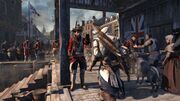 Connor Kenway being halted by a British soldier.
 -
 Connor fighting three British soldiers.
 -
British officers.
.jpg)
.jpg)
