

Boston: Difference between revisions
imported>AOHistSupport No edit summary |
imported>Vatsa1708 m Right. And has any of this been mentioned in ACIII? |
||
| Line 1: | Line 1: | ||
{{Era|AC3}} | {{Era|AC3}} | ||
{{WP-REAL}} | {{WP-REAL}} | ||
Revision as of 07:17, 31 May 2012

.jpg)
Boston is a city in the United States, and the capital of Massachusetts.
During the American Revolution, Boston was an important location to both the American and British armies, and was frequently visited by the Assassin Connor Kenway.
Physical Characteristics
At the time of the Revolution, Boston was densely populated (the third largest city in the American colonies)[1], yet physically small. The city proper was located on a small peninsula, called the Shawmut Peninsula, surrounded by the Boston Harbor on two sides and the Charles River on a third. Boston was connected to the Massachusetts mainland by a thin isthmus called the Boston Neck, which measured roughly 120 feet across.[2] The isthmus made the city extraordinarily defensible, but also made it easy to lay siege to. George Washington would exploit this weakness during the early years of the American Revolution.
On Castle Island in Boston Harbor, a fort defended the city from sea-based attacks. Settlers built the first fort, an earthen fortification, in 1634. In 1701, the British rebuilt the fort in stone and named it Castle William (shown above) in honor of the reigning king, William III. After retreating British forces destroyed Fort William in 1775, American patriots seized the remains and rebuilt it as Fort Adams (named after the Founding Father, John Adams) in 1776. [3]
The center of the city holds a large green space, the Boston Common. Though a park today, during the Colonial Era, the Common was just that - land owned in common by the citizens of Boston. Residents used the Common as a cow pasture until 1830. In 1768, British regular troops occupied the city of Boston in an attempt to quell civil unrest, and used the Common as an encampment. The British abandoned the camp, along with the rest of the city, in 1776.[4]
History of the City
Founding
English Puritan settlers of the Massachusetts Bay Company founded the town of Boston on September 17, 1630. Originally, the Puritans intended the town to be a beacon of morality and religiously devout living, "a City upon a Hill," in the words of its governor, John Winthrop. As such, many laws enforced Biblical commandments and what many today would consider moral behavior.[5] Exceptional fishing, plentiful forests, and an excellent harbor soon transformed the town into a commercial center, and many of the Puritan residents found both spiritual and fiscal satisfaction through their strong work ethic.
The Age of the Imperial Crisis
By the 1760s, Boston was a thriving city of roughly 18,000 British colonials. The British government, finding themselves in tremendous debt after the French and Indian War (called the Seven Years' War in Europe), resolved to impose taxes on the American colonies in order to recoup a portion of their losses. Many Boston residents resented the taxes and considered them an infringement of their rights as British subjects. The British Parliament sent military troops to the city to assist in the collection of taxes, and the result was pure animosity between the soldiers and residents.
On March 5, 1770, the situation in Boston reached a head when British troops fired into an mob of Bostonians armed with snowballs and stones. Five civilians died in the incident later named by Boston silversmith Paul Revere the "Boston Massacre." The Massacre only served to increase the tensions in the city. Continued taxation, especially on tea, generated more unrest. In late 1773, members of the Sons of Liberty, a Patriot group, snuck onto ships in the Harbor. Disguised as Mohawk Indians, the Sons of Liberty thew the ship's cargo of tea into the Harbor. The Boston Tea Party, as it was called, served as a form of political protest against what many colonists considered unfair taxes. What it did was force the British government to clamp down on the city and place it under direct Parliamentary control.
As British troops garrisoned the town and placed it under military rule, Patriots stored caches of arms and gunpowder in the outlying villages of Concord and Lexington. In 1775, British troops moved out towards those villages to seize the guns and ammunition, as well as to arrest Patriot leaders hiding in the area. Ahead of them, Revere, William Dawes, and Samuel Prescott rode to warn residents of the approaching troops and rouse the local militia. These "Minutemen" met and engaged the British troops on April 9, 1775 and drove them back to the relative safety of Boston. The American Revolution had begun.
Boston in the Revolution
The Continental Congress in Philadelphia considered the relief of Boston to be one of the most immediate concerns of the Patriot cause. The city was not only a symbol of the Revolution, it was a location of immense strategic value. The Congress tasked their newly-appointed Commander-in-Chief, George Washington, with organizing the various militia troops surrounding Boston and forcing the British from the city. Washington quickly blocked off the Boston Neck and laid the city under siege.
Gallery
-
 Connor standing by the port.
 -
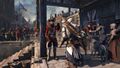 Connor halted by a Redcoat in Boston.

.jpg)
Source
GameInformer April 2012 issue: Assassin's Creed III