Database: Hegra: Difference between revisions
imported>Darman36 No edit summary |
|||
| (7 intermediate revisions by 2 users not shown) | |||
| Line 1: | Line 1: | ||
[[File:ACMir VoM DB - Hegra.webp|right|250px]] | |||
Located about twenty kilometers north of the [[ | Located about twenty kilometers north of the [[AlUla Oasis]], the [[Hegra]] Archaeological Site is an exceptional testimony to the region's strategic position in antiquity and is the first property in {{Wiki|Saudi Arabia}} to be inscribed on {{Wiki|UNESCO}}'s {{Wiki|Lists of World Heritage Sites|World Heritage List}}. It was an essential stop on the [[Incense Road|Incense Route]], a major path of travel between sources of {{Wiki|frankincense}} and {{Wiki|myrrh}} in southern [[Arabia]], the [[Mediterranean Sea|Mediterranean]] world, and elsewhere, through the {{Wiki|Arabian Peninsula}} in [[Nabataean Kingdom|Nabataean times]]. It is a civilizational crossroads in terms of architecture, languages, and commercial goods connecting Arab, Mesopotamian, [[Egypt]]ian, and {{Wiki|Hellenistic period|Hellenistic}} cultures. Additionally, it is an extraordinary heritage site, notably for its nearly 100 ornately carved tomb facades, creations of Nabataean culture in mostly the 1st century CE, and an extensive water management system. There are also numerous inscriptions testifying to multiple cultural influences of the region, including {{Wiki|Dadanitic}}, {{Wiki|Nabataean Aramaic|Nabataean}}, {{Wiki|Greek language|Greek}}, and {{Wiki|Latin}}! | ||
The Hegra Archaeological Site (al-Hijr / Mada'in Salih) is the first World Heritage property to be inscribed in Saudi Arabia on UNESCO's World Heritage List in 2008. | The Hegra Archaeological Site (al-Hijr / Mada'in Salih) is the first World Heritage property to be inscribed in Saudi Arabia on UNESCO's World Heritage List in 2008. | ||
==Gallery== | |||
<gallery captionalign="center" position="center" widths="180"> | |||
DTA Hegra.png|General view of Hegra, with two tombs in the foreground and [[Ithlib Mountain]] in the background. | |||
</gallery> | |||
[[Category:Database: AlUla]] | [[Category:Database: AlUla]] | ||
[[Category:Database: A Cultural Hub]] | |||
{{DEFAULTSORT:Hegra}} | {{DEFAULTSORT:Hegra}} | ||
Latest revision as of 04:20, 7 October 2026

Located about twenty kilometers north of the AlUla Oasis, the Hegra Archaeological Site is an exceptional testimony to the region's strategic position in antiquity and is the first property in Saudi Arabia to be inscribed on UNESCO's World Heritage List. It was an essential stop on the Incense Route, a major path of travel between sources of frankincense and myrrh in southern Arabia, the Mediterranean world, and elsewhere, through the Arabian Peninsula in Nabataean times. It is a civilizational crossroads in terms of architecture, languages, and commercial goods connecting Arab, Mesopotamian, Egyptian, and Hellenistic cultures. Additionally, it is an extraordinary heritage site, notably for its nearly 100 ornately carved tomb facades, creations of Nabataean culture in mostly the 1st century CE, and an extensive water management system. There are also numerous inscriptions testifying to multiple cultural influences of the region, including Dadanitic, Nabataean, Greek, and Latin!
The Hegra Archaeological Site (al-Hijr / Mada'in Salih) is the first World Heritage property to be inscribed in Saudi Arabia on UNESCO's World Heritage List in 2008.
Gallery[edit | edit source]
-
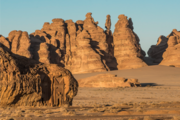 General view of Hegra, with two tombs in the foreground and Ithlib Mountain in the background.
