Welcome to Assassin's Creed Wiki! Log in and join the community.
Database: Rites of Passage: Difference between revisions
Jump to navigation
Jump to search
mNo edit summary |
mNo edit summary |
||
| (One intermediate revision by one other user not shown) | |||
| Line 1: | Line 1: | ||
[[File:ACMir VoM DB - Rites of Passage.webp|right|250px]] | [[File:ACMir VoM DB - Rites of Passage.webp|right|250px]] | ||
Ithlib Mountain contained sacred and functional spaces for the [[Nabataeans]]. There are a number of niches carved into the rock faces, to house {{Wiki|Baetyl|betyls}} (from the {{Wiki|Semitic languages|Semitic}} "Beit-il", divine dwelling), rectangular [[stone]]s symbolizing {{Wiki|Nabataean religion|Nabataean deities}}. Most of the betyls are {{Wiki|Aniconism|aniconic}}, without faces or defined features. Meetings, of which little is known, were held in a large room dug out from the rock called a {{Wiki|triclinium}} ("three benches" in Latin), intended for banquets and ritual feasting. In Arabic, this is now referred to as the {{Wiki|Divan|diwan}}. Water in Ithlib was supplied by an ingenious system of channels, cisterns and reservoirs fed by rainwater. | Ithlib Mountain contained sacred and functional spaces for the [[Nabataeans]]. There are a number of niches carved into the rock faces, to house {{Wiki|Baetyl|betyls}} (from the {{Wiki|Semitic languages|Semitic}} "Beit-il", divine dwelling), rectangular [[stone]]s symbolizing {{Wiki|Nabataean religion|Nabataean deities}}. Most of the betyls are {{Wiki|Aniconism|aniconic}}, without faces or defined features. Meetings, of which little is known, were held in {{Wiki|ar:ديوان جبل أثلب|a large room}} dug out from the rock called a {{Wiki|triclinium}} ("three benches" in Latin), intended for banquets and ritual feasting. In Arabic, this is now referred to as the {{Wiki|Divan|diwan}}. Water in Ithlib was supplied by an ingenious system of channels, cisterns and reservoirs fed by rainwater. | ||
==Gallery== | |||
<gallery captionalign="center" position="center" widths="180"> | |||
DTA Rites of Passage.png|An unfinished Nabataean niche sheltering a betyl carved in Hegra. | |||
</gallery> | |||
[[Category:Database: AlUla]] | [[Category:Database: AlUla]] | ||
[[Category:Database: Honoring the Dead]] | [[Category:Database: Honoring the Dead]] | ||
{{DEFAULTSORT:Rites of Passage}} | {{DEFAULTSORT:Rites of Passage}} | ||
Latest revision as of 18:50, 3 October 2026

Ithlib Mountain contained sacred and functional spaces for the Nabataeans. There are a number of niches carved into the rock faces, to house betyls (from the Semitic "Beit-il", divine dwelling), rectangular stones symbolizing Nabataean deities. Most of the betyls are aniconic, without faces or defined features. Meetings, of which little is known, were held in a large room dug out from the rock called a triclinium ("three benches" in Latin), intended for banquets and ritual feasting. In Arabic, this is now referred to as the diwan. Water in Ithlib was supplied by an ingenious system of channels, cisterns and reservoirs fed by rainwater.
Gallery[edit | edit source]
-
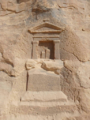 An unfinished Nabataean niche sheltering a betyl carved in Hegra.
