

-
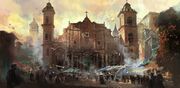 Concept art of the cathedral
 -
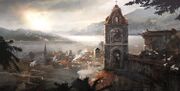 Concept art of the cathedral's rooftop
 -
 Concept art of Havana's architecture, including the cathedral
 -
 Concept art of an Assassin overlooking the plaza
 -
 Concept art of festivities at the plaza
Welcome to Assassin's Creed Wiki! Log in and join the community.
Cathedral of Havana: Difference between revisions
Jump to navigation
Jump to search
mNo edit summary |
m Text replacement - "{{Landmarks Infobox" to "{{Landmark Infobox" |
||
| (3 intermediate revisions by one other user not shown) | |||
| Line 1: | Line 1: | ||
{{Era|Landmarks}}{{WP-REAL|Havana Cathedral}} | {{Era|Landmarks}}{{WP-REAL|Havana Cathedral}} | ||
{{ | {{Landmark Infobox | ||
|image = Cathedral of Havana.jpg | |image = Cathedral of Havana.jpg | ||
|description = [[Havana]]'s largest and most famous cathedral. | |description = [[Havana]]'s largest and most famous cathedral. | ||
| Line 8: | Line 8: | ||
|features = [[Viewpoint]] | |features = [[Viewpoint]] | ||
}} | }} | ||
The '''Cathedral of Havana''', referred to in full as '''La Catedral de la Virgen María de la Concepción Inmaculada de La Habana''' (English: ''Cathedral of The Virgin Mary of the Immaculate Conception''), is a cathedral located in [[Havana]], [[Cuba]]. It also serves as the seat of the {{Wiki|Roman Catholic Archdiocese of San Cristobal de la Habana}}. | The '''Cathedral of Havana''',<ref name="Wiki">{{WP|Havana Cathedral}}</ref> referred to in full as '''La Catedral de la Virgen María de la Concepción Inmaculada de La Habana'''<ref name="Database">''[[Assassin's Creed IV: Black Flag]]'' – [[Database: Cathedral of Havana]]</ref> (English: ''Cathedral of The Virgin Mary of the Immaculate Conception''), is a [[Church|cathedral]] located in [[Havana]], [[Cuba]]. It also serves as the seat of the {{Wiki|Roman Catholic Archdiocese of San Cristobal de la Habana}}.<ref name="Wiki"/> | ||
The cathedral was built on the site of an earlier smaller church; construction began in 1748 and finished many years later, in 1777. | The cathedral was built on the site of an earlier smaller church; construction began in 1748 and finished many years later, in 1777. Constructed in a {{Wiki|Baroque architecture|Baroque}} style, it features many curves and double curves that turn into column-like {{Wiki|pilaster}} structures within the façade. The obvious asymmetry and the use of [[Atlantic Ocean|Atlantic]] [[coral]] as construction material make it a unique house of worship.<ref name="Database"/> | ||
In 1722, [[Edward Kenway]] visited the site whereupon the cathedral would be built 26 years later, believing he would find there his [[assassination]] target, the [[West Indies Rite of the Templar Order|Caribbean Templars]]' [[Grand Master of the Templar Order|Grand Master]] [[Laureano de Torres y Ayala]]. Instead, he found Torres' bodyguard, [[El Tiburón]], whom he followed to the [[Castillo de San Salvador de la Punta]].<ref name="AC4">''[[Assassin's Creed IV: Black Flag]]'' – [[Tainted Blood]]</ref> | |||
In | In 2013, when a [[Noob|research analyst]] at [[Abstergo Entertainment]] relived Edward's [[Genetic memory|genetic memories]],<ref name="AC4Modern">''[[Assassin's Creed IV: Black Flag]]'' – [[21st century conversations|Modern day]]</ref> they saw that Abstergo had anachronistically included a simulated church model due to its status as a recognizable modern landmark.<ref name="Database"/> While exploring the temporally-displaced monument, they found two [[Animus data fragment]]s.<ref name="AC4Modern"/> | ||
==Gallery== | ==Gallery== | ||
| Line 47: | Line 43: | ||
[[Category:Viewpoints]] | [[Category:Viewpoints]] | ||
[[Category:Churches]] | [[Category:Churches]] | ||
Latest revision as of 23:50, 31 August 2026
The Cathedral of Havana,[1] referred to in full as La Catedral de la Virgen María de la Concepción Inmaculada de La Habana[2] (English: Cathedral of The Virgin Mary of the Immaculate Conception), is a cathedral located in Havana, Cuba. It also serves as the seat of the Roman Catholic Archdiocese of San Cristobal de la Habana.[1]
The cathedral was built on the site of an earlier smaller church; construction began in 1748 and finished many years later, in 1777. Constructed in a Baroque style, it features many curves and double curves that turn into column-like pilaster structures within the façade. The obvious asymmetry and the use of Atlantic coral as construction material make it a unique house of worship.[2]
In 1722, Edward Kenway visited the site whereupon the cathedral would be built 26 years later, believing he would find there his assassination target, the Caribbean Templars' Grand Master Laureano de Torres y Ayala. Instead, he found Torres' bodyguard, El Tiburón, whom he followed to the Castillo de San Salvador de la Punta.[3]
In 2013, when a research analyst at Abstergo Entertainment relived Edward's genetic memories,[4] they saw that Abstergo had anachronistically included a simulated church model due to its status as a recognizable modern landmark.[2] While exploring the temporally-displaced monument, they found two Animus data fragments.[4]
Gallery[edit | edit source]


-
 A group of Templars gathered at the Plaza de la Catedral
 -
 Edward meeting up with Rhona Dinsmore near the cathedral


Appearances[edit | edit source]
- Assassin's Creed IV: Black Flag (first appearance)
- Assassin's Creed: Black Flag (indirect mention only)
- Assassin's Creed: Identity – Black Flag Update (appears in deleted scene(s) only)
