Welcome to Assassin's Creed Wiki! Log in and join the community.

Barbican of Jerusalem: Difference between revisions
Jump to navigation
Jump to search
imported>StPerkele Created page with " {{Era|AC1}} {{Conjecture}} {{Stub}} {{Memory Infobox |image = Barbacanmain.png|thumb|310px |description = A huge fortification. |appearance = ''Assassin's Creed'' |..." |
m Text replacement - ">''Assassin's Creed''" to ">''Assassin's Creed''" |
||
| (26 intermediate revisions by 18 users not shown) | |||
| Line 1: | Line 1: | ||
{{Era|Landmarks}} | |||
{{Conjecture}} | |||
{{Landmark Infobox | |||
|image=Ac1 Barbican of Jerusalem.png | |||
|description=A large fortification in [[Jerusalem]] | |||
|location=Jerusalem's Rich District | |||
|architect= | |||
|dateconstructed= | |||
|datedestroyed= | |||
|abandoned= | |||
|functions= | |||
|affiliation= | |||
|other factions= | |||
|features= | |||
|price= | |||
|events= | |||
}} | |||
The '''Barbican of Jerusalem '''was a fortification in [[Jerusalem]]'s Rich District, located just next to the [[Bab Ariha]] and [[Saint Anne's Church]]. The barbican was surrounded by walls and consisted of one guarded entrance gate and one exit.<ref>''[[Assassin's Creed]]''</ref> Inside its walls was a building which contained the [[Levantine Rite of the Templar Order|Levantine Templar]] [[Slavery|slaver]] [[Talal]]'s warehouse where he kept his [[human]] cargo. In 1191, the [[Levantine Brotherhood of Assassins|Levantine Assassin]] [[Altaïr Ibn-La'Ahad]] infiltrated the barbican in order to assassinate Talal.<ref>''[[Assassin's Creed]]'' – [[Assassination (Talal)]]</ref> | |||
==Behind the scenes== | |||
Although the Barbican of Jerusalem's design corresponds to a typical barbican, the expression does not apply, since barbicans are usually located on the outer side of a city's walls. | |||
==Gallery== | |||
<gallery captionalign="center" position="center" widths="180"> | |||
Barbacanmain.png|Altaïr inside the barbican | |||
</gallery> | |||
==Appearances== | |||
*''[[Assassin's Creed]]'' {{1st}} | |||
*''[[Assassin's Creed: The Secret Crusade]]'' | |||
==References== | |||
== | {{Reflist}} | ||
[[Category:Landmarks in Jerusalem]] | |||
{{ | |||
[[Category:Landmarks | |||
Latest revision as of 17:14, 22 September 2026

|
I wanted to ask you something. Which is... what's your name? This article title is conjecture. Although the article subject is canon, no official name for it has been given. |
The Barbican of Jerusalem was a fortification in Jerusalem's Rich District, located just next to the Bab Ariha and Saint Anne's Church. The barbican was surrounded by walls and consisted of one guarded entrance gate and one exit.[1] Inside its walls was a building which contained the Levantine Templar slaver Talal's warehouse where he kept his human cargo. In 1191, the Levantine Assassin Altaïr Ibn-La'Ahad infiltrated the barbican in order to assassinate Talal.[2]
Behind the scenes[edit | edit source]
Although the Barbican of Jerusalem's design corresponds to a typical barbican, the expression does not apply, since barbicans are usually located on the outer side of a city's walls.
Gallery[edit | edit source]
-
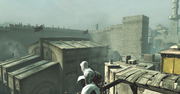 Altaïr inside the barbican

Appearances[edit | edit source]
- Assassin's Creed (first appearance)
- Assassin's Creed: The Secret Crusade