Database: Roman Life in AlUla: Difference between revisions
mNo edit summary |
|||
| (3 intermediate revisions by one other user not shown) | |||
| Line 1: | Line 1: | ||
[[File:ACMir VoM DB - Roman Life in AlUla.webp| | [[File:ACMir VoM DB - Roman Life in AlUla.webp|right|250px]] | ||
During antiquity, the [[Roman Empire]] gradually spread around the [[Mediterranean Sea|Mediterranean]] and beyond, particularly in North [[Africa]], [[Egypt]], but also in [[Anatolia|Asia Minor]] and southwestern [[Asia]]. A huge area of prosperity and trade, the Empire was interested in the [[Arabia]]n trade routes that supplied incense, spices, and other goods from the region itself or from further east and south. Established in [[Jordan]], the [[Nabataean Kingdom]] became a key partner and was annexed into the Empire in 106 CE, under the reign of [[Trajan]]. Roman presence then spread further including at [[Hegra]] where a Roman garrison established a [[fort]] to protect and collect charges along this trade route. Little is known about the life of the [[Roman army|legionaries]] there, except that they belonged to {{Wiki|Legio III Cyrenaica|Legion III}} of [[Cyrenaica]] (a region of present-day [[Libya]]) and that the fort was perhaps the southernmost inland fortified post in the Empire. Despite nomadic [[raid]]s and the threat of the {{Wiki|Parthian Empire}}, Rome's rival centered in [[Iran|Persia]], this area of the Empire remained under the influence of Rome for many centuries. A strong new political chapter started with the establishment of the [[Arabia|Arab]]-[[Islam|Muslim]] [[Umayyad Caliphate|caliphate]] in the seventh century CE. | During antiquity, the [[Roman Empire]] gradually spread around the [[Mediterranean Sea|Mediterranean]] and beyond, particularly in North [[Africa]], [[Egypt]], but also in [[Anatolia|Asia Minor]] and southwestern [[Asia]]. A huge area of prosperity and trade, the Empire was interested in the [[Arabia]]n trade routes that supplied incense, spices, and other goods from the region itself or from further east and south. Established in [[Jordan]], the [[Nabataean Kingdom]] became a key partner and was annexed into the Empire in 106 CE, under the reign of [[Trajan]]. Roman presence then spread further including at [[Hegra]] where a Roman garrison established a [[fort]] to protect and collect charges along this trade route. Little is known about the life of the [[Roman army|legionaries]] there, except that they belonged to {{Wiki|Legio III Cyrenaica|Legion III}} of [[Cyrenaica]] (a region of present-day [[Libya]]) and that the fort was perhaps the southernmost inland fortified post in the Empire. Despite nomadic [[raid]]s and the threat of the {{Wiki|Parthian Empire}}, Rome's rival centered in [[Iran|Persia]], this area of the Empire remained under the influence of Rome for many centuries. A strong new political chapter started with the establishment of the [[Arabia|Arab]]-[[Islam|Muslim]] [[Umayyad Caliphate|caliphate]] in the seventh century CE. | ||
==Gallery== | |||
<gallery captionalign="center" position="center" widths="180"> | |||
DTA The Romans in AlUla 1.png|Two coins: a [[silver]] one showing the Roman emperor Trajan, and on the {{Wiki|Obverse and reverse|reverse}} a camel representing his conquest of Arabia... | |||
DTA The Romans in AlUla 2.png|...and a bronze one showing the empress {{Wiki|Tranquillina}}. | |||
DTA The Romans in AlUla 3.png|Two Latin inscriptions in [[stone]], one engraved... | |||
DTA The Romans in AlUla 4.png|...the other painted, dedicated to Roman emperors and officials. | |||
</gallery> | |||
[[Category:Database: AlUla]] | [[Category:Database: AlUla]] | ||
[[Category:Database: A Cultural Hub]] | |||
{{DEFAULTSORT:Roman Life in AlUla}} | {{DEFAULTSORT:Roman Life in AlUla}} | ||
Latest revision as of 05:50, 10 October 2026

During antiquity, the Roman Empire gradually spread around the Mediterranean and beyond, particularly in North Africa, Egypt, but also in Asia Minor and southwestern Asia. A huge area of prosperity and trade, the Empire was interested in the Arabian trade routes that supplied incense, spices, and other goods from the region itself or from further east and south. Established in Jordan, the Nabataean Kingdom became a key partner and was annexed into the Empire in 106 CE, under the reign of Trajan. Roman presence then spread further including at Hegra where a Roman garrison established a fort to protect and collect charges along this trade route. Little is known about the life of the legionaries there, except that they belonged to Legion III of Cyrenaica (a region of present-day Libya) and that the fort was perhaps the southernmost inland fortified post in the Empire. Despite nomadic raids and the threat of the Parthian Empire, Rome's rival centered in Persia, this area of the Empire remained under the influence of Rome for many centuries. A strong new political chapter started with the establishment of the Arab-Muslim caliphate in the seventh century CE.
Gallery[edit | edit source]
-
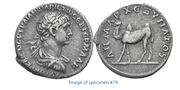
-
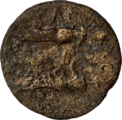 ...and a bronze one showing the empress Tranquillina.
 -
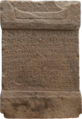 Two Latin inscriptions in stone, one engraved...
 -
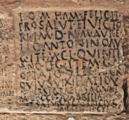 ...the other painted, dedicated to Roman emperors and officials.


