Database: The Thriving Town: Difference between revisions
mNo edit summary |
|||
| (6 intermediate revisions by one other user not shown) | |||
| Line 1: | Line 1: | ||
[[File:ACMir VoM DB - The Thriving Town.webp|right|250px]] | |||
It is very difficult to date the first occupation of the site where [[Al-Ula Valley|AlUla]]'s [[Al-Ula|Old Town]] stands today. It is located at an advantageous position: on a naturally raised area along the western side of the valley where it narrows, with a large outcrop to offer a defensive look out point. The first settlement may date back to the {{Wiki|Lihyan|Dadanite and Lihyanite}} times, during the first millennium BCE. We know much more about the settlement during the [[Islam]]ic [[Ayyubid dynasty|era]], around 1200 CE onwards. There was nothing like the opulent estate of Nimlot, which was invented as a creative choice by the developers. However, it was indeed a prosperous town with notable agricultural resources due to the natural availability of water and fertile soil in the valley. There were hundreds of mostly small mud-brick houses huddled together in a maze of narrow lanes designed to preserve coolness. These houses generally had two floors connected by an internal staircase. Notably, it was not uncommon to build an additional room upstairs, known as a [[wikt:طيارة|tayyarah]], which spanned the street to the opposite house. In an open area along the east side of the town, the tantora, a sundial, was erected. When its shadow reached a certain stone—embedded at a precise distance in the ground in front of it—on the {{Wiki|Winter at Tantora Festival|winter solstice}} each year, a water distribution regime through the cultivated oasis farms went into effect. The security of the town was ensured by the connected exterior facades of the houses at the perimeter, effectively creating a defensive wall with very few gates, to which was added the [[fort]] on the outcrop at an ideal spot for observation. Outside the walls, there was an open-air market for the exchange of goods coming from afar. The town was occupied continuously until the creation of a new AlUla with modern amenities in the 1980s. | It is very difficult to date the first occupation of the site where [[Al-Ula Valley|AlUla]]'s [[Al-Ula|Old Town]] stands today. It is located at an advantageous position: on a naturally raised area along the western side of the valley where it narrows, with a large outcrop to offer a defensive look out point. The first settlement may date back to the {{Wiki|Lihyan|Dadanite and Lihyanite}} times, during the first millennium BCE. We know much more about the settlement during the [[Islam]]ic [[Ayyubid dynasty|era]], around 1200 CE onwards. There was nothing like the opulent estate of Nimlot, which was invented as a creative choice by the developers. However, it was indeed a prosperous town with notable agricultural resources due to the natural availability of water and fertile soil in the valley. There were hundreds of mostly small mud-brick houses huddled together in a maze of narrow lanes designed to preserve coolness. These houses generally had two floors connected by an internal staircase. Notably, it was not uncommon to build an additional room upstairs, known as a [[wikt:طيارة|tayyarah]], which spanned the street to the opposite house. In an open area along the east side of the town, the tantora, a sundial, was erected. When its shadow reached a certain stone—embedded at a precise distance in the ground in front of it—on the {{Wiki|Winter at Tantora Festival|winter solstice}} each year, a water distribution regime through the cultivated oasis farms went into effect. The security of the town was ensured by the connected exterior facades of the houses at the perimeter, effectively creating a defensive wall with very few gates, to which was added the [[fort]] on the outcrop at an ideal spot for observation. Outside the walls, there was an open-air market for the exchange of goods coming from afar. The town was occupied continuously until the creation of a new AlUla with modern amenities in the 1980s. | ||
==Gallery== | |||
<gallery captionalign="center" position="center" widths="180"> | |||
DTA The Thriving Town.png|Aerial view of the Old Town and its [[AlUla Oasis|oasis]], separated today by a modern road, with remains of mud brick buildings: tightly packed in the town, and within individual farms and gardens in the oasis. | |||
</gallery> | |||
[[Category:Database: AlUla]] | [[Category:Database: AlUla]] | ||
[[Category:Database: Life in the Oasis]] | |||
{{DEFAULTSORT:The Thriving Town}} | {{DEFAULTSORT:The Thriving Town}} | ||
Latest revision as of 05:38, 10 October 2026

It is very difficult to date the first occupation of the site where AlUla's Old Town stands today. It is located at an advantageous position: on a naturally raised area along the western side of the valley where it narrows, with a large outcrop to offer a defensive look out point. The first settlement may date back to the Dadanite and Lihyanite times, during the first millennium BCE. We know much more about the settlement during the Islamic era, around 1200 CE onwards. There was nothing like the opulent estate of Nimlot, which was invented as a creative choice by the developers. However, it was indeed a prosperous town with notable agricultural resources due to the natural availability of water and fertile soil in the valley. There were hundreds of mostly small mud-brick houses huddled together in a maze of narrow lanes designed to preserve coolness. These houses generally had two floors connected by an internal staircase. Notably, it was not uncommon to build an additional room upstairs, known as a tayyarah, which spanned the street to the opposite house. In an open area along the east side of the town, the tantora, a sundial, was erected. When its shadow reached a certain stone—embedded at a precise distance in the ground in front of it—on the winter solstice each year, a water distribution regime through the cultivated oasis farms went into effect. The security of the town was ensured by the connected exterior facades of the houses at the perimeter, effectively creating a defensive wall with very few gates, to which was added the fort on the outcrop at an ideal spot for observation. Outside the walls, there was an open-air market for the exchange of goods coming from afar. The town was occupied continuously until the creation of a new AlUla with modern amenities in the 1980s.
Gallery[edit | edit source]
-
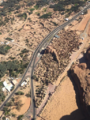 Aerial view of the Old Town and its oasis, separated today by a modern road, with remains of mud brick buildings: tightly packed in the town, and within individual farms and gardens in the oasis.
