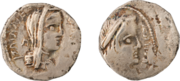
Database: Dadanite/Lihyanite & Nabataean Civilizations

Even today, it is challenging to clearly identify the chronology of the different authorities that dominated the AlUla region during the first millennium BCE. First, there was the Kingdom of Dadan, which began developing a settlement center already established at Dadan. Around 500 or 400 BCE, the Kingdom of Lihyan seems to have come to power, further aggrandizing Dadan as its capital. Both kingdoms took advantage of the exceptional location on the incense road to connect southern Arabia to the Levant, Egypt, and Mesopotamia. The Lihyanites also developed a remarkable culture. In addition to the local Dadanitic script used to engrave and carve hundreds of inscriptions in stone across the area, impressive colossal statues were carved in a local sculptural style. It is uncertain when and how the Nabataean Kingdom, whose capital was at Petra located in present-day Jordan, took control of the AlUla region, but it established its regional authority at Hegra, located about 20 km north of Dadan, by the middle of the 1st century BCE Nabataean wealth also relied on long-distance trade, and its culture adopted and adapted various external influences, such as Mesopotamia, Egypt, and Greece. Its craftsmen carved the magnificent tombs from the sandstone outcrops of Hegra. Although the Nabataean Kingdom was annexed by the Roman Empire in 106 CE, Nabataean culture thrived for centuries after.
Gallery[edit | edit source]
-
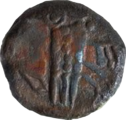 Liyhanite bronze coin
 -
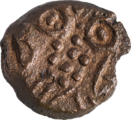 Liyhanite bronze coin
 -