

Wood

|
Patience, brothers. Soon we will reveal the secrets of Assassin's Creed III: Liberation, Assassin's Creed IV: Black Flag and Assassin's Creed: Rogue. This article has been identified as being out of date. Please update the article to reflect recent releases and then remove this template once done. |

Wood is the structural tissue that comprises the stems, branches, and roots of trees. The fibrous substance tends to be strong yet pliable, and as such it has been used throughout human history as a staple construction material.
Lumber and timber are terms for wood which has been processed into planks and beams. While 'wood' refers to the material, 'woods' is a synonym for a woodland and even forest.[1][2]
Trade[edit | edit source]
Those working with wood were commonly called woodworkers, though carpenters and joiners were two separate occupations under that collective noun.[3]
History[edit | edit source]
Classical antiquity[edit | edit source]

In the 5th century BCE, the most common wood used in Greece was that of olive trees due to their ubiquity throughout the region.[4]
Given Egypt's climate and the deserts ruling the landscape, wood was highly valued even during the Ptolemaic reign. At the time, the most commonly available wood was cedar.[5]
Italian Renaissance[edit | edit source]
Pine and oak, particularly holm oak, were two of the most common kinds of wood used throughout Europe in the 15th and 16th centuries. Soldiers relied on pine for crafting arrows, shields, and war hammers but turned to holm oak for crossbow bolts, fire pots, and the poles of pikes. Oak, elm, and fir were used in the construction of ships like carracks. The frames of cannons were built with olive wood.[6]
In Venice, Italy, gondolas were made using eight different kinds of woods, including mahogany, cherry, fir, walnut, oak, elm, larch, and lime.[7]
Spanish Renaissance[edit | edit source]
During the Reconquista, the Spanish Brotherhood of Assassins used wood to grow and renovate their base-of-operations at Sierra de Cazorla and had a dedicated supply room in order to send for both wood and stone.[8]
American Revolution[edit | edit source]
During the American Revolutionary War for independence from the British Empire, the Colonial Assassin Ratonhnhaké:ton and the artisans living at the Davenport Homestead made ample use of numerous varieties of wood in their products, including ash, maple, oak, pine, hickory, spruce, and rosewood.[9]
Behind the scenes[edit | edit source]
Crafting[edit | edit source]
Wood is used as a crafting material across several Assassin's Creed games.
In Assassin's Creed: Project Legacy, several types of wood were available as material in crafting. These were pine, oak, holm oak, elm, fir, and olive wood, and they were needed for the construction of barricades, carracks, cannons, and various weapons.
Gallery[edit | edit source]
-
 Ash lumber
 -
 Birch lumber
 -
 Cherry lumber
 -
 Fir lumber
 -
 Hickory lumber
 -
 Maple lumber
 -
 Oak lumber
 -
 Pine lumber
 -
 Rosewood lumber
 -
 Spruce lumber
 -
 Walnut lumber
 -
 Wood
Wood -
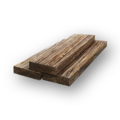 Wood planks
 -
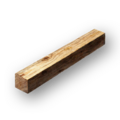 Oak wood


Appearances[edit | edit source]
 This list is incomplete. You can help the Assassin's Creed Wiki by expanding it. This list is incomplete. You can help the Assassin's Creed Wiki by expanding it.
|
|---|
- Assassin's Creed
- Assassin's Creed: Altaïr's Chronicles
- Assassin's Creed II
- Assassin's Creed: The Secret Crusade
- Assassin's Creed: Project Legacy
- Assassin's Creed: The Chain
- Assassin's Creed III
- Assassin's Creed IV: Black Flag
- Assassin's Creed: Origins
- Assassin's Creed: Odyssey
- Assassin's Creed: Rebellion
- Assassin's Creed: Valhalla
- Discovery Tour: Viking Age
- Assassin's Creed: Mirage
- The Forty Thieves
- Valley of Memory (mentioned only)
- Assassin's Creed: Nexus VR (mentioned in Database entry only)
- Assassin's Creed Roleplaying Game (mentioned only)
- Assassin's Creed: Shadows
