
Temple of Pythagoras
| This article is about the temple itself. You may be looking for the memory set in the temple. |
- Salaì: "[Leonardo] found the entrance to a temple, something he read about in his books. I have not seen him that excited in years. [...] The temple contains the perfect number, something discovered by some scholar from Grecia."
- Ezio: "Pythagoras."
- —Salaì and Ezio Auditore, regarding Leonardo da Vinci's discovery, 1506.[src]-[m]
The Temple of Pythagoras was an ancient temple built by the Pythagoreans, the followers of Pythagoras. It could be accessed through a hidden catacomb beneath Rome and led to an Isu temple, the Pythagorean Vault. The catacomb also concealed the entrance to a Templar lair where the Order stored scrolls, manuscripts, and the Hidden Blade designs stolen by Pietro de Galencia from the Villa Auditore.
The Pythagoreans believed that the forces of nature could be translated into numbers, and that mathematics could allow man to harness nature's power. The temple was said to contain the Pythagorean Unifier, the perfect number that was coupled to everything in nature, and could open the minds of men.
History[edit | edit source]
Hermeticists[edit | edit source]
During his time at the Villa Auditore, Leonardo da Vinci researched the Temple of Pythagoras and discovered it to be within a hidden catacomb. He drew a map to the catacomb entrance, and used invisible ink to sketch the pieces of the map onto his paintings on the villa walls.[1] However, when the city was attacked, the paintings fell into the hands of the Borgia family.[2]
As Leonardo continued his research in Rome, he eventually came into contact with the Cult of Hermes, a secret order that had counted Pythagoras among their numbers. Leonardo frequently visited the personal library of the Cult's leader, Ercole Massimo, in order to acquire even more information on the temple.[2]
After years of exploring the hidden catacombs, Leonardo finally discovered the entrance to the temple itself. Because of this, he was kidnapped by the Hermeticists in 1506, who desired the location of the temple and the Pythagorean Unifier, in order to use it to "remake humanity."[2] They brought the artist down into the catacombs, and began attempting to beat the answer out of him.[3]

A friend of Leonardo's, the Assassin Ezio Auditore, managed to gather the villa paintings and follow the map to the catacombs.[1] After Ezio rescued Leonardo from the cultists, Leonardo insisted that they needed to enter the temple and destroy the perfect number, else they would risk "another madman discovering it."[3]
The two ventured deeper to explore the Temple of Pythagoras and passed through three chambers, which each represented an element; namely light, wind, and fire. Each chamber required an amount of free-running skill to traverse it, and activate the necessary mechanisms to open the door to the next room.[3]
They eventually came upon the final chamber, a Vault with a strange pedestal at its center. When Ezio placed his hand over it, his DNA communed with the pedestal, and revealed the supposed perfect number, the coordinates 43 39 19N 75 27 42W.[3]
Leonardo was devastated to realize that the number was meaningless, and Ezio coaxed him to simply leave the temple behind, as the message it held was not meant for them.[3]
Leaving the temple, Leonardo was escorted by an Assassin scout. After Ezio left, the Assassin explored the catacombs and found a secluded tunnel that was blocked by thick grates and a metal door locked shut. Through the grates, he spotted several scrolls and manuscripts, but one item in particular caught his attention: a small chest bearing the Assassins' mark. After reporting his findings to Niccolò Machiavelli, the scout and three other apprentices were sent to retrieve the chest, only to be captured and killed by Borgia guards, who later relocated the chest to the Palatine Hill.[4]
Giovanni Borgia[edit | edit source]

Around the 1530s, the Assassin Giovanni Borgia discovered a map to the Temple of Pythagoras and remembered that a member of his Order had visited it many years earlier. Though he knew Ezio had not found anything, he was convinced that he needed to travel there.[5]
Giovanni and his wife Maria Amiel thus travelled to Rome, and went through the catacombs. Maria noted that it was the "strangest place [she had] ever visited", and that none had likely entered the temple in decades.[5]
Just as Ezio had done, Giovanni easily activated each of the mechanisms within the temple, as well as the strange pedestal within its vault. The vault caused Giovanni to fall unconscious, and he seemed to become possessed by an otherworldly being that called itself "Consus".[5]
William Miles[edit | edit source]
After observing Ezio and Leonardo's visit to the temple through the genetic memories of Desmond Miles, William Miles and Harlan Cunningham discovered the true meaning of the "perfect number." After processing the coordinates, they flew to Turin, New York, the location of the Grand Temple.[6]
Behind the scenes[edit | edit source]
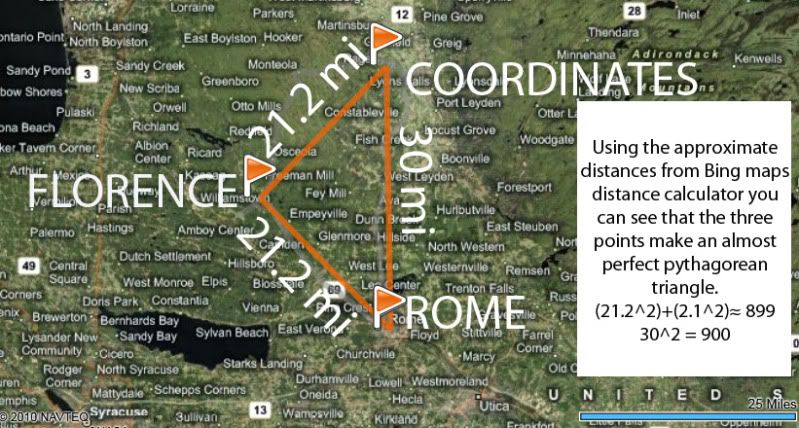
Connecting the Grand Temple's coordinates with Rome, New York to the South and Florence, New York to the West results in an almost perfect Pythagorean triangle.
Gallery[edit | edit source]
-
 The door to the Temple of Pythagoras
 -
 Leonardo opening the entrance
 -
 Ezio and Leonardo in the first chamber
 -
 The temple's second chamber
 -
 Ezio and Leonardo in the final chamber


Appearances[edit | edit source]
- Assassin's Creed: Brotherhood – The Da Vinci Disappearance (first appearance)
- Assassin's Creed: Project Legacy
- Assassin's Creed: Initiates (mentioned only)
- Assassin's Creed: Identity (mentioned in Database entry only)
References[edit | edit source]
- ↑ 1.0 1.1 Assassin's Creed: Brotherhood – The Da Vinci Disappearance – Decoding Da Vinci
- ↑ 2.0 2.1 2.2 Assassin's Creed: Brotherhood – The Da Vinci Disappearance – A Roll of the Dice
- ↑ 3.0 3.1 3.2 3.3 3.4 Assassin's Creed: Brotherhood – The Da Vinci Disappearance – The Temple of Pythagoras
- ↑ Assassin's Creed: Identity – Niccolò Machiavelli's journal – Entry #4: "An Assassin's Requiem"
- ↑ 5.0 5.1 5.2 Assassin's Creed: Project Legacy – Divine Science: Chapter 1 – Maria Amiel
- ↑ Assassin's Creed: Brotherhood – The Da Vinci Disappearance – Modern day