

Auto-da-fé
| This article is about the ritual. You may be looking for the memory of Arno Dorian or the memory of Aguilar de Nerha. |

|
Patience, brothers. Soon we will reveal the secrets of FamilyTreeDNA. This article has been identified as being out of date. Please update the article to reflect recent releases and then remove this template once done. |

An auto-da-fé (English: act of faith) was a ritual of public penance of condemned heretics.
The auto-da-fé was originally a ritual used by the Spanish Inquisition, in which the accused would prove their good faith to fellow Christians. However, the proceedings often ended with the accused being condemned to death, in some cases by burning at the stake, and so the term therefore came to refer to the burning itself.[1]
History
In 1491, the Templar Gaspar Martínez planned to burn a captive Assassin alive.[2] Fortunately, Italian Assassin Ezio Auditore assassinated Martínez and rescued the Assassin before the execution could be carried out.[3]
In 1492, a team of Spanish Assassins, led by Aguilar de Nerha, assassinated Gustavo Ramírez's executioner before he could perform an auto-da-fé.[4]
Later that year, Aguilar and his fellow Assassins Benedicto and María were subjected to the auto-da-fé in Seville by Tomás de Torquemada and the Spanish Inquisition. While the Mentor, Benedicto, was executed, Aguilar and Maria were able to free themselves and fight their away out of Seville to escape.[1]
In 1683, Francisco Rizi made the oil painting Auto de fe en la plaza Mayor de Madrid, which included Torquemada, King Ferdinand II of Aragon, and Queem Isabella I of Castile attending the auto-da-fé in 1492.[1]
During the French Revolution, auto-da-fé took on the meaning of a revolutionary act of faith directed against Christian clerics.[5]
In 2016, the Council of Elders had a copy of Rizi's auto-da-fe painting in their meeting room.[1]
Gallery
-
 Database image of an auto-da-fé
 -
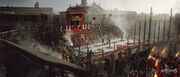 Concept art
 -
 Francisco Rizi's Auto de Fe en la plaza Mayor de Madrid
 -
 Auto de Fe en la plaza Mayor de Madrid in the Council of Elders' meeting room


Appearances
- Assassin's Creed II: Discovery (first appearance, as public burning)
- Assassin's Creed: Unity (first identified as Auto-da-fé)
- Assassin's Creed (film)
- Assassin's Creed: The Official Movie Novelization
- Assassin's Creed: Rebellion
References
- ↑ 1.0 1.1 1.2 1.3 Assassin's Creed (film)
- ↑ Assassin's Creed II: Discovery – Assassinate Gaspar Martínez
- ↑ Assassin's Creed II: Discovery – Rescue the Assassin
- ↑ Assassin's Creed: Rebellion – The Auto-Da-Fé
- ↑ Assassin's Creed: Unity – Database: Auto-da-fé