

Auto-da-fé: Difference between revisions
imported>Darman36 I think "Grand Inquisition" is a reference to the time period, eg. Belle Epoch, not the painting's name. |
imported>Darman36 Just reviewed the scene. No mention of anyone in the painting. Added trivia |
||
| Line 10: | Line 10: | ||
==History== | ==History== | ||
In 1491, the Templar [[Gaspar Martínez]] planned to burn a captive [[Assassins|Assassin]] alive.<ref>''[[Assassin's Creed II: Discovery]]'' – [[Assassinate Gaspar Martínez]]</ref> Fortunately, [[Italian Brotherhood of Assassins|Italian Assassin]] [[Ezio Auditore da Firenze|Ezio Auditore]] assassinated Martínez and rescued the Assassin before the execution could be carried out.<ref>''Assassin's Creed II: Discovery'' – [[Rescue the Assassin]]</ref> | In 1491, the Templar [[Gaspar Martínez]] planned to burn a captive [[Assassins|Assassin]] alive.<ref>''[[Assassin's Creed II: Discovery]]'' – [[Assassinate Gaspar Martínez]]</ref> Fortunately, the [[Italian Brotherhood of Assassins|Italian Assassin]] [[Ezio Auditore da Firenze|Ezio Auditore]] assassinated Martínez and rescued the Assassin before the execution could be carried out.<ref>''Assassin's Creed II: Discovery'' – [[Rescue the Assassin]]</ref> | ||
In 1492, a team of [[Spanish Brotherhood of Assassins|Spanish Assassins]], led by [[Aguilar de Nerha]], assassinated [[Gustavo Ramírez]]'s executioner before he could perform an ''auto-da-fé''.<ref name="Rebellion">''[[Assassin's Creed: Rebellion]]'' – [[The Auto-Da-Fé]]</ref> | In 1492, a team of [[Spanish Brotherhood of Assassins|Spanish Assassins]], led by [[Aguilar de Nerha]], assassinated [[Gustavo Ramírez]]'s executioner before he could perform an ''auto-da-fé''.<ref name="Rebellion">''[[Assassin's Creed: Rebellion]]'' – [[The Auto-Da-Fé]]</ref> | ||
Later that year, Aguilar and | Later that year, Aguilar, [[María]], and their [[Mentor]] [[Benedicto]] were subjected to the ''auto-da-fé'' in [[Seville]] by [[Tomás de Torquemada]] and the Spanish Inquisition, with King [[Ferdinand II of Aragon|Ferdinand II]] of [[Kingdom of Aragon|Aragon]] and Queen [[Isabella I of Castile|Isabella I]] of [[Kingdom of Castile|Castile]] in attendance. Although Benedicto was executed, Aguilar and Maria were able to free themselves and fight their way out of Seville to escape.<ref name="ACfilm" /> | ||
During the [[France|French]] [[French Revolution|Revolution]], ''auto-da-fé'' took on the meaning of a revolutionary act of faith directed against Christian [[Scholar|clerics]].<ref>''[[Assassin's Creed: Unity]]'' – [[Database: Auto-da-fé]]</ref> | During the [[France|French]] [[French Revolution|Revolution]], ''auto-da-fé'' took on the meaning of a revolutionary act of faith directed against Christian [[Scholar|clerics]].<ref>''[[Assassin's Creed: Unity]]'' – [[Database: Auto-da-fé]]</ref> | ||
In | In 1683, [[Francisco Rizi]] made the oil painting ''{{Wiki|File:Francisco rizi-auto de fe.jpg|Auto de fe en la plaza Mayor de Madrid}}''. In 2016, a copy of it hung in the [[Council of Elders]]' meeting room, where councilwoman [[Ellen Kaye]] erroneously dated the piece to 1492.<ref name="ACfilm" /> | ||
==Gallery== | ==Gallery== | ||
| Line 29: | Line 27: | ||
ACMovie Francisco Rizi's Grand Inquisition in Council of Elders' meeting room.jpg|''Auto de Fe en la plaza Mayor de Madrid'' in the Council of Elders' meeting room | ACMovie Francisco Rizi's Grand Inquisition in Council of Elders' meeting room.jpg|''Auto de Fe en la plaza Mayor de Madrid'' in the Council of Elders' meeting room | ||
</gallery> | </gallery> | ||
==Behind the scenes== | |||
Rizi's painting used in the film is a stylized version of his actual artwork. Its most glaring difference is the replacement of the central, fenced-off, open-air court with the execution stakes shown in the above concept art by [[Lino Khay]]. The partial green crest with gold writing on the right hand bleacher in the original work is also missing.<ref name="EspWiki">{{WP|es:Auto de fe en la plaza Mayor de Madrid|Auto de fe en la plaza Mayor de Madrid}}</ref> | |||
Further, it is not a representation of the film's location of the ''auto-da-fe'', nor of any of the characters in that scene. As clearly stated in the title, the area depicted is {{Wiki|Plaza Mayor, Madrid|Plaza Mayor}} in [[Madrid]], not [[Seville]] as shown in the film, and instead features King {{Wiki|Charles II of Spain|Charles II}}, Queen {{Wiki|Marie Louise d'Orléans}}, and {{Wiki|queen mother}} {{Wiki|Mariana of Austria|Mariana}} of [[Austria]] in the background presiding over an ''auto-da-fe'' on 30 June 1680, with Grand Inquisitor {{Wiki|Diego Sarmiento Valladares}} standing on the ground just left of their box holding a {{Wiki|crozier}}. According to ''{{Wiki|Alguacil|Alguacil Mayor}}'' (Chief Justice) {{Wiki|es:José del Olmo|José del Olmo}}, the stage [[architect]] and an Inquisition informant, the ceremony lasted all day, as recorded in great detail in his book, ''[http://fama2.us.es/fde/relacionHistoricaDelAuto.pdf Relación histórica del auto general de fe, que se celebró en Madrid Este Año de 1680]''.<ref name="EspWiki"/> | |||
==Appearances== | ==Appearances== | ||
Revision as of 02:15, 28 April 2021
| This article is about the ritual. You may be looking for the memory of Arno Dorian or the memory of Aguilar de Nerha. |

|
Patience, brothers. Soon we will reveal the secrets of FamilyTreeDNA. This article has been identified as being out of date. Please update the article to reflect recent releases and then remove this template once done. |

An auto-da-fé (English: act of faith) was a ritual of public penance of condemned heretics.
The auto-da-fé was originally a ritual used by the Spanish Inquisition, in which the accused would prove their good faith to fellow Christians. However, the proceedings often ended with the accused being condemned to death, in some cases by burning at the stake, and so the term therefore came to refer to the burning itself.[1]
History
In 1491, the Templar Gaspar Martínez planned to burn a captive Assassin alive.[2] Fortunately, the Italian Assassin Ezio Auditore assassinated Martínez and rescued the Assassin before the execution could be carried out.[3]
In 1492, a team of Spanish Assassins, led by Aguilar de Nerha, assassinated Gustavo Ramírez's executioner before he could perform an auto-da-fé.[4]
Later that year, Aguilar, María, and their Mentor Benedicto were subjected to the auto-da-fé in Seville by Tomás de Torquemada and the Spanish Inquisition, with King Ferdinand II of Aragon and Queen Isabella I of Castile in attendance. Although Benedicto was executed, Aguilar and Maria were able to free themselves and fight their way out of Seville to escape.[1]
During the French Revolution, auto-da-fé took on the meaning of a revolutionary act of faith directed against Christian clerics.[5]
In 1683, Francisco Rizi made the oil painting Auto de fe en la plaza Mayor de Madrid. In 2016, a copy of it hung in the Council of Elders' meeting room, where councilwoman Ellen Kaye erroneously dated the piece to 1492.[1]
Gallery
-
 Database image of an auto-da-fé
 -
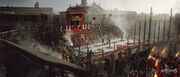 Concept art
 -
 Francisco Rizi's Auto de Fe en la plaza Mayor de Madrid
 -
 Auto de Fe en la plaza Mayor de Madrid in the Council of Elders' meeting room


Behind the scenes
Rizi's painting used in the film is a stylized version of his actual artwork. Its most glaring difference is the replacement of the central, fenced-off, open-air court with the execution stakes shown in the above concept art by Lino Khay. The partial green crest with gold writing on the right hand bleacher in the original work is also missing.[6]
Further, it is not a representation of the film's location of the auto-da-fe, nor of any of the characters in that scene. As clearly stated in the title, the area depicted is Plaza Mayor in Madrid, not Seville as shown in the film, and instead features King Charles II, Queen Marie Louise d'Orléans, and queen mother Mariana of Austria in the background presiding over an auto-da-fe on 30 June 1680, with Grand Inquisitor Diego Sarmiento Valladares standing on the ground just left of their box holding a crozier. According to Alguacil Mayor (Chief Justice) José del Olmo, the stage architect and an Inquisition informant, the ceremony lasted all day, as recorded in great detail in his book, Relación histórica del auto general de fe, que se celebró en Madrid Este Año de 1680.[6]
Appearances
- Assassin's Creed II: Discovery (first appearance, as public burning)
- Assassin's Creed: Unity (first identified as Auto-da-fé)
- Assassin's Creed (film)
- Assassin's Creed: The Official Movie Novelization
- Assassin's Creed: Rebellion
References
- ↑ 1.0 1.1 1.2 Assassin's Creed (film)
- ↑ Assassin's Creed II: Discovery – Assassinate Gaspar Martínez
- ↑ Assassin's Creed II: Discovery – Rescue the Assassin
- ↑ Assassin's Creed: Rebellion – The Auto-Da-Fé
- ↑ Assassin's Creed: Unity – Database: Auto-da-fé
- ↑ 6.0 6.1
 Auto de fe en la plaza Mayor de Madrid on Wikipedia