

Auto-da-fé: Difference between revisions
imported>Kaikai947 |
imported>Lacrossedeamon Adding categories |
||
| Line 32: | Line 32: | ||
{{Reflist}}[[zh:信仰审判]] | {{Reflist}}[[zh:信仰审判]] | ||
[[Category:Ceremonies]] | [[Category:Ceremonies]] | ||
[[Category:Execution methods]] | |||
Revision as of 12:37, 30 April 2020
| This article is about the ritual. You may be looking for the memory of Arno Dorian or the memory of Aguilar de Nerha. |

An auto-da-fé (English: act of faith) was a ritual of public penance of condemned heretics.
The auto-da-fé was originally a ritual used by the Spanish Inquisition, in which the accused would prove their good faith. However, the proceedings often ended with the accused being condemned to death, in some cases by burning at the stake. The term therefore came to refer to the burning itself.[1]
History
In 1491, the Templar Gaspar Martínez planned to burn a captive Assassin alive. Fortunately, Italian Master Assassin Ezio Auditore da Firenze assassinated Martínez and rescued the Assassin before the execution could be carried out.
In 1492, a team of Spanish Assassins, led by Aguilar de Nerha, assassinated Gustavo Ramírez's executioner before he could perform an auto-da-fé.[2]
Later that year, Aguilar and his fellow Assassins Benedicto and María were subjected to the auto-da-fé in Seville by Tomás de Torquemada and the Spanish Inquisition. While the Mentor, Benedicto, was executed, Aguilar and Maria were able to free themselves and fight their away out of Seville to escape.[1]
During the French Revolution, auto-da-fé took on the meaning of a revolutionary act of faith directed against Christian clerics.[3]
Gallery
-
 Database image of Auto-da-fé in Assassin's Creed: Unity
 -
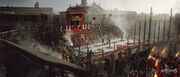 Concept art


Appearances
- Assassin's Creed II: Discovery (first appearance, as public burning)
- Assassin's Creed: Unity (first identified as Auto-da-fé)
- Assassin's Creed: The Movie
- Assassin's Creed: The Official Movie Novelization
- Assassin's Creed: Rebellion