

St James' Park: Difference between revisions
imported>Lady Kyashira mNo edit summary |
imported>Lady Kyashira mNo edit summary |
||
| Line 1: | Line 1: | ||
{{Era|Landmarks}} | {{Era|Landmarks}} | ||
{{WP-REAL|St James's Park}} | {{WP-REAL|St James's Park}} | ||
{{Landmark Infobox | |||
|image = ACS DB St James Park.jpg | |||
|imgdesc = | |||
|hideb = | |||
|description = One of the eight royal parks in London. | |||
|location = [[Westminster]] in [[London]], [[United Kingdom]] | |||
|architect = | |||
|dateconstructed = c. 1603 | |||
|datedestroyed = | |||
|abandoned = | |||
|functions = Park | |||
|affiliation = {{Wiki|The Royal Parks}} | |||
|Other factions = | |||
|hidea = | |||
|features = | |||
|price = | |||
|events = | |||
}} | |||
'''St James's Park''' is a park in [[Westminster]] in [[London]], [[United Kingdom]]. Situated east of the [[Buckingham Palace]], it is the oldest of the Royal Parks on London. | '''St James's Park''' is a park in [[Westminster]] in [[London]], [[United Kingdom]]. Situated east of the [[Buckingham Palace]], it is the oldest of the Royal Parks on London. | ||
Revision as of 06:01, 21 June 2020
St James's Park is a park in Westminster in London, United Kingdom. Situated east of the Buckingham Palace, it is the oldest of the Royal Parks on London.
History
Prior to its construction, the area was the site of the St. James's Hospital, which specialized in treating women who suffered from leprosy. Patients worked on the marshy land around the hospital as part of their treatment, raising hogs for the hospital to sell. In 1532, the land was acquired by King Henry VIII to use as as a hunting ground. On the other hand, Queen Elizabeth used the park to host lavish parties.[1]
During the reign of James I, the King invested in park by adding a number of gardens and a menagerie of Exotic animals. The park was also later where King Charles I made his final procession from prior to his execution at the Whitehall Palace.[1]
The park later continued to be taken care of by Charles II, the son of Charles I. After he died, the park gained a reputation for a number of criminal activities and prostitution, such that John Wilmot wrote a poem which described the happenings that occured in the park in graphic detail.[1]
Gallery
-
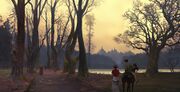 Concept Art
