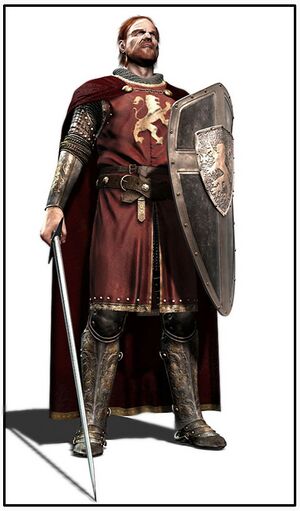
Richard was a man strong in faith, and relied upon God for crucial decisions. He did, however, seem tolerant towards non-believers, as Altaïr denying the help of God over his victory against Robert did not trouble him.
Richard was a man strong in faith, and relied upon God for crucial decisions. He did, however, seem tolerant towards non-believers, as Altaïr denying the help of God over his victory against Robert did not trouble him.
Richard was also a strong military leader, and wasn't afraid to use his sword to answer his problems, after all, he scored a major victory for the Crusader army by capturing Acre. Later, towards the end of the game, Richard was to do battle against Saladin at the Battle of Arsuf, before being confronted by Altaïr about Robert's betrayal, so he relied on God to help him decide who to believe. He choice was that the best way to believe which one was telling the truth, was whoever stood at the end of combat, saying "Surely God will side with one whose cause is righteous!"
Richard was also a strong military leader, and wasn't afraid to use his sword to answer his problems. He scored a major victory for the Crusader army by capturing Acre.
Richard believed that mankind could never change. In his mind, the only way for him to have brought peace was for his men to crush the enemy: [[Saladin]] and the Saracens.<ref name="Assassin's Creed"/> Richard was given the name "Lionheart" because of his kindness to his prisoners and because he was fierce in combat.<ref name=wr/>
Richard believed that mankind could never change. In his mind, the only way for him to have brought peace was for his men to crush the enemy: [[Saladin]] and the Saracens.<ref name="Assassin's Creed"/> Richard was given the name "Lionheart" because of his kindness to his prisoners and because he was fierce in combat.<ref name=wr/>
Despite being the King of England, Richard spoke with a French accent. Though, his fluency in English would be historically inaccurate as Richard spoke entirely in French, only knowing a few English words, due to the fact he was brought up in France by his mother, Eleanor of Aquitaine.
Despite being the King of England, Richard spoke with a French accent. This may be due to the fact he was brought up in France by his mother, Eleanor of Aquitaine.
==Trivia==
==Trivia==
Revision as of 16:56, 16 May 2011
Ezio, my friend! How may I be of service?
This article is in desperate need of a revamp. Please improve it in any way necessary in order for it to achieve a higher standard of quality in accordance with our Manual of Style.
Richard I of England (8 September 1157 - 6 April 1199), or Richard the Lionheart, was the king of England from 1189 to his death in 1199. He was the leader of the Crusader army during the Third Crusade, and was considered a great military leader and warrior. The Saracens called him "Melek-Ric" or "Malek al-Inkitar" (King of England).[1]
At the beginning of Assassin's Creed, Richard and his army had not long taken the port city of Acre. His ultimate goal was to lead his army into the city of Jerusalem so that he could free the Holy Land in the name of the Christian faith.
With a base of operations established in Acre, the Crusaders prepared to march south. However, Saladin, leader of the Islamic army, currently ruled the city of Jerusalem. Stinging from his army’s defeat at Acre, he would not allow Richard to humiliate him again. The Muslim forces were massing in the ruins of Arsuf, intending to ambush the Crusaders and prevent them from reaching Jerusalem. These war maneuvers had left the rest of the Holy Land wide open. While Richard and Saladin battled against one another, the men left to govern in their stead had begun to take advantage of their new found positions of power. Exploitation, manipulation, and provocation ruled the day.
Richard was completely unaware of his men's intentions by being so involved in this war against Saladin. Richard's only goal was to reclaim the Holy City of Jerusalem in the name of God and for the Christians. When he argued with William, he reminded him that he had made a promise to God to fight for the Crusader army.[2]
Richard the Lionheart made a brief appearance during two missions in the game - first when he was seen arguing with William, and then, near to the end of the game at Arsuf, where he was personally confronted by Altaïr. He was unaware of the Templars' plan to betray him by using the Piece of Eden and conquering the Holy Land in the Templar name. After Altaïr had assassinated everyone but Robert, Robert attempted to convince Richard to ally himself with Saladin against the Assassins, who were their common enemies. Altaïr learned of Robert's plans and personally rode to Arsuf to tell Richard of the Templars' betrayal.
After a fierce battle with Saracen and Crusader soldiers, he found King Richard, Robert and other elite soldiers of the army. When Altaïr told the King of England about Robert's treason, with Robert denying it, Richard didn't know who to trust after Altaïr asked Richard if he was actually, truly, surprised by his subjects' plan of betrayal: he wasn't, but he still didn't trust Altaïr.
Richard decided to let "the Lord" choose who was the one who told the truth, by letting Altaïr and Robert fight each other to see which one had "God's support". Altaïr's efficiency with the Hidden Blade proved superior to the Templar's sword skills, and King Richard believed him. They discussed the politics and philosophy of war and peace, in which Richard told Altaïr that he wasn't ready for peace with Saladin yet, before Altaïr went back to Masyaf to engage in combat with Al Mualim.[2]
Richard was a man strong in faith, and relied upon God for crucial decisions. He did, however, seem tolerant towards non-believers, as Altaïr denying the help of God over his victory against Robert did not trouble him.
Richard was also a strong military leader, and wasn't afraid to use his sword to answer his problems. He scored a major victory for the Crusader army by capturing Acre.
Richard believed that mankind could never change. In his mind, the only way for him to have brought peace was for his men to crush the enemy: Saladin and the Saracens.[2] Richard was given the name "Lionheart" because of his kindness to his prisoners and because he was fierce in combat.[1]
Despite being the King of England, Richard spoke with a French accent. This may be due to the fact he was brought up in France by his mother, Eleanor of Aquitaine.
Trivia
Concept art of King Richard.When you observe King Richard through Eagle Vision he appears to be red, which implies that he is an enemy, even though he appears to be friendly towards Altaïr.
Richard can be attacked, but he will not die. In order for you to do this, you have to throw one soldier to him. He will fall down. Then that soldier will stand up and try to attack you from inside the barrier. He will hit Richard and force him out of the barrier. You can attack him, but not kill him.