


Pantheon: Difference between revisions
imported>Slate Vesper No edit summary |
imported>VatsaAWB m Unlinking "Abstergo recruits"; cosmetic changes |
||
| Line 14: | Line 14: | ||
The '''Pantheon''' is one of [[Rome]]'s oldest and most famous Roman Catholic churches, and its name "Pantheon" means "Temple of all the Gods". | The '''Pantheon''' is one of [[Rome]]'s oldest and most famous Roman Catholic churches, and its name "Pantheon" means "Temple of all the Gods". | ||
==History== | == History == | ||
===Early origins=== | === Early origins === | ||
The original Pantheon was built in 31 BCE by Marcus Agrippa, after the Battle of Actium. In 126 CE, it was restored to its current form by the Emperor Hadrian, however, it retained Agrippa's original inscription and dedication. The inscription reads "''M·AGRIPPA·L·F·COS·TERTIVM·FECIT''" and the translation to English states: "Marcus Agrippa, son of Lucius, in his third consulate, made this". | The original Pantheon was built in 31 BCE by Marcus Agrippa, after the Battle of Actium. In 126 CE, it was restored to its current form by the Emperor Hadrian, however, it retained Agrippa's original inscription and dedication. The inscription reads "''M·AGRIPPA·L·F·COS·TERTIVM·FECIT''" and the translation to English states: "Marcus Agrippa, son of Lucius, in his third consulate, made this". | ||
Originally, the Pantheon was used to commemorate the Roman gods and goddesses, but it was converted into a church by {{Wiki|Pope Boniface IV}} in 609. Both the name and style of the building have inspired similar churches in Europe, most notably a second Pantheon in [[Paris]], [[France]]. | Originally, the Pantheon was used to commemorate the Roman gods and goddesses, but it was converted into a church by {{Wiki|Pope Boniface IV}} in 609. Both the name and style of the building have inspired similar churches in Europe, most notably a second Pantheon in [[Paris]], [[France]]. | ||
===Renaissance=== | === Renaissance === | ||
During the [[Renaissance]], the [[Assassins|Assassin]] [[Ezio Auditore da Firenze|Ezio Auditore]] climbed the rear of the building and entered through the landmark's oculus to assassinate a guard captain. This allowed him to disguise himself in the guard's uniform, before he set off to find the [[Juan Borgia the Elder|Banker]]. | During the [[Renaissance]], the [[Assassins|Assassin]] [[Ezio Auditore da Firenze|Ezio Auditore]] climbed the rear of the building and entered through the landmark's oculus to assassinate a guard captain. This allowed him to disguise himself in the guard's uniform, before he set off to find the [[Juan Borgia the Elder|Banker]]. | ||
Also, during his time in Rome, Ezio purchased the Pantheon as a landmark. | Also, during his time in Rome, Ezio purchased the Pantheon as a landmark. | ||
==Trivia== | == Trivia == | ||
*The Pantheon played a part in the simulated location of Rome for the [[Assassin's Creed: Brotherhood|first]] and [[Assassin's Creed: Revelations|second stage]] of the [[Animi Training Program]], although | *The Pantheon played a part in the simulated location of Rome for the [[Assassin's Creed: Brotherhood|first]] and [[Assassin's Creed: Revelations|second stage]] of the [[Animi Training Program]], although Abstergo recruits could not go inside its interior or climb to the Pantheon's rooftop. | ||
*Whether it was day or night in ''Brotherhood'', there was always a column of light shining down from the Pantheon's oculus. | *Whether it was day or night in ''Brotherhood'', there was always a column of light shining down from the Pantheon's oculus. | ||
*Upon entering the Pantheon, the echoing voice of the [[heralds|herald]] behind the building could be heard. | *Upon entering the Pantheon, the echoing voice of the [[heralds|herald]] behind the building could be heard. | ||
==Gallery== | == Gallery == | ||
<gallery captionalign="center" position="center" widths="180"> | <gallery captionalign="center" position="center" widths="180"> | ||
Pantheon_City_Concept.JPG|Concept art of the Pantheon market. | Pantheon_City_Concept.JPG|Concept art of the Pantheon market. | ||
| Line 42: | Line 42: | ||
</gallery> | </gallery> | ||
==Source== | == Source == | ||
*''[[Assassin's Creed: Brotherhood]]'' | *''[[Assassin's Creed: Brotherhood]]'' | ||
{{ACBH}} | {{ACBH}} | ||
[[Category:Rome]] | [[Category:Rome]] | ||
[[Category:Landmarks]] | [[Category:Landmarks]] | ||
[[Category:Churches]] | [[Category:Churches]] | ||
Revision as of 13:55, 1 October 2012
The Pantheon is one of Rome's oldest and most famous Roman Catholic churches, and its name "Pantheon" means "Temple of all the Gods".
History
Early origins
The original Pantheon was built in 31 BCE by Marcus Agrippa, after the Battle of Actium. In 126 CE, it was restored to its current form by the Emperor Hadrian, however, it retained Agrippa's original inscription and dedication. The inscription reads "M·AGRIPPA·L·F·COS·TERTIVM·FECIT" and the translation to English states: "Marcus Agrippa, son of Lucius, in his third consulate, made this".
Originally, the Pantheon was used to commemorate the Roman gods and goddesses, but it was converted into a church by Pope Boniface IV in 609. Both the name and style of the building have inspired similar churches in Europe, most notably a second Pantheon in Paris, France.
Renaissance
During the Renaissance, the Assassin Ezio Auditore climbed the rear of the building and entered through the landmark's oculus to assassinate a guard captain. This allowed him to disguise himself in the guard's uniform, before he set off to find the Banker.
Also, during his time in Rome, Ezio purchased the Pantheon as a landmark.
Trivia
- The Pantheon played a part in the simulated location of Rome for the first and second stage of the Animi Training Program, although Abstergo recruits could not go inside its interior or climb to the Pantheon's rooftop.
- Whether it was day or night in Brotherhood, there was always a column of light shining down from the Pantheon's oculus.
- Upon entering the Pantheon, the echoing voice of the herald behind the building could be heard.
Gallery
-
 Concept art of the Pantheon market.
 -
 Concept of Assassins by the Pantheon.
 -
 Concept of the Pantheon at night.
 -
Panoramic view of the Pantheon square.
-
The interior of the Pantheon.
-
Ezio riding towards the Pantheon.
-
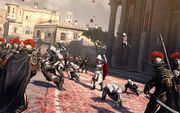 Ezio and his apprentices outside the Pantheon.
 -
 The Pantheon in the Animi Training Program.


Source
| |||||||||||||||||||||||||||||||||||||