


Octavian de Valois: Difference between revisions
imported>Amnestyyy I should probably do something again right about.... now :) |
imported>Amnestyyy starting some minor rewording |
||
| Line 2: | Line 2: | ||
{{Working Revamp|Amnestyyy}} | {{Working Revamp|Amnestyyy}} | ||
{{WPtargets}} | {{WPtargets}} | ||
{{ | {{Quote|You must learn how to speak French. It would mask your barbaric sensibilities.|Octavian to [[Bartolomeo d'Alviano]].|Assassin's Creed: Brotherhood}} | ||
{{Character Infobox | {{Character Infobox | ||
|name = Octavian de Valois | |name = Octavian de Valois | ||
| Line 8: | Line 8: | ||
|imgdesc = | |imgdesc = | ||
|birth = 1448<br>[[France]] | |birth = 1448<br>[[France]] | ||
|death = August 1503 | |death = August 1503 <br>[[Rome]], [[Italy]] | ||
|period = [[Renaissance]] | |period = [[Renaissance]] | ||
|faction = [[Louis XII of France|French Royal House]]<br>[[House of Borgia|Borgia]]<br>[[Templars]] | |faction = [[Louis XII of France|French Royal House]]<br>[[House of Borgia|Borgia]]<br>[[Templars]] | ||
| Line 14: | Line 14: | ||
|voice = [[Arthur Holden]]}} | |voice = [[Arthur Holden]]}} | ||
'''Octavian de Valois''' (1448 - 1503) was the Baron of Valois, | '''Octavian de Valois''' (1448 - 1503) was the Baron of Valois, as well as a general in the [[France|French]] and [[Papacy|Papal armies]]. | ||
During Rodrigo Borgia's reign as Pope, and Cesare Borgia's time a leader of the Papal army, Octavian de Valois aided the Templars by providing military aid, allowing the Templars to retain their influence in [[Rome]]. | |||
==Biography== | ==Biography== | ||
===Rise to power=== | ===Rise to power=== | ||
In 1498, Octavian's distant cousin [[Louis XII of France|Louis XII]] was crowned king. Following this, Louis | In 1498, Octavian's distant cousin, [[Louis XII of France|Louis XII]], was crowned king. Following this, Louis assigned Octavian to lead his [[Italy|Italian]] campaign, despite the fact that his cousin had no actual experience in warfare, and had only received formal training. Nonetheless, Octavian accepted the responsibility. | ||
The following year, Octavian met Cesare and [[Juan Borgia the Elder|Juan Borgia]] at the French court. The latter two were there to court Cesare's future wife, [[Charlotte d'Albret]]. After spending a month with them, Octavian went with the [[House of Borgia|Borgia]] to Italy, thinking that the country would be given to him after they had destroyed all opposition. | The following year, Octavian met Cesare and [[Juan Borgia the Elder|Juan Borgia]] at the French court. The latter two were there to court Cesare's future wife, [[Charlotte d'Albret]]. After spending a month with them, Octavian went with the [[House of Borgia|Borgia]] to Italy, thinking that the country would be given to him after they had destroyed all opposition. | ||
| Line 25: | Line 27: | ||
In January of 1500, Octavian accompanied Cesare, [[Lucrezia Borgia]], and his [[Templars|Templar]] cohorts to [[Monteriggioni]], where they [[Fall of Monteriggioni|laid siege]] to the town in an attempt to eliminate the [[Assassins|Assassin Order]] and [[Ezio Auditore da Firenze|Ezio Auditore]]. | In January of 1500, Octavian accompanied Cesare, [[Lucrezia Borgia]], and his [[Templars|Templar]] cohorts to [[Monteriggioni]], where they [[Fall of Monteriggioni|laid siege]] to the town in an attempt to eliminate the [[Assassins|Assassin Order]] and [[Ezio Auditore da Firenze|Ezio Auditore]]. | ||
When the Borgia infantry breached the city walls, Cesare, Octavian and the others walked into the city, with [[Caterina Sforza]] and [[Mario Auditore]] as their prisoners. Cesare then took a golden wheel-lock firearm from Octavian, which had been fashioned by Ezio's ally | When the Borgia infantry breached the city walls, Cesare, Octavian and the others walked into the city, with [[Caterina Sforza]] and [[Mario Auditore]] as their prisoners. Cesare then took a golden wheel-lock firearm from Octavian, which had been fashioned by Ezio's ally [[Leonardo da Vinci]], and shot Mario in the head. | ||
===The French general of Rome=== | ===The French general of Rome=== | ||
Revision as of 11:48, 29 August 2012

|
I will lead mankind into a new world! This article is currently being reworked by Amnestyyy in order to achieve a better status. We ask that edits to this article are only minor or grammatical in nature until this warning is removed, in order to not disrupt the major revamp. Should you wish to participate in the revamp, please contact the editor at work. |
- "You must learn how to speak French. It would mask your barbaric sensibilities."
- ―Octavian to Bartolomeo d'Alviano.[src]
Octavian de Valois (1448 - 1503) was the Baron of Valois, as well as a general in the French and Papal armies.
During Rodrigo Borgia's reign as Pope, and Cesare Borgia's time a leader of the Papal army, Octavian de Valois aided the Templars by providing military aid, allowing the Templars to retain their influence in Rome.
Biography
Rise to power
In 1498, Octavian's distant cousin, Louis XII, was crowned king. Following this, Louis assigned Octavian to lead his Italian campaign, despite the fact that his cousin had no actual experience in warfare, and had only received formal training. Nonetheless, Octavian accepted the responsibility.
The following year, Octavian met Cesare and Juan Borgia at the French court. The latter two were there to court Cesare's future wife, Charlotte d'Albret. After spending a month with them, Octavian went with the Borgia to Italy, thinking that the country would be given to him after they had destroyed all opposition.
Siege of Monteriggioni
In January of 1500, Octavian accompanied Cesare, Lucrezia Borgia, and his Templar cohorts to Monteriggioni, where they laid siege to the town in an attempt to eliminate the Assassin Order and Ezio Auditore.
When the Borgia infantry breached the city walls, Cesare, Octavian and the others walked into the city, with Caterina Sforza and Mario Auditore as their prisoners. Cesare then took a golden wheel-lock firearm from Octavian, which had been fashioned by Ezio's ally Leonardo da Vinci, and shot Mario in the head.
The French general of Rome

Later that year, Octavian travelled to Rome, where he met Cesare, Juan, and Micheletto at the stables of the Castel Sant'Angelo. There, Cesare left the city in the hands of his three generals. Octavian questioned Cesare's orders regarding the Vatican, but Cesare simply told him not to worry, and that they would soon have no need of them. Octavian went on to station several of his men at the castello, to fortify its defenses.
In 1503, Ezio Auditore came to the conclusion that Octavian needed to die, in order for Cesare to lose the protection and allegiance of the French army. After killing Juan on August 1st, he sought aid from his fellow Assassin Bartolomeo d'Alviano, the leader of the mercenaries in Rome, who was directly opposing the advance of Octavian's French troops.
The French staged an assault on Bartolomeo's barracks, however, Ezio and the Italian mercenaries were able to defend it. Thus, Octavian himself moved to the front lines, and called for Bartolomeo's attention.
With Bartolomeo listening from behind the gates of the stronghold, Octavian requested for his unconditional surrender, which was angrily refused. At this, Octavian told Bartolomeo that he must learn to speak French, in order to mask the condottiero's barbaric sensibilities. Bartolomeo mockingly agreed, asking the Baron to teach him French, while he in turn instructed the Baron in fighting, since he appeared to do so little action in battle.
After exchanging insults, Octavian once again requested for Bartolomeo's surrender before sunrise, and finally revealed that his troops had managed to capture Bartolomeo's wife, Pantasilea. As he left the area, he promised to release Pantasilea, should Bartolomeo come into his camp unarmed and alone.
However, Ezio and Bartolomeo devised a plan to steal the armor of several French soldiers, and walk into the enemy camp with Bartolomeo acting as a prisoner. Once they and several of Bartolomeo's mercenaries had successfully infiltrated the camp, Bartolomeo faced Octavian.
Nobility in death

Octavian, with Pantasilea beside him, greeted Bartolomeo in a mocking manner, with Bartolomeo angrily demanding that his wife be released. As Octavian attempted to continue with his insults, telling Bartolomeo that his entitlements were too much for a man of his low caliber, Bartolomeo claimed that his name was at least worth its currency, unlike Octavian's, which was counterfeit.
Bartolomeo insisted that nobility was gained by battling beside one's soldiers, and not by kidnapping innocent women to cheat one's way out of battle. As he once again demanded that his wife be released, Octavian sneered that "savages never learn," before aiming his pistol at Pantasilea's head.
Seeing the danger, Ezio fired his hidden gun into the air, startling Octavian and signaling the mercenaries to initiate the attack. Hastily, Octavian fled deeper into the camp with Pantasilea in tow, while the Papal Guards defended his retreat. Ezio, Bartolomeo, and their mercenaries engaged the French soldiers, and a furious battle erupted.

Ezio left the fight to Bartolomeo and pursued Octavian. As he set foot in the main courtyard, Octavian only narrowly missed shooting him, before quickly dragging Pantasilea behind the safety of his arquebusiers, and the stronghold walls.
He heatedly called out to the Assassin, threatening to kill Pantasilea should he notice the slightest hint that Ezio was near. However, Ezio was able to avoid notice, and assassinated Octavian from above.
As he died, Octavian told Ezio that he had only wanted respect. Ezio then reminded him that it was earned, and not inherited or purchased. The Baron then realized the error of his ways as he closed his eyes, before Ezio delivered his final blessings.
Personality
- "He is so blinded by the trickle of royalty in his blood, that the lazy inbred can't see the battlefield."
- ―Bartolomeo, on the Baron.[src]
A power-hungry man by nature, the Baron wanting nothing more than to be respected and feared. However, he believed in attempting to purchase these things rather than earn them. Having noble blood in his veins, the Baron believed in acting like royalty, condemning battle to be barbaric and beneath him. His personality was almost exactly the opposite of his Italian counterpart, Bartolomeo d'Alviano, which resulted in great differences in their tactics during combat.
Final words
- Octavian: I only wanted respect.
- Ezio: Respect is earned, not inherited or purchased.
- Octavian: Perhaps you are right... I need more time...
- Ezio: Che tu sia pari nella morte. (May you be equal in death.) Requiescat in pace. (Rest in peace.)
Trivia
- In the novelization, his name is spelled as "Octavien," with an "e". This would be correct, as Octavien is the French translation of Octavian.
- In Assassin's Creed: Brotherhood, he is never referred to by his real name. When a character mentions him, it is only by his title, or by his last name (the Baron, Baron de Valois, Valois).
- In the Assassin's Creed: Brotherhood novel, Octavian shoots Ezio during the siege of Monteriggioni. In-game, Ezio is shot by two arquebusiers.
- There have been two alternate versions of Octavian's death:
- In Assassin's Creed: Ascendance, Octavian and his men hold Pantasilea hostage in the Roman Forum, but are attacked by Ezio. Ezio kills Octavian from above with his hidden blade and, unlike in the game, he is wearing his usual Assassin robes, instead of the French armor. Also, as his final words, Octavian spoke that he only played a small part of Cesare's plans for conquests, rather than his desire for respect.
- In the Brotherhood novel, Octavian is in the middle of the courtyard attempting to convince Ezio to spare him. Octavian subsequently accepts his fate, bowing down before Ezio kills him with a sword.
Gallery
-
Portrait of Octavian de Valois.
-
 Octavian de Valois' personal firearm.
 -
 Cesare and Octavian during the Siege of Monteriggioni.
 -
 Octavian threatening Pantasilea.
 -
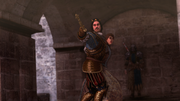 Octavian holding Pantasilea hostage.


Source
| |||||||||||||||||||||||||||||||||||||