


Map: Difference between revisions
imported>Stormbeast m Just changing heading and adding reference |
imported>Legoguy451 No edit summary |
||
| Line 4: | Line 4: | ||
'''Maps''' were devices used in order to help the members of the [[Assassins|Assassin Order]] navigate around the cities, and plan assassinations or [[investigation]]s. | '''Maps''' were devices used in order to help the members of the [[Assassins|Assassin Order]] navigate around the cities, and plan assassinations or [[investigation]]s. | ||
The maps displayed by the [[Animus]] acted as a compromise and visualization of [[Altaïr Ibn-La'Ahad]]'s, [[Ezio Auditore da Firenze]]'s, [[Haytham Kenway]]'s, | The maps displayed by the [[Animus]] acted as a compromise and visualization of [[Altaïr Ibn-La'Ahad]]'s, [[Ezio Auditore da Firenze]]'s, [[Haytham Kenway]]'s, [[Ratonhnhaké:ton]]'s and [[Edward Kenway]]'s memories of the region's layouts, as well as giving a sense of direction for the [[Animus]] user while reliving the memories of their ancestors. | ||
==Representation via Animi== | ==Representation via Animi== | ||
Revision as of 19:19, 26 January 2014

|
Patience, brothers. Soon we will reveal the secrets of Assassin's Creed III: Liberation and Assassin's Creed IV: Black Flag. This article has been identified as being out of date. Please update the article to reflect recent releases and then remove this template once done. |

Maps were devices used in order to help the members of the Assassin Order navigate around the cities, and plan assassinations or investigations.
The maps displayed by the Animus acted as a compromise and visualization of Altaïr Ibn-La'Ahad's, Ezio Auditore da Firenze's, Haytham Kenway's, Ratonhnhaké:ton's and Edward Kenway's memories of the region's layouts, as well as giving a sense of direction for the Animus user while reliving the memories of their ancestors.
Representation via Animi
Animus 1.28
More areas appeared on the Animus map after every successful climb and synchronization with a view point. These virtual maps also marked certain key areas that could be recognized by a unique symbol.[1]
While viewing the memories of Altaïr in the Animus 1.28, the symbols indicated the Assassins' Bureau, investigation missions, such as eavesdropping, interrogation, pickpocketing, Assassin informants, exits to the Kingdom, and the locations of citizens that could be saved from the guards. Additionally, it displayed the icon for Altaïr's assassination target, after he was given leave to proceed by the city's bureau leader.[1]
Animus 2.0
While viewing the memories of Ezio Auditore in the Animus 2.0, symbols were displayed to mark key memories, side events such as races or courier assignments, shops like art merchants, doctors, blacksmiths, tailors, and travel booths, as well as hidden treasure chests and Assassin Tombs. This newer version of the Animus also featured a white and red color sheme, instead of the blue and white scheme of the Animus 1.28[2]
Animus 2.01
In Rome, along with the previous symbols, several new ones had been added. These included unique icons for the four guilds - the Assassin's Guild, the Courtesan's Guild, the Mercenaries' Guild and the Thieves' Guild – as well as the Borgia towers and repressed memories of Cristina Vespucci.[3]
Additionally, there was an option to change the view of the map to show the division of districts, the percentage of renovations completed in each district, and the Borgia influence.[3]
Animus 2.03
In the Animus 2.03, the appearance of the map was similar to the map of Animus 1.28 and 2.0 with the same icons just like the previous Animus 2.01, with some minor differences.[4]
The map also displayed the Templar influence across Constantinople as well as the status of the Assassin Dens.[4]
Animus 3.0
While reliving the memories of Haytham Kenway and Ratonhnhaké:ton, Desmond could still use view points to uncover parts of the map, but walking through the city could reveal locations as well. The higher the viewpoint where the ancestor was, the more information would be revealed around them.[5]
The Animus 3.0's map system was revamped to enable fast travel to any designated point, such as tunnel entrances, ports or captured forts. The map also logged any tasks or challenges Desmond had not completed.[5]
Animus Omega
While reliving Edward Kenway's memories of the West Indies, the map style had changed significantly. Locations fell into four rough categories: villages and towns, uninhabited deserted islands, forts, and large cities. Additionally, once a location had been fully explored and its collectibles retrieved, its icon would change color from white to gold. All of the location icons could be used as fast-travel points.
The maps were also divided into sections, each labeled by whatever fort lay within the area, which would appear foggy. After Kenway would take over said fort, the map's appearance for that area would be cleared of the fog, and additional points of interest would be revealed.
Any unvisited location would appear as a question mark until it was either revealed by taking over its area fort or by viewing it through Kenway's spyglass while sailing.[6]
Trivia
- In Assassin's Creed: Revelations, the compass' directions had been rotated approximately 90º, with the Masyaf castle now in the east, rather than the north, as it was in Assassin's Creed.
Gallery
-
 A map of Acre displayed by the Animus 1.28
 -
 Map of Venice displayed by the Animus 2.0
 -
 Map of Rome displayed by the Animus 2.01
 -
 Map of San Donato, a multiplayer location
 -
 Map of Constantinople displayed by the Animus 2.03
 -
 Map of Davenport Homestead displayed by the Animus 3.0
 -
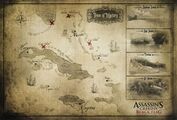 A map showing the West Indies in Assassin's Creed IV: Black Flag


