

François-Joseph Paul de Grasse: Difference between revisions
imported>Bovkaffe No edit summary |
imported>Slate Vesper mNo edit summary |
||
| Line 7: | Line 7: | ||
|birth = 13 September 1722<br>{{Wiki|Le Bar-sur-Loup}}, [[France|Kingdom of France]] | |birth = 13 September 1722<br>{{Wiki|Le Bar-sur-Loup}}, [[France|Kingdom of France]] | ||
|death = 11 January 1788<br>{{Wiki|Tilly, Yvelines|Tilly}}, Kingdom of France | |death = 11 January 1788<br>{{Wiki|Tilly, Yvelines|Tilly}}, Kingdom of France | ||
|affiliates = [[French Navy]] | |affiliates = [[French Navy]] | ||
|appear = ''[[Assassin's Creed III]]''}} | |appear = ''[[Assassin's Creed III]]''}} | ||
'''François-Joseph Paul, Marquis de Grasse Tilly, Comte de Grasse''' (1722 – 1788) was a [[French Navy]] admiral, best known for his command of the French fleet at the [[Battle of the Chesapeake]], which directly led to the [[United Kingdom|British]] surrender at Yorktown. | '''François-Joseph Paul, Marquis de Grasse Tilly, Comte de Grasse''' (1722 – 1788) was a [[French Navy]] admiral, best known for his command of the French fleet at the [[Battle of the Chesapeake]], which directly led to the [[United Kingdom|British]] surrender at Yorktown. | ||
| Line 14: | Line 14: | ||
Born as the youngest child of a French nobleman, de Grasse joined the military at the age of eleven when he became a page in the religious military {{Wiki|Order of Malta}}. Having fully joined the French Navy in 1740, he had become a captain by 1775, helping the French secure [[Saint-Domingue]]. | Born as the youngest child of a French nobleman, de Grasse joined the military at the age of eleven when he became a page in the religious military {{Wiki|Order of Malta}}. Having fully joined the French Navy in 1740, he had become a captain by 1775, helping the French secure [[Saint-Domingue]]. | ||
In 1781, the [[Assassin]] [[Ratonhnhaké:ton]] sought Admiral de Grasse's help | In 1781, the [[Assassins|Assassin]] [[Ratonhnhaké:ton]] sought Admiral de Grasse's help through [[Marquis de Lafayette]], in order to shell [[Fort George]] and create a distraction so that he could slip inside undetected and kill [[Charles Lee]]. After Connor assisted de Grasse's fleet in the Chesapeake, the admiral agreed to the Assassin's plan, though he admitted it made no sense to him. | ||
Ten days later, de Grasse's fleet was anchored in [[New York City|New York]]'s harbor, flying British flags scavenged from the wrecks in the Chesapeake. After Connor lit a signal fire, the fleet opened fire, breaching Fort George's walls and creating the diversion Connor desired. | Ten days later, de Grasse's fleet was anchored in [[New York City|New York]]'s harbor, flying British flags scavenged from the wrecks in the Chesapeake. After Connor lit a signal fire, the fleet opened fire, breaching Fort George's walls and creating the diversion Connor desired. | ||
Revision as of 00:37, 15 August 2014


|
Where are the paintings? This article is in need of more images and/or better quality pictures from official media in order to achieve a higher status. You can help the Assassin's Creed Wiki by uploading better images on this page. |
François-Joseph Paul, Marquis de Grasse Tilly, Comte de Grasse (1722 – 1788) was a French Navy admiral, best known for his command of the French fleet at the Battle of the Chesapeake, which directly led to the British surrender at Yorktown.
Biography
Born as the youngest child of a French nobleman, de Grasse joined the military at the age of eleven when he became a page in the religious military Order of Malta. Having fully joined the French Navy in 1740, he had become a captain by 1775, helping the French secure Saint-Domingue.
In 1781, the Assassin Ratonhnhaké:ton sought Admiral de Grasse's help through Marquis de Lafayette, in order to shell Fort George and create a distraction so that he could slip inside undetected and kill Charles Lee. After Connor assisted de Grasse's fleet in the Chesapeake, the admiral agreed to the Assassin's plan, though he admitted it made no sense to him.
Ten days later, de Grasse's fleet was anchored in New York's harbor, flying British flags scavenged from the wrecks in the Chesapeake. After Connor lit a signal fire, the fleet opened fire, breaching Fort George's walls and creating the diversion Connor desired.
De Grasse died in 1788, briefly before the beginning of the French Revolution. Despite his actions during the Revolutionary War, the French revolutionaries considered him nobility, and his estate was ransacked. His family fled to the United States afterwards, being welcomed as the children of a hero.
Gallery
-
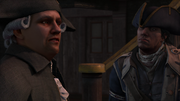 Connor telling de Grasse of his plan
 -
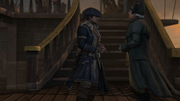 Admiral de Grasse agreeing to help Connor

