Followers of Romulus: Difference between revisions
imported>GuardDog m minor rewording |
imported>GuardDog adding image |
||
| Line 56: | Line 56: | ||
Romulus2.jpg|Two Followers of Romulus, startled by the death of another. | Romulus2.jpg|Two Followers of Romulus, startled by the death of another. | ||
Romulus.jpg|Ezio Auditore fighting a group of the Followers in the [[Terme di Traiano]]. | Romulus.jpg|Ezio Auditore fighting a group of the Followers in the [[Terme di Traiano]]. | ||
Assassin's Creed - Brotherhood ( 58 )..jpg|A pack of Followers attacking Ezio in the | ACBRomulus.jpg|Three leaders of the Followers conversing in the [[Cloaca Maxima]] lair. | ||
Assassin's Creed - Brotherhood ( 58 )..jpg|A pack of Followers attacking Ezio in the Cloaca Maxima. | |||
</gallery> | </gallery> | ||
Revision as of 13:50, 1 February 2011
- "A place in heaven awaits those who serve the wolf!"
- ―A leader of the Followers of Romulus[src]
The Followers of Romulus, also known as Secta Luporum[1] (English: Sect of the Wolves), were adherents of Romulus, the mythical founder of Rome. According to legend, Romulus and his brother Remus were raised by a wolf, and as a result, were said to be half wolf and half man. In tribute to this, the Followers' attire included a skinned wolf pelt.[2]
Appearance
The Followers of Romulus are portrayed as powerfully-built, rather brutish men covered in wolfskin pelts, who attack viciously in large packs.
They are armed with various short blades and throwing knives, and tend to growl and snarl when in a fight. They commonly employ a unique, spinning slash attack, a move that is not performed by any other, aside from Ezio himself (with his hidden blades). When killed, and often before attacking, they howl like a wolf.
The Followers are also adept free-runners, as the lairs that they occupy require such skills to traverse. Additionally, they often attack in ambushes, hiding above or in tunnels before springing onto their prey in large numbers.[2]
Borgia Alliance
The leaders of the Followers are paid by the Borgia to do their bidding, and as such, the Followers are mainly used to cause fear in the civilians, and send them into the arms of the Catholic Church. However, the Followers themselves are misguided, with their leaders commanding them in the name of Romulus, despite not believing in his mystical existence themselves.[2]
Lairs
- Main article: Lairs of Romulus
In Rome of the early 16th century, the Master Assassin, Ezio Auditore da Firenze, was able to enter the Followers' lairs, each of which were located below a famous landmark in Rome. By traversing them, he was able to find out more about them, and obtain their scrolls, which were located in shrines deep within their hidden enclaves.
By exploring and completing all six of their lairs, Ezio was also able to obtain six keys to unlock the Followers' secret treasures, the unbreakable armor and Dagger of Brutus.
Each of the six keys was alos accompanied by a scroll, which, when combined, told the story of how Brutus and certain other Assassins plotted the murder of Julius Caesar. In the scrolls, it was written that Brutus planned to hold the first meeting under the Colosseum, where he found one of the vaults of Those Who Came Before.[2]
Trivia
- In certain art (their Database image, and the image featured above), the Followers are depicted with a heavy weapon or a pair of short blades. In-game, they use only a single short blade.
- The Followers are relatively weak attackers, and can only perform slight damage to a single block of Ezio's health, rather than removing the block entirely.
- The Followers often use throwing knives before directly attacking.
- The Followers have unique death cries, as well as unique attack animations.
Gallery
-
A Follower of Romulus guarding the lair in Nero's Golden Palace.
-
Two Followers of Romulus, startled by the death of another.
-
Ezio Auditore fighting a group of the Followers in the Terme di Traiano.
-
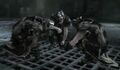 Three leaders of the Followers conversing in the Cloaca Maxima lair.
 -
 A pack of Followers attacking Ezio in the Cloaca Maxima.

..jpg)


References
| |||||||||||||||||||||||||||||||||||||