

Erechtheion: Difference between revisions
imported>Darman36 Captions no longer used in infoboxes; (hideX) parameters no longer used since Feb 2017 – see {Template:Landmark} history |
imported>Zone of Endless m removing newline between Era and WP-REAL |
||
| Line 1: | Line 1: | ||
{{Era|Landmarks}} | {{Era|Landmarks}}{{WP-REAL}} | ||
{{WP-REAL}} | |||
{{Landmark Infobox | {{Landmark Infobox | ||
|image = ACOD Erechtheion.jpg | |image = ACOD Erechtheion.jpg | ||
Revision as of 00:14, 15 October 2021
The Erechtheion was an ancient Greek temple on the north side of the Akropolis Sanctuary in Athens, Attika, Greece.
The most significant site of worship on the acropolis, the temple was known for its caryatids and was dedicated to the Greek gods Poseidon and Athena. In addition, it was also dedicated to Erechtheus and Kekrops, two legendary kings of Athens, the latter of which was said to have been buried beneath the portico.[1] The Olive Tree of Athena was located west of the temple.[2]
During the Peloponnesian War, the temple was visited by the Spartan misthios Kassandra.[3]
Behind the scenes
The Erechtheion is a landmark in Assassin's Creed: Odyssey, situated on the Akropolis Sanctuary. The temple is an anachronism in the game as construction of the temple only began in 421 BCE, a year after the game's conclusion, and completed in 406 BCE.
The model of the Porch of the Caryatids was also used by level artist Kevin Kok in Assassin's Creed: Origins for an unnamed place of worship in the poor district of Alexandria.[4]
Gallery
-
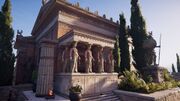 The Porch of the Caryatids

Appearances
References
- ↑ Assassin's Creed: Odyssey – Historical Locations – Attika: Erechtheion
- ↑ Discovery Tour: Ancient Greece – Discovery Sites: Olive Tree of Athena
- ↑ Assassin's Creed: Odyssey
- ↑ Kevin Kok (31 October 2017). Assassin's Creed Origins: Alexandria. ArtStation. Retrieved on 3 July 2020.