

Chimera: Difference between revisions
imported>Lady Kyashira mNo edit summary |
imported>Zone of Endless m removing newline between Era and WP-REAL |
||
| Line 1: | Line 1: | ||
{{Era|Individuals}} | {{Era|Individuals}}{{WP-REAL|Chimera (mythology)}} | ||
{{WP-REAL|Chimera (mythology)}} | |||
{{Youmay|the mythical beast|the Cult of Kosmos [[The Chimera|member]]}} | {{Youmay|the mythical beast|the Cult of Kosmos [[The Chimera|member]]}} | ||
{{Stub}} | {{Stub}} | ||
Revision as of 00:06, 15 October 2021
| This article is about the mythical beast. You may be looking for the Cult of Kosmos member. |


The Chimera was a fire-breathing creature in Greek mythology, an amalgamation of a goat, lion, and a snake. It was slain by the hero Bellerophon with the aid of Pegasos.
Influence
During the 5th century BCE, a member of the The Silver Vein branch of the Cult of Kosmos took up the mythical name, calling herself The Chimera.[1]
Another member of the Cult, Asterion of the Gods of the Aegean Sea, was the captain of the trireme, the Astraios, whose sails and finery of which had been emblazoned with the Chimera's likeness.[1]
Around 422 BCE, an Achaian engineer named Gyras designed and developed a naval weapon which he named after the monster as Chimera's Breath, for like the creature, the weapon spewed fire.[2]
Behind the scenes
Sails and finery featuring the Chimera for the ship Adrestia can be found in the Smuggler's Shipwreck near Eretria in Euboea in Assassin's Creed: Odyssey. The image of the Chimera in said finery is based on a painting on a 4th century BCE kylix.
The image of the Chimera on the finery of Astraios is based on a painting on a 6th century BCE cup.
Homer included the Chimera in his Iliad.
The Chimera was also said to be one of the offspring of Typhon and Echidna, making it the sibling of mythical creatures such as Cerberus, the Theban Sphinx and the Nemean Lion.
Gallery
-
 The sail bearing the image of the Chimera
 -
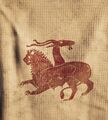 The ship design of the Chimera
 -
 The Astraios bearing the likeness of the Chimera
 -
 One of the shields aboard the Astraios


Appearances
- Assassin's Creed: Odyssey (artwork only)