

Bronze: Difference between revisions
imported>VilkaTheWolf |
imported>Sadelyrate |
||
| Line 29: | Line 29: | ||
===18th century=== | ===18th century=== | ||
Over the course of his career, the [[France|French]] pirate [[Alonzo Batilla]] acquired and used multiple bronze implements.<ref>''[[Assassin's Creed: Pirates]]''</ref> | Over the course of his career, the [[France|French]] pirate [[Alonzo Batilla]] acquired and used multiple bronze implements.<ref>''[[Assassin's Creed: Pirates]]''</ref> | ||
===21st century=== | |||
While [[Clay Kaczmarek]] was within the [[Animus]], searching for references to an [[Apples of Eden|artifact]], he overheard someone recounting an old tale, which mentioned how the "Apple of [[Eden]] was not flesh at all, but solid like [[marble]] or bronze."<ref>''[[Assassin's Creed: Revelations]]: [[The Lost Archive]] – [[The Mole]]</ref> | |||
==Mythology== | ==Mythology== | ||
Revision as of 15:51, 10 March 2020

|
Ezio, my friend! How may I be of service? This article is in desperate need of a revamp. Please improve it in any way necessary in order for it to achieve a higher standard of quality in accordance with our Manual of Style. |

|
Where are the paintings? This article is in need of more images and/or better quality pictures from official media in order to achieve a higher status. You can help the Assassin's Creed Wiki by uploading better images on this page. |

Bronze is an alloy consisting primarily of copper, commonly with about 12–12.5% tin and often with the addition of other metals (such as aluminum, manganese, nickel or zinc) and sometimes non-metals or metalloids such as arsenic, phosphorus or silicon. These additions produce a range of alloys that may be harder than copper alone, or have other useful properties, such as stiffness, ductility, or machinability.
The discovery of the metal was so significant an historical era was named by the use of it.
History
5th century BCE
During the 5th century BCE in Greece, bronze was a material used in weapons and armor, rendering the formerly used obsidian glass largely obsolete.[1] The city of Chalkis on the island of Euboea was especially renowned for its metalwork with bronze.[2]
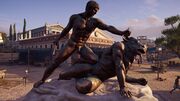
The Argive sculptor Polykleitos preferred to work with bronze, and became famous for his art.[3] The Athenian sculptor Phidias also used bronze, most notably in his 10 meter Statue of Athena in the Akropolis Sanctuary of Athens.[4]
Perhaps the most notable building in the ancient Greece in regards to bronze was the Temple of Athena Chalkioikos in the polis of Sparta, Lakonia. The interior of the temple was covered with bronze sheets, and thus it was called Chalkioikos (Bronze House).[5] Another building named after the metal was the Chalkotheke in the Akropolis Sanctuary of Athens.[6]
During the Peloponnesian War, the Spartan misthios Kassandra acquired bronze in varying amounts over the course of her travels.[7]
1st century BCE
In the 1st century BCE Egypt, the use of bronze was less common but still used in the creation of weapons. The Medjay-turned-Hidden One Bayek acquired bronze in varying amounts over the course of his travels, using it to better his gear.[8]
12th century
The Knights Templar minted a currency using various metals, including bronze, for their own use during the Crusades. Later, these coins were obtained by the Assassin Altaïr Ibn-La'Ahad from Templar guards, pirate, and duelists in Cyprus and Acre's harbor.[9]
17th century
Bronze was widely used as a material of statues, including the equestrian statue of Henry IV of France. Cast in Florence and shipped to Paris in 1614, the statue was erected at Pont Neuf in 1618. Another bronze statue, this time of Louis XIII was erected in Place des Vosges in 1639.[10]
18th century
Over the course of his career, the French pirate Alonzo Batilla acquired and used multiple bronze implements.[11]
21st century
While Clay Kaczmarek was within the Animus, searching for references to an artifact, he overheard someone recounting an old tale, which mentioned how the "Apple of Eden was not flesh at all, but solid like marble or bronze."[12]
Mythology
In Greek, bronze featured in both in the everyday life, as well as in myths. In the latter, the most notable instances are the jar on Naxos Island wherein the story claimed the Greek god of war Ares was imprisoned,[13] and the club wielded by the bandit Periphetes.[14]
According to the legend, the Argive king Akrisios locked his daughter Danae within a chamber of bronze in an attempt to prevent a prophecy. Despite his attempt, the god Zeus infiltrated the chamber and impregnated Danae, leading to the birth of Perseus and the fulfillment of Akrisios' prophecy. In the same legend, Perseus was also given a mirror-bright bronze shield by the goddess Athena.[15]
Gallery
-
-
The Statue of Athena in Akropolis Sanctuary
-
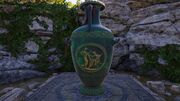 The Bronze Vessel of Ares on Naxos Island
 -
 The Bronze Club of Periphetes in Argolis


Appearances
- Assassin's Creed: Bloodlines
- Assassin's Creed: Pirates
- Assassin's Creed: Unity
- Assassin's Creed: Origins
- Assassin's Creed: Odyssey
References
- ↑ Assassin's Creed: Odyssey – Arid Islands. Ubisoft. Accessed 15 June 2018.
- ↑ Assassin's Creed: Odyssey – Euboea: Chalkis City
- ↑ Assassin's Creed: Odyssey – Argolis: Polykleitos' Workshop
- ↑ Discovery Tour: Ancient Greece – Akropolis Sanctuary: "Athena Promachos"
- ↑ Assassin's Creed: Odyssey – Lakonia: Temple of Athena Chalkioikos
- ↑ Discovery Tour: Ancient Greece – The Akropolis of Athens: "Chalkotheke"
- ↑ Assassin's Creed: Odyssey
- ↑ Assassin's Creed: Origins
- ↑ Assassin's Creed: Bloodlines
- ↑ Assassin's Creed: Unity
- ↑ Assassin's Creed: Pirates
- ↑ Assassin's Creed: Revelations: The Lost Archive – The Mole
- ↑ Assassin's Creed: Odyssey – Naxos: Bronze Vessel of Ares
- ↑ Assassin's Creed: Odyssey – Argolis: Bronze Club of Periphetes
- ↑ Assassin's Creed: Odyssey – A Treasury of Legends