Welcome to Assassin's Creed Wiki! Log in and join the community.


Bottega di Leonardo: Difference between revisions
Jump to navigation
Jump to search
imported>AED No edit summary |
imported>Uditore mNo edit summary |
||
| Line 1: | Line 1: | ||
{{Era|AC2|ACB}} | {{Era|AC2|ACB}} | ||
[[File:Bottegaleoflorence.jpg|thumb|260px]] | {{WPlocations}} | ||
[[File:Bottegaleoflorence.jpg|thumb|260px|The workshop.]] | |||
'''Bottega di Leonardo a Firenze''' was the workshop of [[Leonardo da Vinci]] in [[Florence]]. This is the place where [[Ezio Auditore Da Firenze|Ezio Auditore's]] [[Hidden Blade|hidden blade]] was repaired, along with the construction of the second hidden blade and the [[Poison blade|poison blade]] upgrade.<ref name="AC2">''[[Assassin's Creed II]]''</ref> | '''Bottega di Leonardo a Firenze''' was the workshop of [[Leonardo da Vinci]] in [[Florence]]. This is the place where [[Ezio Auditore Da Firenze|Ezio Auditore's]] [[Hidden Blade|hidden blade]] was repaired, along with the construction of the second hidden blade and the [[Poison blade|poison blade]] upgrade.<ref name="AC2">''[[Assassin's Creed II]]''</ref> | ||
| Line 15: | Line 16: | ||
==Gallery== | ==Gallery== | ||
<center><gallery captionalign=left> | <center><gallery captionalign=left> | ||
20100806103907!Leonardo_workshop.jpg|Leonardo reading his designs | 20100806103907!Leonardo_workshop.jpg|Leonardo reading his designs | ||
Revision as of 02:52, 17 October 2011
Bottega di Leonardo a Firenze was the workshop of Leonardo da Vinci in Florence. This is the place where Ezio Auditore's hidden blade was repaired, along with the construction of the second hidden blade and the poison blade upgrade.[1]
Databse Entry
Leonardo da Vinci opened his own studio after completing his apprenticeship to Verrocchio, one of the most successful Florentine artists of the day.
Between 1476 and 1481, Leonardo probably continued to collaborate with Verrocchio, although no one is quite sure what he was working on. In 1481, he was given his first commission by the monks of San Donato a Scopeto, to paint The Adoration of Magi.
In true da Vinci style, he began the painting, but never finished it.[1]
Trivia
- The memory Ace Up My Sleeve is the first time that Ezio enters the workshop.
- In Assassin's Creed: Brotherhood, you are able to enter the workshop during the Cristina Memories that take place in Florence.[2]
Gallery
-
Leonardo reading his designs
-
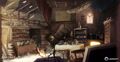 Concept art of Leonardo's workshop.
 -
Some of Leonardo's sketches in his workshop.


