


Borgia tower: Difference between revisions
imported>Slate Vesper mNo edit summary |
imported>The Crimson Eagle No edit summary |
||
| Line 1: | Line 1: | ||
{{Era|ACB|Bbook|Templars}} | {{Era|ACB|Bbook|Templars}} | ||
[[File:Acb-guard-tower.jpg|thumb|220px|right|Concept art of a Borgia Tower | [[File:Acb-guard-tower.jpg|thumb|220px|right|Concept art of a Borgia Tower]] | ||
'''Borgia Towers''' were [[Guard Towers|guard towers]] found within the [[Italy|Italian]] city of [[Rome]]. They were used by the [[House of Borgia|Borgia]] as a display of their dominance over the city, and a base for an assigned [[Borgia Captains|Captain]] to manage the patrols that maintained control in each district. | '''Borgia Towers''' were [[Guard Towers|guard towers]] found within the [[Italy|Italian]] city of [[Rome]]. They were used by the [[House of Borgia|Borgia]] as a display of their dominance over the city, and a base for an assigned [[Borgia Captains|Captain]] to manage the patrols that maintained control in each district. | ||
| Line 9: | Line 9: | ||
In order to [[Liberation of Rome|liberate Rome]] and humiliate the Borgia, the [[Assassins|Assassin]] [[Ezio Auditore da Firenze]] killed each tower's Captain, and then burned down the tower itself, as a demonstration to the people that the Borgia's oppressive rule was coming to an end. | In order to [[Liberation of Rome|liberate Rome]] and humiliate the Borgia, the [[Assassins|Assassin]] [[Ezio Auditore da Firenze]] killed each tower's Captain, and then burned down the tower itself, as a demonstration to the people that the Borgia's oppressive rule was coming to an end. | ||
[[File:Bar 5.png|thumb|left|250px|Ezio Auditore escaping a Borgia tower after igniting it | [[File:Bar 5.png|thumb|left|250px|Ezio Auditore escaping a Borgia tower after igniting it]] | ||
Once a tower had been destroyed, the Assassins rebuilt it and claimed it for themselves. With the tower under Assassin rule, Ezio was able to recruit one more potential [[Apprentices|apprentice]], and manage his entire [[Italian Assassins|guild]] from there. | Once a tower had been destroyed, the Assassins rebuilt it and claimed it for themselves. With the tower under Assassin rule, Ezio was able to recruit one more potential [[Apprentices|apprentice]], and manage his entire [[Italian Assassins|guild]] from there. | ||
| Line 23: | Line 23: | ||
==Gallery== | ==Gallery== | ||
<gallery widths="180" position="center" captionalign="center"> | <gallery widths="180" position="center" captionalign="center"> | ||
ACB6.jpg|Ezio pulling a Captain from a Borgia tower | ACB6.jpg|Ezio pulling a Captain from a Borgia tower | ||
Leap Of Faith.jpg|Ezio leaping from a Borgia tower | Leap Of Faith.jpg|Ezio leaping from a Borgia tower | ||
New man 4.png|Ezio leaving a burning Borgia tower | New man 4.png|Ezio leaving a burning Borgia tower | ||
</gallery> | </gallery> | ||
Revision as of 22:49, 10 April 2013
Borgia Towers were guard towers found within the Italian city of Rome. They were used by the Borgia as a display of their dominance over the city, and a base for an assigned Captain to manage the patrols that maintained control in each district.
Though some Captains would choose to fight off a threat, a number usually fled from confrontation and sought sanctuary in the tower. The heavy fortifications served as effective protection for the Captain, who would only venture out again at the next guard shift.
Destruction
- Niccolò: "Just because you kill a few guards does not mean the people will grant access to the stables."
- Ezio: "You are right. We need to send a signal."
- —Niccolò Machiavelli and Ezio Auditore, moments before Ezio burned down a Borgia Tower.[src]
In order to liberate Rome and humiliate the Borgia, the Assassin Ezio Auditore da Firenze killed each tower's Captain, and then burned down the tower itself, as a demonstration to the people that the Borgia's oppressive rule was coming to an end.

Once a tower had been destroyed, the Assassins rebuilt it and claimed it for themselves. With the tower under Assassin rule, Ezio was able to recruit one more potential apprentice, and manage his entire guild from there.
Additionally, the district around the tower would begin to show signs of civilized life returning; crime would decrease, as bandits would start to leave, and the guards in the area would reduce in numbers. Citizens also began to have a more prominent presence in the area as well, and could be found wandering the streets, while shops and landmarks nearby would become available for purchase.
Trivia
- Borgia towers served as View Points for the surrounding area, and were surrounded by many circling crows, whereas a single eagle resided towards its peak, a prominent symbol of the Assassins.
- Burning a Borgia tower would automatically activate its view point, saving Ezio the effort of having to climb it once more and interact with it.
- After the destruction of a Borgia tower, vigilantes appeared in the area to assist Ezio and hold back guards during a fight or chase.
- Viewing an unburned Borgia tower with Eagle Vision showed that the Borgia banners on its sides glowed red, similarly to an enemy.
- In Assassin's Creed: Ascendance, the murders of Oliverotto da Fermo and Vitellozzo Vitelli took place in what appeared to be the same Borgia tower that kept Bartolomeo d'Alviano at bay. This causes conflict in the timeline, as Ezio destroyed the tower in 1500, while the deaths of Oliverotto and Vitellozzo took place in 1502.
Gallery
-
 Ezio pulling a Captain from a Borgia tower
 -
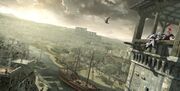
 Ezio leaping from a Borgia tower
 -
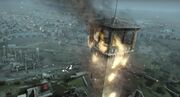
 Ezio leaving a burning Borgia tower


Reference
| |||||||||||||||||||||||||||||||||||||