Viana Castle: Difference between revisions
imported>Amnestyyy No edit summary |
imported>Amnestyyy No edit summary |
||
| Line 1: | Line 1: | ||
{{Era|ACB}} | |||
[[File:Viana_Castle_4.png|thumb|250px|right|The castle of Viana, as seen in ''[[Assassin's Creed: Brotherhood]]''.]] | |||
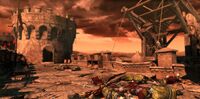
'''Viana Castle''' was a large fortified stronghold in [[Viana]], Kingdom of Navarre, which was conquered by Spain in 1512. The castle was held by Louis de Beaumont at the time it was [[Siege of Viana|besieged]] by [[Cesare Borgia]] and King John's army of 10,000 men in 1507. | '''Viana Castle''' was a large fortified stronghold in [[Viana]], Kingdom of Navarre, which was conquered by Spain in 1512. The castle was held by Louis de Beaumont at the time it was [[Siege of Viana|besieged]] by [[Cesare Borgia]] and King John's army of 10,000 men in 1507. | ||
==Siege of Viana== | ==Siege of Viana== | ||
Following his escape from Valencia, Cesare Borgia allied himself with his cousin-in-law, [[John III of Navarre]]. John III tasked Cesare to besiege Viana and it's fortification in 1507, due to his military expertise. The [[Assassin]] [[Ezio Auditore da Firenze]] was tracking Cesare during this period, and eventually located him in Viana. Ezio fought his way through the fortification outside the castle, where he encountered Cesare who managed to escape, and managed to mount it's walls by climbing a siege tower. Ezio found Cesare on one of the castle's battlements, where he fought and killed him. With their commander dead, John III's troops eventually abandoned their attempt to reclaim the castle. {{-}} | Following his escape from Valencia, Cesare Borgia allied himself with his cousin-in-law, [[John III of Navarre]]. John III tasked Cesare to besiege Viana and it's fortification in 1507, due to his military expertise. The [[Assassin]] [[Ezio Auditore da Firenze]] was tracking Cesare during this period, and eventually located him in Viana. Ezio fought his way through the fortification outside the castle, where he encountered Cesare who managed to escape, and managed to mount it's walls by climbing a siege tower. Ezio found Cesare on one of the castle's battlements, where he fought and killed him. With their commander dead, John III's troops eventually abandoned their attempt to reclaim the castle. {{-}} | ||
==Gallery== | ==Gallery== | ||
<gallery widths="200" position="center" captionalign="center" captiontextcolor="#ffffff" bordersize="medium" spacing="small"> | <gallery widths="200" position="center" captionalign="center" captiontextcolor="#ffffff" bordersize="medium" spacing="small"> | ||
| Line 17: | Line 17: | ||
Siege of Viana 5.jpg | Siege of Viana 5.jpg | ||
</gallery> | </gallery> | ||
==Reference== | |||
*''[[Assassin's Creed: Brotherhood]]'' | |||
[[Category:Spain]] | [[Category:Spain]] | ||
[[Category:Landmarks]] | [[Category:Landmarks]] | ||
Revision as of 16:17, 25 February 2013

Viana Castle was a large fortified stronghold in Viana, Kingdom of Navarre, which was conquered by Spain in 1512. The castle was held by Louis de Beaumont at the time it was besieged by Cesare Borgia and King John's army of 10,000 men in 1507.
Siege of Viana
Following his escape from Valencia, Cesare Borgia allied himself with his cousin-in-law, John III of Navarre. John III tasked Cesare to besiege Viana and it's fortification in 1507, due to his military expertise. The Assassin Ezio Auditore da Firenze was tracking Cesare during this period, and eventually located him in Viana. Ezio fought his way through the fortification outside the castle, where he encountered Cesare who managed to escape, and managed to mount it's walls by climbing a siege tower. Ezio found Cesare on one of the castle's battlements, where he fought and killed him. With their commander dead, John III's troops eventually abandoned their attempt to reclaim the castle.
Gallery
-
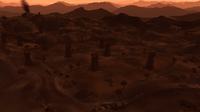 The battle near the castle.
 -
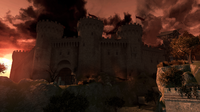 Inner walls of the castle.
 -
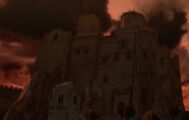 The inner keep.
 -
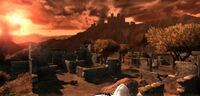 Viana Castle as seen in the distance.
 -
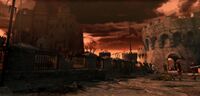 Outer battlements under attack.
 -
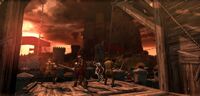 The upper battlements.
 -